

More news on this day
Vietnam’s Sun PhuQuoc Airways has vaulted from start-up to global headline maker, joining Vietnam Airlines, Air India, Air Cambodia and Ethiopian Airlines in a surge of landmark Boeing orders that is rapidly reshaping the future of long-haul travel, Asian tourism and the aircraft maker’s recovery story.
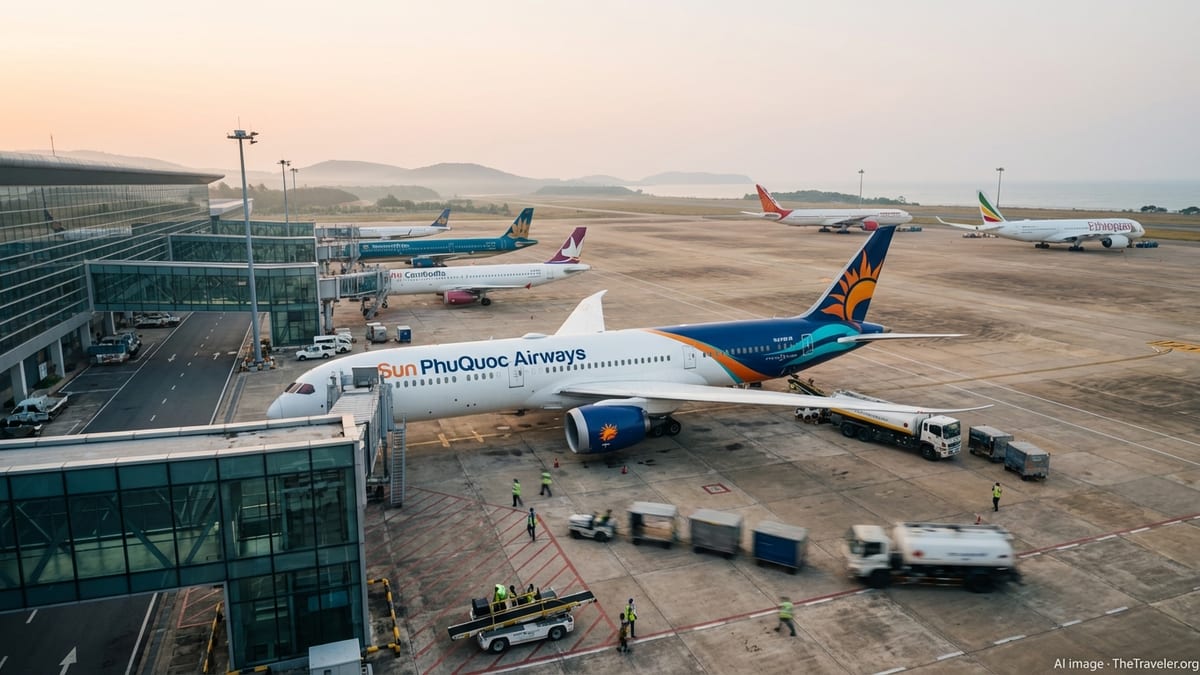
A Start-Up From Phu Quoc That Just Placed a Mega Widebody Bet
Sun PhuQuoc Airways, a young carrier backed by Vietnam’s Sun Group tourism and hospitality empire, has stunned the aviation market with an agreement for up to 40 Boeing 787-9 Dreamliners valued at around 22.5 billion dollars at catalogue prices. Announced in Washington on February 18, 2026, during a high-profile state visit, the deal is Boeing’s largest widebody order by a Vietnamese airline and one of the most ambitious long-haul bets ever made by an emerging leisure carrier.
Launched only in late 2025 with a narrowbody Airbus fleet focused on domestic and short regional routes, Sun PhuQuoc Airways is positioning itself as a premium, network-building airline anchored on the resort island of Phu Quoc. The 787-9 order marks a rapid move into twin-aisle operations, less than a year after it began flying, and signals a strategy built around connecting a fast-growing Vietnamese beach destination directly to Europe, North America and Northeast Asia.
The Boeing 787-9, with a typical capacity close to 290 passengers and a range exceeding 14,000 kilometers, is central to that vision. Sun PhuQuoc has highlighted nonstop links from Phu Quoc to key tourism and diaspora markets as a priority, a shift that would move the island from feeder routes into the ranks of primary intercontinental gateways in Southeast Asia.
For Boeing, the order also provides a fresh endorsement of the 787 family’s role in enabling long, thin point-to-point routes, particularly for airlines seeking to avoid congested hubs and to target high-yield leisure and visiting-friends-and-relatives traffic.
Vietnam Airlines, Air Cambodia, Air India and Ethiopian Drive the Boeing Revival
Sun PhuQuoc’s deal lands amid a broader wave of headline-making orders that have made this one of Boeing’s most consequential commercial cycles in more than a decade. Flag carrier Vietnam Airlines has finalized an 8.1 billion dollar agreement for 50 Boeing 737-8 aircraft, giving the manufacturer a decisive foothold in a market where Airbus narrowbodies have long dominated.
Regionally, Cambodia’s national carrier Air Cambodia has placed its largest single-aisle order, for up to 20 737 MAX jets. Unveiled at the 2026 Singapore Airshow, the agreement is valued at roughly 3 billion dollars and marks the first time a Cambodian airline will operate Boeing aircraft. For Boeing, it opens a new chapter in a fast-growing but previously Airbus- and regional-jet-heavy market.
Beyond Southeast Asia, Air India has already inked one of the biggest fleet renewal and expansion programs in modern aviation, including hundreds of Boeing jets across the 737 MAX, 787 and 777X families as the carrier seeks to reclaim its role as a long-haul powerhouse. Ethiopian Airlines, meanwhile, has continued to double down on both the 737 MAX and 787 as the backbone of its pan-African and intercontinental network, placing repeat orders that reinforce Addis Ababa’s role as a key connecting hub between Africa, Europe, the Middle East and Asia.
Taken together, the commitments from Vietnam Airlines, Sun PhuQuoc Airways, Air Cambodia, Air India and Ethiopian Airlines point to a synchronized vote of confidence in Boeing’s latest-generation families. They also underscore how much of the demand for new jets is now being driven by Asia and emerging markets, rather than solely by established North American and European carriers.
Why This Cluster of Deals Is Being Called the Decade’s Most Groundbreaking
Industry analysts are describing this cluster of orders as the most groundbreaking Boeing dealmaking of the decade not because of a single headline number, but because of what the combined pattern reveals. The commitments cut across widebodies and narrowbodies, from the 787-9 to the 737-8 and 737 MAX family, and they span a spectrum of airlines from long-established network carriers to brand-new leisure-focused entrants.
The geographical spread is equally significant. From the beaches of Phu Quoc to the hubs of Hanoi and Phnom Penh, from New Delhi to Addis Ababa, these orders are anchored in markets where air travel demand has been climbing faster than global averages. In Vietnam and Cambodia, rising middle-class incomes and booming tourism are spurring governments and private groups to build new airports, resort complexes and connectivity strategies designed around aviation.
These deals also come at a delicate phase for Boeing, which has been working to restore confidence after a series of safety and production challenges. High-profile, multi-billion-dollar commitments from state-linked carriers in Vietnam and Cambodia, as well as from influential players such as Air India and Ethiopian Airlines, provide a public endorsement that could help stabilize Boeing’s production skyline well into the 2030s.
Crucially, this wave of orders is less about replacing aging aircraft and more about net new growth. Airlines are signaling expectations that international travel, particularly in Asia and to and from South Asia and Africa, will continue expanding rapidly, and that they intend to capture that demand with more fuel-efficient, longer-range jets.
What the 787 and 737-8 Orders Mean for Global Route Maps
Sun PhuQuoc Airways’ 787-9s and Vietnam Airlines’ 737-8s will redraw the map of how and where travelers can fly to and from Vietnam. The widebodies are expected to open nonstop links from Phu Quoc and possibly other Vietnamese cities to major European capitals, key gateways on the U.S. West Coast and Canada, as well as hubs in Northeast Asia. That would reduce the need for passengers to backtrack through Ho Chi Minh City or Hanoi, or to connect via Bangkok, Singapore or Kuala Lumpur.
For Vietnam Airlines, the 737-8 will bring modern, fuel-efficient aircraft into high-density domestic and regional markets, adding capacity on routes within Vietnam and to nearby Asian cities. The aircraft’s range and economics allow the airline to serve thinner routes that might not justify larger widebodies, while offering a more attractive passenger product than older-generation narrowbodies.
Air Cambodia’s 737 MAX fleet will similarly underpin growth on routes within Southeast Asia and to nearby North and East Asian markets. With its first Boeing jets, the Phnom Penh-based carrier can plan new nonstop services to secondary cities in China, India and Japan, as well as new connections to Vietnam and Thailand that tap into tourism and business flows across the Mekong region.
On a global scale, Air India’s and Ethiopian Airlines’ Boeing commitments are aimed at consolidating their roles as connective hubs. Air India is building a network of nonstops linking India with North America, Europe, Australia and East Asia, while Ethiopian is strengthening Addis Ababa’s position as a transfer point between Africa and the rest of the world. The combination of these strategies will give passengers from secondary Asian cities, including those served by Sun PhuQuoc and Air Cambodia, more one-stop and two-stop options across the global network.
Tourism, Trade and the Rise of Phu Quoc as a Global Island Gateway
At the heart of Sun PhuQuoc Airways’ 787 bet is a broader push by Vietnam and Sun Group to elevate Phu Quoc from regional resort to global island gateway. Once known mainly to regional travelers, Phu Quoc has seen a rapid build-out of luxury hotels, theme parks and integrated resort developments over the past decade. The missing piece has been extensive long-haul air access that allows visitors from Europe and North America to fly in without multiple connections.
Nonstop Dreamliner flights could dramatically change that equation. For European travelers, a direct overnight flight to Phu Quoc, bypassing major hubs, reduces travel time and adds convenience. For tour operators and hotel groups, the ability to market package holidays anchored on a non-stop island flight could support higher occupancy, longer stays and more predictable seasonal demand.
The economic ripple effects are likely to extend well beyond tourism. Improved air connectivity typically supports higher foreign direct investment, more small and medium-sized enterprises geared to export-oriented services, and deeper trade ties. Vietnam’s government has made aviation and tourism central pillars of its growth strategy, and deals such as those signed by Sun PhuQuoc Airways and Vietnam Airlines align closely with national development plans.
In Cambodia, Air Cambodia’s Boeing order is being framed not only as a fleet modernization move but also as a symbol of deepening trade and investment links with the United States. Officials have highlighted the thousands of U.S. manufacturing jobs supported by the 737 MAX program, while positioning Phnom Penh as a rising aviation and logistics node in mainland Southeast Asia.
Boeing’s Strategic Comeback in Southeast Asia and Beyond
The string of orders from Vietnam, Cambodia, India and Ethiopia represents an important strategic comeback for Boeing in markets where its rival has long held sway. Southeast Asia, in particular, has in recent years been dominated by Airbus narrowbodies at low-cost carriers, and by a mix of Airbus and Boeing widebodies at full-service airlines. Winning a new Vietnamese customer in Sun PhuQuoc Airways, expanding its presence at Vietnam Airlines, and entering the Cambodian market with Air Cambodia gives Boeing fresh leverage in the region.
Boeing executives have underscored the role of the 737 MAX and 787 families in enabling airlines to cut fuel burn and emissions while opening new routes. For regulators and governments focused on climate targets, the orders can be framed as part of a gradual decarbonization of aviation, even as traffic volumes grow. The manufacturer has also been at pains to emphasize investments in safety, quality and oversight as it ramps up production to meet this new demand.
Globally, the combined weight of the Vietnam Airlines, Sun PhuQuoc, Air Cambodia, Air India and Ethiopian deals helps Boeing secure a steadier delivery pipeline through the 2030s. That, in turn, gives suppliers more visibility and may help stabilize a supply chain still recovering from the pandemic era and previous production halts.
The challenge for Boeing will be to execute these orders on time and on budget while managing a complex mix of customer expectations, regulatory scrutiny and industrial constraints. Any missteps could have outsized repercussions, given the political and economic importance of the airlines involved.
Risks, Timelines and What Travelers Should Expect Next
For travelers, the most visible impact of this wave of Boeing orders will be new routes, newer aircraft and more choice, but the timeline will unfold over years rather than months. Vietnam Airlines’ 737-8 deliveries are scheduled to begin early in the next decade, while neither Vietnam’s Sun PhuQuoc Airways nor Boeing has yet detailed a firm delivery schedule for the 787-9 fleet.
In the near term, Sun PhuQuoc will continue to expand with its existing narrowbody aircraft, adding more domestic and regional destinations, including new international routes to Taipei and other North Asian hubs. As the Dreamliners start to arrive, the carrier is expected to layer in a gradual build-up of long-haul service, with early focus likely on high-demand European cities linked to Vietnam’s tourism market and diaspora.
Air Cambodia’s 737 MAX aircraft, already in the order book, will arrive earlier, supporting near-term growth within Asia. Travelers in Cambodia and neighboring countries should see an increase in point-to-point flights and more competitive fares as capacity grows and new operators enter city pairs that previously lacked direct service.
For Air India and Ethiopian Airlines, many of the aircraft under their recent Boeing commitments are intended to support future growth and fleet renewal over a decade or more. Passengers will see incremental improvements as new jets join the fleets, from quieter cabins and lower emissions to expanded route networks and higher frequencies on key intercontinental sectors.