

More news on this day
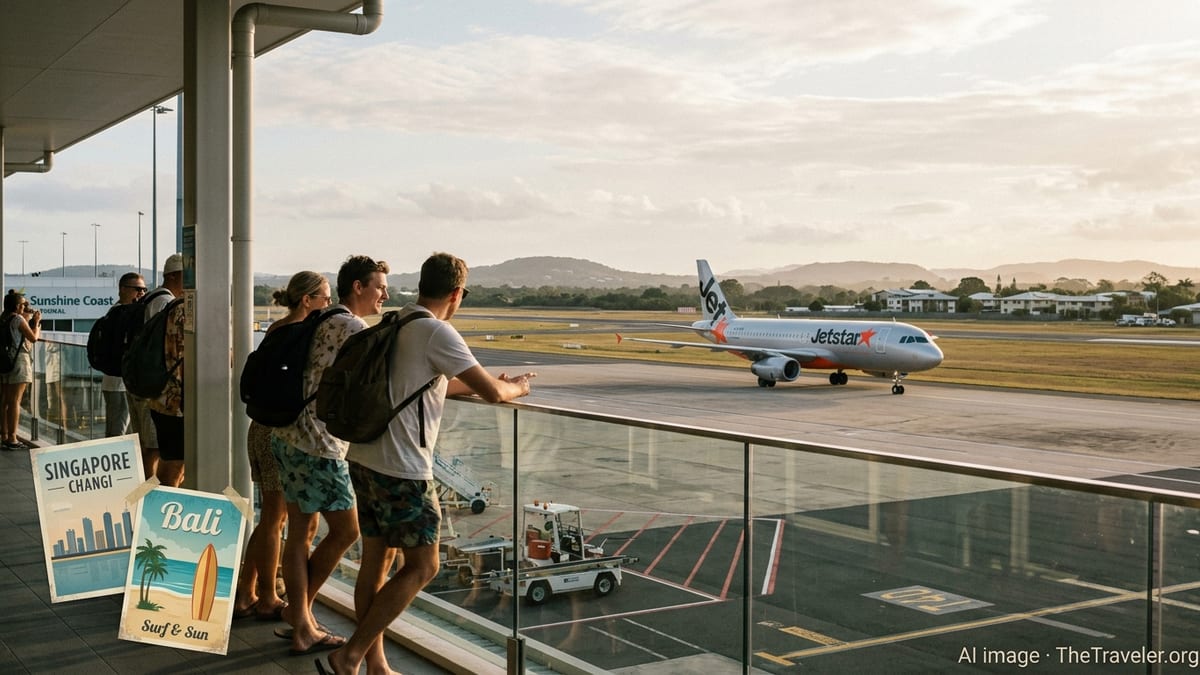
Australia’s Sunshine Coast is preparing for a major shift in its international connectivity, with new Jetstar routes to Bali and onward to Singapore poised to reshape tourism and business links for the fast-growing coastal region.
Get the latest news straight to your inbox!
New Southeast Asia Routes Put Sunshine Coast on the Map
Publicly available information shows that Jetstar plans to launch direct flights from Sunshine Coast Airport to Denpasar in Bali, with through-services continuing to Singapore, from late March 2026. The move will give the region its first direct connection to Southeast Asia and a single-stop pathway to one of the world’s busiest aviation hubs.
The new services are expected to operate multiple times per week, significantly increasing the Sunshine Coast’s international seat capacity and complementing existing connections to New Zealand. Aviation and tourism reports indicate that the route has been designed to capture both leisure demand to Bali and longer-haul traffic leveraging Singapore’s extensive onward network into Europe, Asia and beyond.
For Sunshine Coast residents, the development means fewer transfers through Brisbane or Sydney for trips to Asia and Europe. For inbound travellers, it offers a more seamless way to reach popular holiday destinations such as Noosa, Mooloolaba and the Hinterland without adding a domestic flight or long road journey after landing in Australia.
The announcement follows several years of infrastructure and planning work at Sunshine Coast Airport and aligns with broader efforts to position the facility as a regional gateway for Southeast Queensland, rather than solely a domestic feeder.
Tourism Boost for Both Bali and the Sunshine Coast
Indonesia remains one of the most popular international destinations for Australian holidaymakers, with Bali a particular favourite for short breaks, family trips and surf travel. Direct Sunshine Coast to Bali flights are expected to tap into that demand by removing the need for a connection through capital-city airports and by offering competitive low-fare options.
Tourism market analysis suggests that the Sunshine Coast stands to gain as much as it sends. The new routes open an easier path for Indonesian and Singaporean travellers to explore the region’s beaches, food scene and nature-based experiences. This is likely to appeal to free independent travellers and families looking for an alternative to more crowded Australian gateways.
Local visitor economy strategies have highlighted the importance of growing international overnight stays and length of visit. Easier air access from Asia, particularly via Singapore, is expected to encourage longer itineraries that combine the Sunshine Coast with other Australian destinations, supporting higher overall tourism spend per trip.
Travel trade commentary also points to new opportunities in niche segments, including wellness retreats, culinary tourism and surf tourism, where both Bali and the Sunshine Coast already have strong reputations. Joint marketing between airlines, tourism bodies and tour operators is anticipated as launch dates draw closer.
Singapore Hub Opens New Trade and Investment Channels
While leisure travel is expected to drive initial bookings, the Bali and Singapore services carry broader implications for trade and investment. Singapore is widely viewed as a key financial and logistics hub in the Asia Pacific, hosting regional headquarters for multinational companies and a growing start-up ecosystem.
Business and investment reports suggest that easier access from the Sunshine Coast to Singapore could support greater two-way engagement in sectors such as technology, health, education, agribusiness and clean energy. Reduced travel times and more direct connectivity can make it more feasible for Sunshine Coast-based firms to pitch for regional contracts, attend trade events and host partners from across Asia.
The airport’s designation as a priority development precinct has already been flagged as a catalyst for commercial development around the terminal, including logistics, aviation services and office space. Improved international connectivity is expected to make such projects more attractive to investors, particularly those looking for alternatives to more congested metropolitan locations.
For Singaporean and other Asian investors, the region’s growing population, major health and education facilities, and pipeline of infrastructure projects may look more compelling with regular direct flights. Market observers note that property, tourism infrastructure and agri-food supply chains are likely to be early beneficiaries of any uplift in cross-border interest.
Rebuilding Capacity After the Bonza Setback
The expansion into Bali and Singapore comes after a challenging period for Sunshine Coast aviation, following the collapse of low-cost carrier Bonza in 2024. That airline used the airport as a base and had focused on underserved domestic routes, leaving a gap in capacity and connections when flights abruptly stopped.
Aviation industry analysis at the time warned of a significant short-term impact on passenger numbers, local jobs and small businesses that serviced airline operations. The shift toward new international services is being interpreted by analysts as part of a broader strategy to diversify the airport’s route mix and reduce reliance on any single carrier or market segment.
Jetstar already operates key domestic routes from the Sunshine Coast, and the decision to layer on new international links suggests confidence in the region’s underlying demand. The move also aligns with trends elsewhere in Australia, where secondary airports are courting overseas services to stabilise traffic and attract new forms of economic activity.
For travellers who previously relied on Bonza’s point-to-point domestic fares, the immediate benefit may be limited. However, the overall effect of greater international connectivity could ultimately support a stronger network of domestic and regional services as passenger volumes grow.
What Travellers and Businesses Need to Know
For prospective passengers, the key details to watch include finalised schedules, frequencies and seasonal variations once the Sunshine Coast to Bali and onward Singapore services move from announcement to operation. Standard international travel requirements apply, so travellers will need valid passports and, where necessary, visas or travel authorisations for Indonesia and any onward destinations via Singapore.
Given the hub role of Changi Airport, the new connection is poised to change typical itinerary planning for Sunshine Coast residents. Instead of connecting through Australian capitals to reach Europe, parts of Asia or even Africa, many itineraries may now be built around a single stop in Singapore, with potential benefits in total travel time and checked-baggage handling.
For local businesses, the advice from trade and investment advisers is to view the new routes as a chance to reassess regional market strategies. This may include exploring participation in trade missions routed via Singapore, reviewing supply-chain options that leverage new air freight capacity, or targeting segments of the Singaporean and Indonesian consumer markets that are a natural fit for Sunshine Coast products and services.
As launch dates approach, further timetable details, fare sales and promotional campaigns are expected to emerge. For now, the Sunshine Coast’s forthcoming links to Bali and Singapore signal a new phase in the region’s evolution from a domestic holiday favourite into an internationally connected hub for tourism, business and investment.