

More news on this day
Holidaymakers planning to drive through Switzerland to reach Italy may soon face an extra charge, as a long-discussed transit tax for foreign motorists gathers renewed political momentum in Bern.
Get the latest news straight to your inbox!
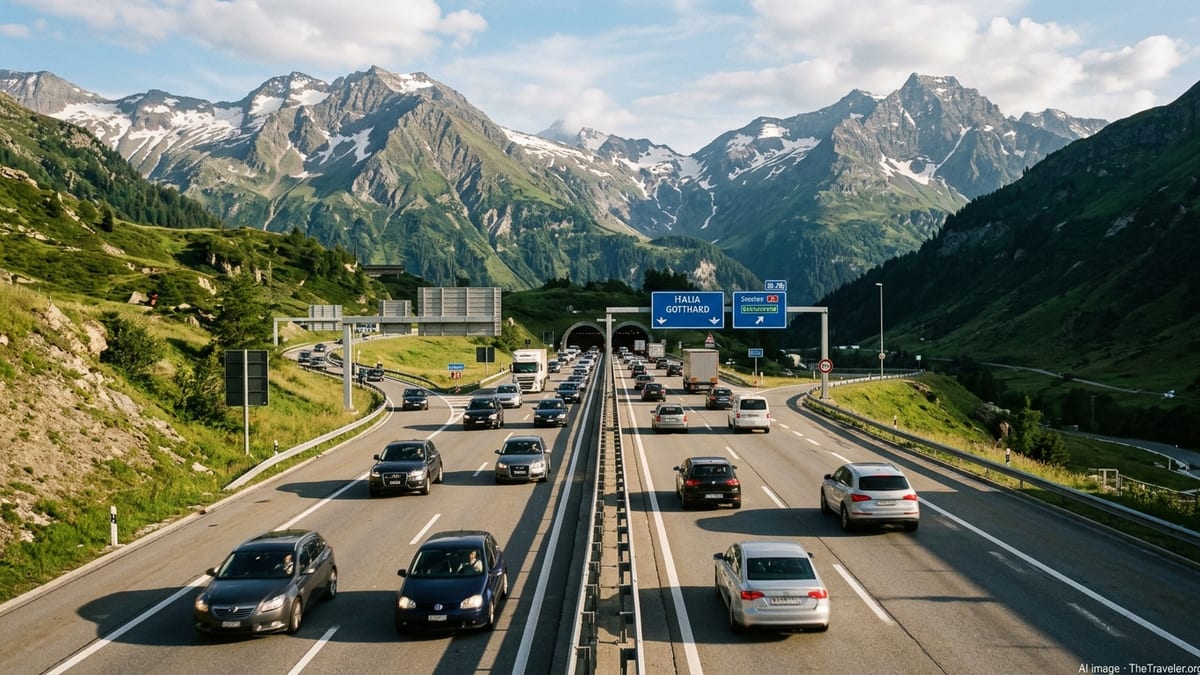
Proposal aims to target foreign transit traffic on Swiss motorways
Recent parliamentary initiatives in Switzerland outline a new fee on private cars, campers and motorcycles that cross the country without a significant stay, with particular impact on north–south routes used by tourists driving to Italy. According to publicly available information, the idea is to introduce a flexible transit levy on foreign-registered vehicles using the national motorway network primarily as a corridor through the Alps.
Drafts reported in Swiss media describe a tax that would apply when motorists enter and leave Switzerland within a limited period and distance threshold, distinguishing between classic holiday transit and longer visits that include overnight stays or tourism spending. The measure is framed by its backers as a way to make through-traffic contribute more directly to road infrastructure and environmental costs along busy Alpine axes such as the Gotthard and San Bernardino corridors.
While the exact amount has not been finalised, discussions point to a dynamic fee that could vary depending on demand, similar in spirit to congestion charges used in some cities. The levy would come on top of the existing motorway vignette, which all cars currently need to use Swiss autobahns, and which is often purchased by drivers heading from Germany or France toward the Italian lakes and Mediterranean coast.
Environmental and funding arguments drive the debate
Supporters in parliament have linked the transit tax to Switzerland’s long-standing efforts to shift freight and passenger flows away from the road and onto rail across the Alps, as well as to shore up funding for the National Roads and Agglomeration Traffic Fund. Publicly available policy papers highlight concerns that rising traffic volumes, including seasonal holiday peaks, are straining both infrastructure and environmental targets in sensitive mountain regions.
Backers argue that foreign motorists using Switzerland as a quick crossing point benefit from high-quality tunnels and mountain motorways but currently pay relatively little beyond the annual vignette, which costs the same regardless of whether a driver spends a single afternoon transiting the country or commutes daily on the network. A variable transit charge, they contend, could better reflect actual usage and help finance costly Alpine maintenance and safety upgrades.
Environmental groups cited in local coverage have broadly welcomed the prospect of targeted road pricing, particularly if rates can be adjusted to discourage peak-time congestion and encourage alternative modes such as rail. However, they also warn that the design of the scheme will be crucial to avoid simply shifting traffic onto smaller mountain passes and secondary roads that traverse fragile landscapes and village centres.
Federal government cautious amid legal and technical concerns
The Swiss Federal Council has so far reacted cautiously, with previous assessments expressing doubts about a nationwide transit levy for passenger vehicles. Publicly accessible summaries of government positions highlight potential conflicts with bilateral transport agreements with the European Union, which govern non-discriminatory access to Swiss transit routes, as well as concerns over the complexity of monitoring millions of cross-border journeys annually.
Any system that distinguishes between simple cross-border trips and genuine transit journeys would likely require automated number-plate recognition, time stamps at multiple entry and exit points, and robust data protection safeguards. Government analyses indicate that such monitoring would be costly and politically sensitive in a country with strong privacy traditions, particularly if data were retained for enforcement purposes.
For now, the Federal Council has not tabled its own draft law, instead signalling that it will examine parliamentary proposals and their compatibility with Swiss constitutional principles and international commitments. That means the political process is at an early stage, with several rounds of committee work, possible revisions and, ultimately, the prospect of a nationwide referendum likely before any transit tax could come into force.
Implications for tourists and drivers heading to Italy
If eventually approved, a Swiss transit levy would directly affect drivers from Germany, France, the Benelux countries and beyond who routinely route their summer and winter holidays through Swiss territory to reach destinations in northern and central Italy. Popular itineraries from southern Germany to Lombardy or from eastern France to the Italian Riviera often follow the A2 and A13 motorways over or under key Alpine passes, routes that would almost certainly be covered by any future transit regime.
Travel industry commentary suggests that even a modest additional fee could influence route planning for cost‑conscious families and coach operators, particularly when combined with existing Swiss costs such as the motorway vignette and fuel prices that are typically higher than in neighbouring countries. Some travellers may consider diverting via Austria or France if those alternatives remain cheaper or administratively simpler.
On the other hand, a clearly communicated, digital fee integrated with online trip planning tools could become another predictable component of cross-border road travel, similar to electronic toll systems in parts of Italy and Austria. For tour operators and self-drive holidaymakers, the main concern is likely to be transparency over pricing, simple payment options and certainty about when a journey counts as taxable transit rather than a stay that includes tourism activities inside Switzerland.
Next steps and what motorists should watch
The timeline for any decision remains uncertain. Parliamentary deliberations are expected to continue over the coming months, with potential instructions for the government to prepare a detailed legal framework if a majority in both chambers supports the concept. In Switzerland’s system of direct democracy, opponents ranging from motorists’ clubs to business associations could then seek a referendum, delaying implementation by several years.
For now, motorists planning to drive through Switzerland to Italy in upcoming holiday seasons continue to face the familiar requirements: a valid motorway vignette for cars under 3.5 tonnes, compliance with local speed and tunnel safety rules, and, for heavy vehicles, distance-based road charges that are already well established. Any new transit tax for private vehicles would add a further layer of regulation and cost, but it is not yet in force.
Travelers are therefore advised to monitor official Swiss government channels and reputable news outlets for updates on the debate, particularly those planning long-distance drives across the Alps. As discussions evolve, the prospect of an additional fee for simply passing through Switzerland may become an important factor in choosing routes to Italy and budgeting for future European road trips.