

More news on this day
Sudden cancellations of key TAM and United Airlines departures from São Paulo have disrupted travel on two strategically important routes, cutting direct access to São Luís in Brazil’s northeast and to Newark in the United States and leaving passengers scrambling for alternatives amid wider regional aviation turmoil.
Key São Paulo Links to São Luís and Newark Abruptly Broken
The cancellations involve a TAM service connecting São Paulo to São Luís, a vital domestic link to Maranhão’s capital, and a United Airlines departure from São Paulo to Newark, one of the most heavily used gateways between Brazil and the northeastern United States. Both flights were pulled from schedules with limited advance warning, according to airport and passenger reports, amplifying disruption already rippling through Brazil’s aviation network.
The United cancellation comes as Newark Liberty International continues to recover from Winter Storm Hernando, which forced airlines across the northeastern United States to ground thousands of flights in recent days. Industry trackers estimate more than 10,000 flights were cancelled nationwide as carriers temporarily suspended operations at major hubs, including Newark, before cautiously rebuilding schedules once conditions improved.
At the same time, multiple updates from Brazilian travel industry outlets indicate a fresh wave of cancellations by carriers operating in and out of São Paulo, Rio de Janeiro, and Brasília, including United and LATAM (still widely referred to as TAM in Brazil). These moves affect a mix of domestic and long-haul international services, adding to a pattern of rolling disruption that has hit Brazil repeatedly this season.
For travelers booked on the São Paulo to São Luís and São Paulo to Newark sectors, the removal of these specific flights has immediate consequences: sharply reduced same-day options, longer itineraries via secondary hubs, and a scramble to secure scarce seats during an already stressed operational period.
Passengers Face Long Queues, Sparse Information and Costly Rebookings
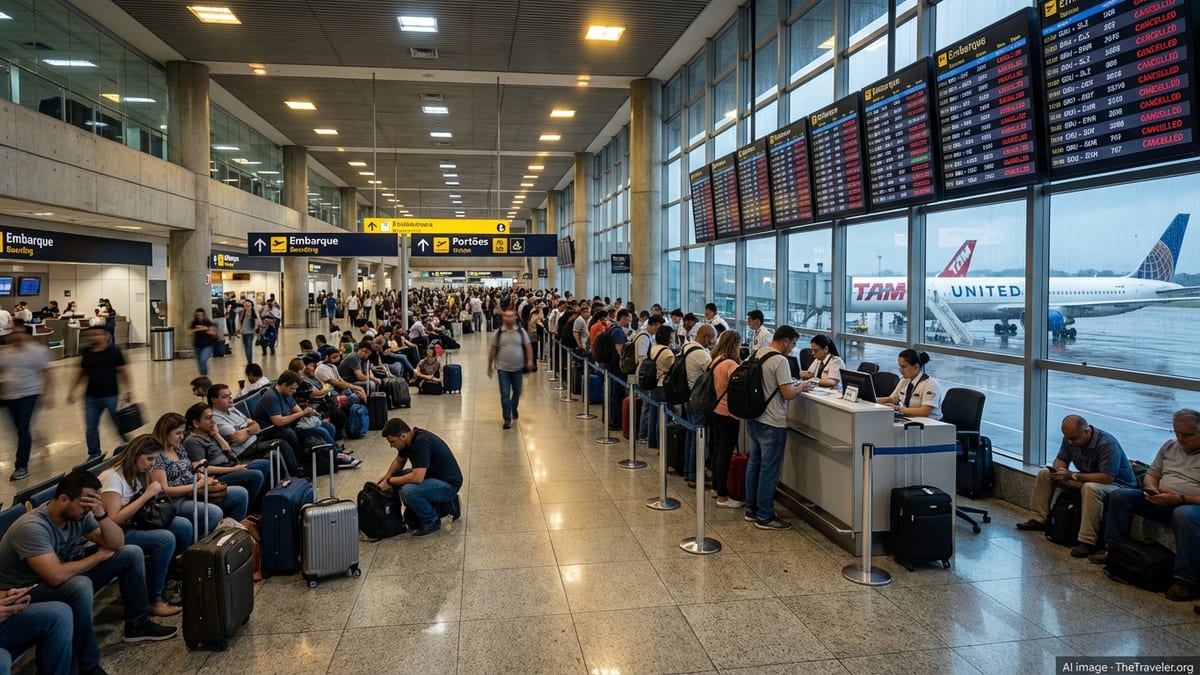
At São Paulo–Guarulhos, passengers reported long lines at customer service counters after learning that their TAM departure to São Luís or United service to Newark had been scrubbed or heavily delayed. Many travelers said they were initially notified via app or email only minutes before they were due to leave for the airport, while others discovered the change only when departure boards flipped to “cancelled.”
Families heading to Maranhão for holidays and business travelers bound for the northeastern United States through Newark suddenly found themselves competing for a limited number of rebooking options. With many Brazil–US flights already operating close to capacity and weather-related schedule changes continuing to reverberate across North America, alternative routings often involve overnight connections, detours through other cities, or downgrades from direct to one or two-stop journeys.
Consumer advocates in Brazil say the pattern reflects a recurring problem: when large, weather-driven disruptions hit major hubs abroad, knock-on cancellations reach Brazilian airports before airlines have clear, passenger-friendly contingency plans in place. Travelers frequently report inconsistent information at different touchpoints, with call centers, apps, and airport counters sometimes giving conflicting guidance on vouchers, refunds, and hotel support.
Early indications from travel agents suggest that some affected United customers on the São Paulo–Newark route have been offered fee waivers and date changes in line with the carrier’s broader weather policy for the northeastern United States. For TAM passengers on the São Paulo–São Luís domestic leg, rebooking options appear to vary depending on fare class and whether tickets were purchased directly with the airline or through intermediaries.
Weather in the U.S. and System Strain in Brazil Converge
The timing of the Newark cancellation is closely tied to the lingering effects of Winter Storm Hernando, a powerful nor’easter that has battered the eastern United States with heavy snow, high winds and blizzard conditions. U.S. authorities and aviation analysts report that the storm triggered some of the most extensive winter-weather disruptions of the season, with New York area airports, including Newark, suspending large parts of their operations over the weekend before slowly reopening.
Even as Newark resumes flights, the intricate web of aircraft rotations, crew duty limits and maintenance windows means that disruption continues to echo across airline networks. Carriers like United, which rely on Newark as a primary transatlantic and Latin American hub, have had to prioritize certain routes and temporarily curtail others while they reposition aircraft and staff. A long-haul leg from São Paulo to Newark is especially vulnerable in this context because any irregularity at the U.S. end can cascade into missed connections, crew timing conflicts and knock-on delays back in Brazil.
Within Brazil, recent travel-industry reporting has highlighted broader schedule instability involving United, LATAM, American, Azul, GOL and other major airlines. Over recent weeks, dozens of domestic and international flights in and out of São Paulo, Rio de Janeiro, Belo Horizonte and other key cities have been cancelled on short notice as carriers adjust capacity, react to weather abroad and juggle operational constraints.
Analysts note that Brazil’s heavy dependence on a handful of hub airports, particularly Guarulhos, magnifies the effect of each cancellation. When a long-haul service like São Paulo–Newark is cut, it not only affects point-to-point passengers but also those connecting from secondary Brazilian cities who suddenly lose their planned transcontinental link.
São Luís Route Highlights Domestic Connectivity Gaps
The loss of the TAM service between São Paulo and São Luís, even for a short period, underscores the fragility of Brazil’s domestic connectivity, especially to the less densely served north and northeast. São Luís is a key gateway for tourism to Maranhão’s Lençóis Maranhenses region and a critical node for business and government travel within the state. For many passengers, São Paulo is the logical starting point for such trips, concentrating demand onto a limited number of daily departures.
When one of those flights disappears from the schedule, the impact is immediate and disproportionate. Travelers who had planned same-day connections from other Brazilian cities into São Paulo to catch a São Luís-bound service are now faced with either overnight stays, detours via alternative hubs, or the prospect of postponing trips altogether. Tour operators serving Maranhão say that a single cancellation can disrupt multi-day itineraries, especially for international visitors who have tightly packed schedules.
Local business leaders have long argued that Brazil’s regional capitals need more resilient air links to São Paulo and Brasília. They point out that in times of disruption, these routes are the first to be trimmed, even though they play an outsized role in sustaining regional tourism and commerce. The current cancellation episode adds fresh urgency to calls for more diversified route options and clearer minimum service commitments on strategically important domestic corridors.
While airlines routinely adjust frequencies based on demand and operational factors, the lack of redundancy on routes like São Paulo–São Luís means that any unplanned cut can leave entire regions partially isolated from the country’s main economic hubs.
What Travelers Can Do as Disruptions Continue
With weather-related recovery still under way in the northeastern United States and Brazilian carriers continuing to fine-tune their schedules, further short-notice changes on Brazil–US and key domestic routes remain possible in the coming days. Travel advisors are urging passengers flying from São Paulo to either São Luís or Newark to monitor their bookings closely and to check departure status repeatedly in the 24 hours before travel.
Experts recommend that travelers affected by cancellations document all communications with airlines, including app notifications and counter interactions, and keep receipts for meals, transportation and lodging that might be claimable later. In Brazil, consumer protection rules can entitle passengers on cancelled or heavily delayed flights to assistance such as food vouchers, accommodation and rerouting, depending on the circumstances and length of delay.
For those with flexible plans, proactively rebooking to alternate days or routing through different hubs may help avoid the tightest pinch points while networks stabilize. Some carriers serving Newark are offering temporary fee waivers and relaxed change conditions under their weather policies, which can be used to shift travel dates without additional charges.
For now, the sudden loss of two key TAM and United services out of São Paulo serves as a stark reminder of how quickly global shocks, from North American blizzards to local operational strains, can converge to sever critical air links across Brazil. Until airlines fully restore resilience on both domestic and international networks, travelers on these routes will need to remain prepared for last-minute changes and build extra margin into their plans.