

More news on this day
Late-night travelers using Tampa International Airport and the Veterans Expressway face an unusual stretch of recurring ramp closures in March, as construction and improvement projects converge on some of the region’s most heavily used interchanges.
Get the latest news straight to your inbox!
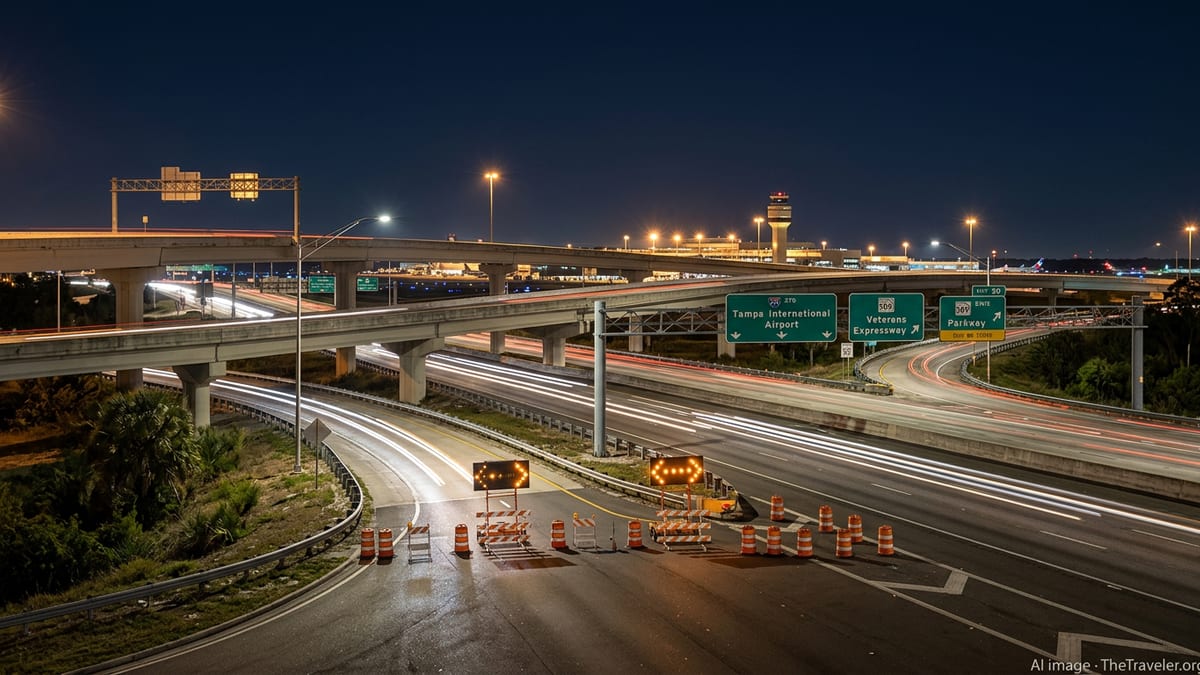
Multiple Projects Converge Around TPA and SR 589
A cluster of roadway projects in and around Tampa International Airport is resulting in a concentration of overnight closures on ramps that connect Interstate 275, State Road 60 and the Veterans Expressway. Publicly available lane-closure calendars show a series of night-by-night shutdowns affecting ramps that serve both the airport access roads and the SR 589 corridor, often between 10 p.m. and 5 a.m., when traffic volumes are lower but airport activity remains steady for late flights.
The Veterans Expressway, which begins just south of the airport and extends north through Hillsborough County, has been under phased enhancement and widening work along its southern end where it overlaps westbound State Road 60. That effort, which began in 2022 to add capacity near the Airport/Spruce Street and Courtney Campbell Causeway interchanges, has periodically required short-term ramp closures and detours during overnight construction windows.
At the same time, continued work tied to the reconstruction of the Howard Frankland Bridge and express lane connections on I-275 is rippling into the interchange system that funnels traffic toward the airport and the Veterans. Recent closure notices highlight repeated nighttime impacts to ramps feeding SR 60 westbound and SR 589 northbound from I-275, a critical junction for travelers heading to Clearwater, northern Pinellas County and Tampa’s western suburbs.
Transportation planning documents for the broader Hillsborough expressway and I-275 corridor indicate that additional ramp and access changes are anticipated over the next several years, including revisions to how Tampa International Airport connects to the interstate and nearby toll facilities. Those long-range plans help explain why intermittent closures have become more frequent, as crews stage work and adjust traffic patterns ahead of larger construction phases.
Record Run of Late-Night Ramp Shutdowns
While Tampa drivers are accustomed to occasional overnight closures, the current sequence stands out for its duration and concentration around the airport. Recent reports describe nightly ramp shutdowns to and from I-275 near Exit 39, where the interstate meets SR 60 and SR 589, stretching across multiple consecutive weeks in March instead of the more typical few days of work at a time.
Historic closure notices for the same interchange often covered a single week of nightly closures, such as past instances in which the left northbound I-275 ramp bridge to SR 60 West and SR 589 North closed between 10 p.m. and 5 a.m. over a limited series of dates. In contrast, current lane-closure schedules and construction forecasts point to an almost continuous pattern of late-night ramp impacts around the airport connector system, as separate projects overlap.
In addition to the regional interstate and expressway work, Tampa International Airport has its own multi-year construction program under way on the George J. Bean Parkway and terminal frontage roads. Earlier phases of that work already produced two-week cycles of overnight detours for drivers entering and circulating around the main terminal complex. This month’s wave of closures occurs against that backdrop, contributing to a perception among travelers and airport-area commuters that “something” is closed nearly every night somewhere along their route.
Traffic observers note that the combination of airport frontage work, interstate bridge construction and express lane enhancements creates an unusually dense construction footprint in a relatively compact area. Even when each individual closure is limited to a short distance of ramp or lane, the combined effect can feel like a rolling series of disruptions for anyone relying on late-night access to the terminals or the Veterans Expressway.
Detours and Delays for Airport Travelers
For travelers catching red-eye departures, late international arrivals or early-morning flights out of Tampa International Airport, these closures translate into unfamiliar detours at hours when roadway cues are harder to follow. Detour plans typically route traffic away from closed ramps via Spruce Street, Westshore Boulevard and Kennedy Boulevard, or through alternate approaches that reconnect with SR 60 and SR 589 farther from the airport.
During past ramp closures at Exit 39, drivers leaving the airport for the Veterans Expressway or Clearwater were instructed to follow eastbound Spruce Street before looping back to Memorial Highway and SR 589. Similar patterns are appearing again in current closure information, with message boards and temporary signs guiding motorists through longer, sometimes circuitous paths to reach their intended route.
These detours can add several minutes to travel times, which may be insignificant during off-peak overnight hours for some drivers but critical for those cutting it close to catch a flight. Ride-hailing drivers and airport-area hotel shuttles are particularly sensitive to such changes, as they often make multiple trips during the late-night window when closures are in effect.
Publicly available information from airport planning updates also points to ongoing construction related to TPA’s future Airside D, expanded parking facilities and roadway modifications around the Red Express curbsides. While most of that building work occurs away from the main interstate ramps, any additional lane shifts or temporary closures within the airport campus can compound the impact of simultaneous shutdowns on nearby highways.
Veterans Expressway and I-275 Corridor Under Long-Term Pressure
The current wave of late-night ramp closures underscores how much long-term construction pressure exists along the I-275 and Veterans Expressway corridors. The opening of the new southbound Howard Frankland Bridge span in 2025 shifted traffic patterns across Old Tampa Bay, but associated work on express lanes, approach ramps and widening projects continues into 2026 along both sides of the bay.
On the Pinellas County side, an ongoing $300-million-plus widening initiative for I-275 is adding capacity and integrating with the Gateway Expressway system. On the Hillsborough side, transportation studies describe a complex set of future improvements, including new express connections between I-275 and the Veterans Expressway and revisions to airport access ramps. Each phase requires careful staging to keep traffic flowing, often relying on overnight closures to minimize daytime impact.
For regular users of the Veterans Expressway, these projects translate into fluctuating lane configurations near the airport and Courtney Campbell Causeway interchange. The overlap of expressway enhancements with airport construction and downtown interchange work means that even after the current stretch of late-night closures subsides, additional waves of ramp and lane restrictions are likely in the years ahead.
Regional transportation advocates have emphasized that, despite short-term inconvenience, the combination of new bridge capacity, express lanes and reworked airport access is intended to reduce long-standing congestion pinch points at Exit 39 and other nearby junctions. The scale of construction reflects the role of Tampa International Airport and the Veterans Expressway as critical gateways for both local commuters and visitors to the Tampa Bay region.
What Drivers Should Expect in the Coming Weeks
Motorists planning late-night trips to or from Tampa International Airport and the Veterans Expressway over the coming weeks should be prepared for periodic ramp and lane closures that may not be identical from one night to the next. Lane-closure schedules are often adjusted at short notice due to weather or construction progress, and some ramps may reopen earlier or remain closed longer than initially projected.
Travel planners recommend that drivers build additional time into overnight airport trips, especially if their route typically involves the I-275 and SR 60 interchange, the Veterans Expressway entrance ramps or the George J. Bean Parkway. Keeping a flexible route in mind, such as alternate approaches via local streets or other interstate exits, can help reduce stress if a familiar ramp is unexpectedly blocked.
For now, the series of late-night closures appears to mark one of the most sustained periods of ramp disruption around the airport in recent years, reflecting the sheer number of overlapping projects converging on a small but crucial piece of Tampa Bay’s transportation network. As construction advances on bridge, express lane and airport expansion efforts, drivers can expect nighttime work to remain a regular feature of travel in and out of Tampa International Airport and along the Veterans Expressway.