

More news on this day
Finland’s third-largest city, Tampere, is preparing to use its newly awarded 2026 European Capital of Smart Tourism title to showcase how data-driven services, climate goals and inclusive design can reshape urban travel in Northern Europe.
Get the latest news straight to your inbox!
A European Testbed for Smart, Low-Impact Tourism
The European Commission selected Tampere as the 2026 European Capital of Smart Tourism in late 2025, highlighting the city’s performance across accessibility, sustainability, digitalisation and cultural heritage. Reports on the competition describe Tampere as a destination using its existing smart city infrastructure as a platform for new visitor experiences, rather than building a separate tourism bubble.
Publicly available information on the designation notes that Tampere outperformed rival cities with a programme for 2026 that integrates tourism into broader climate and innovation agendas. The title is expected to bring increased international visibility, but also pressure to demonstrate that large visitor numbers can be managed without undermining local quality of life or environmental targets.
Tampere’s tourism roadmap is closely tied to the city’s goal of becoming climate neutral by 2030, set out in an updated Climate Neutral Tampere 2030 roadmap. City documents identify tourism and events as both an economic driver and a sector where emissions from accommodation, mobility and consumption must be reduced through coordinated planning.
Destination management material indicates that Visit Tampere has committed to turning the wider region into a carbon-neutral tourism destination by 2030, aligning local operators with national Sustainable Travel Finland criteria. This alignment means that the 2026 smart tourism year is being treated less as a one-off campaign and more as a milestone within a longer transition.
Smart Mobility and Seamless Access to Nature
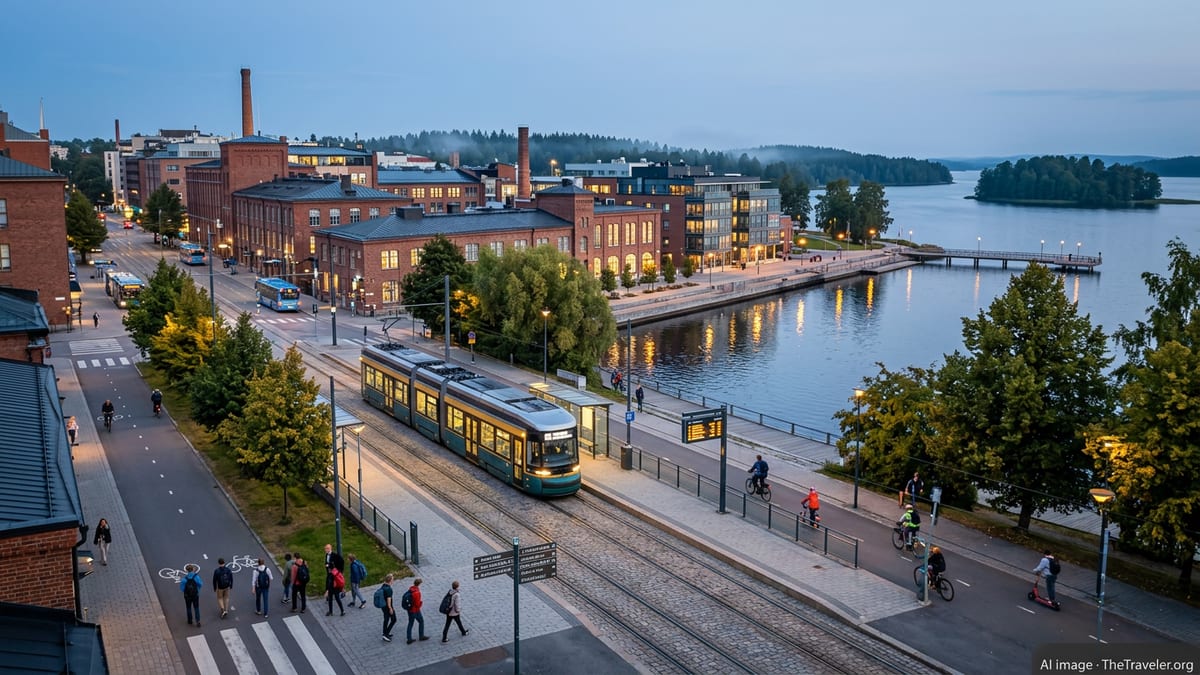
Tampere’s smart tourism strategy builds heavily on transport innovation. The city’s light rail, which has reshaped local mobility over the past few years, is promoted as the backbone for car-free stays that connect accommodation, cultural venues and lakeside districts. Planning documents and promotional material emphasise that visitors can rely on a mix of tram, bus, cycling and pedestrian routes to move between key sights.
A Sustainable Tourism Mobility Action Plan produced for the region focuses on “slow travel” and the reduction of private car use, proposing better multimodal connections and clear guidance for visitors on low-emission options. The plan frames mobility not just as a logistics issue but as part of the visitor experience, encouraging longer stays and deeper exploration rather than rapid, high-footprint trips.
Nature access is another pillar. European smart tourism coverage of Tampere highlights the Outdoor Express concept, which packages public transport links to nearby nature reserves and trails. These services are designed to move visitors out from the compact city centre to lakes, forests and national parks without increasing private traffic in sensitive environments.
Accessibility is built into many of these initiatives. Recent European Smart Tourism profiles of Tampere point to barrier-free nature trails, accessible lakeside beaches and improved connections for people with reduced mobility. The intention is to ensure that the region’s outdoor assets are usable by a wide range of visitors, tying inclusion directly to the “smart” label.
Apps, Data and Immersive Digital Culture
Digitalisation sits at the core of Tampere’s tourism reinvention. The Tampere.Finland mobile app, developed initially as a city service platform, now functions as a key tool for both residents and visitors. Official descriptions explain that the app combines event information, culture routes and feedback channels, effectively turning smartphones into personalised city guides.
Smart tourism reports also reference digital culture routes that give 24/7 access to curated walks across districts, museums and architectural sites. These routes are integrated into the app and other digital tools, allowing users to follow themed itineraries that highlight design, industrial heritage or contemporary creative spaces, often supported by audio or interactive storytelling.
Gamified experiences are emerging alongside these routes. Local innovation stories describe mobile applications that blend historical photography, location data and game mechanics to encourage exploration of Tampere’s industrial landscapes and neighbourhoods. Such tools align with broader European trends in smart tourism, where open data and geolocation are used to disperse crowds and surface lesser-known points of interest.
Behind the scenes, Tampere positions itself as a living lab for smart city companies and research projects. Events such as Imagine, a Finnish smart city development forum hosted in the city, have showcased pilot solutions around urban data, safety and mobility that can be repurposed for tourism. This creates a feedback loop where visitor behaviour informs planning, and planning in turn shapes new services.
Sustainability Labels, Events and the Experience Economy
Sustainability in Tampere’s tourism sector increasingly extends into meetings, incentives, conferences and events. Tampere Hall and its commercial events arm have secured the Sustainable Travel Finland label, signalling that one of the region’s largest cultural and congress hubs is aligning operations with national sustainability benchmarks. Publicly available information explains that this involves detailed work on waste, energy, food sourcing and carbon offsetting for events.
The STF label is becoming a marker for the broader region as more tourism businesses adopt the programme’s criteria. Visit Tampere’s climate action planning positions these certifications as tools for communicating with international buyers and independent travellers who are seeking verifiable low-impact choices rather than marketing slogans.
Major sports and cultural events remain an anchor for Tampere’s visitor economy, and the smart tourism agenda seeks to manage their impact more efficiently. With the city already experienced in hosting ice hockey tournaments and large concerts, 2026 is seen as an opportunity to test crowd management tools, mobility planning and digital guidance at scale, while collecting data that can improve future event design.
Parallel to large-scale gatherings, the city is promoting an “experience economy” narrative where local food, design, sauna culture and neighbourhood exploration are positioned as year-round draws. Smart tourism material from European platforms highlights how Tampere’s industrial heritage districts, public saunas and lakeside venues are being tied together through curated routes and digital storytelling, encouraging visitors to spend more time and money in local communities.
From Pilot Projects to Replicable Models
European tourism observers view Tampere’s 2026 role as a chance to turn years of pilot projects into replicable models for other mid-sized cities. As part of the EU Mission for Climate-Neutral and Smart Cities, Tampere is expected to document how its tourism initiatives contribute to emissions reductions and resilience, not just to branding.
City climate roadmaps identify tourism as one of several sectors where cross-cutting measures are necessary, including sustainable procurement, plant-based food promotion and support for the sharing economy. When combined with digital visitor tools and smart mobility, these measures form a test case for integrating environmental, social and economic objectives in a single destination strategy.
European Commission communications on the smart tourism competition note that Tampere’s programme for 2026 will be accompanied by a launch event and a series of activities drawing in European networks. For the city, this presents a platform to showcase technology companies, universities, cultural institutions and tourism operators as parts of one innovation ecosystem.
As the 2026 title year approaches, Tampere’s challenge is to balance experimentation with reliability. The city is positioning itself as a northern hub where travelers can experience a functioning smart city, not just a promotional concept, giving Europe a concrete reference point for what technology-enabled, sustainable and inclusive urban tourism can look like in practice.