

More news on this day
British safety technology specialist Tended has partnered with the European Space Agency to deploy a virtual worksite solution that brings space-grade positioning and navigation tools into live railway construction, aiming to sharply reduce risk and delays on busy rail corridors.
Get the latest news straight to your inbox!
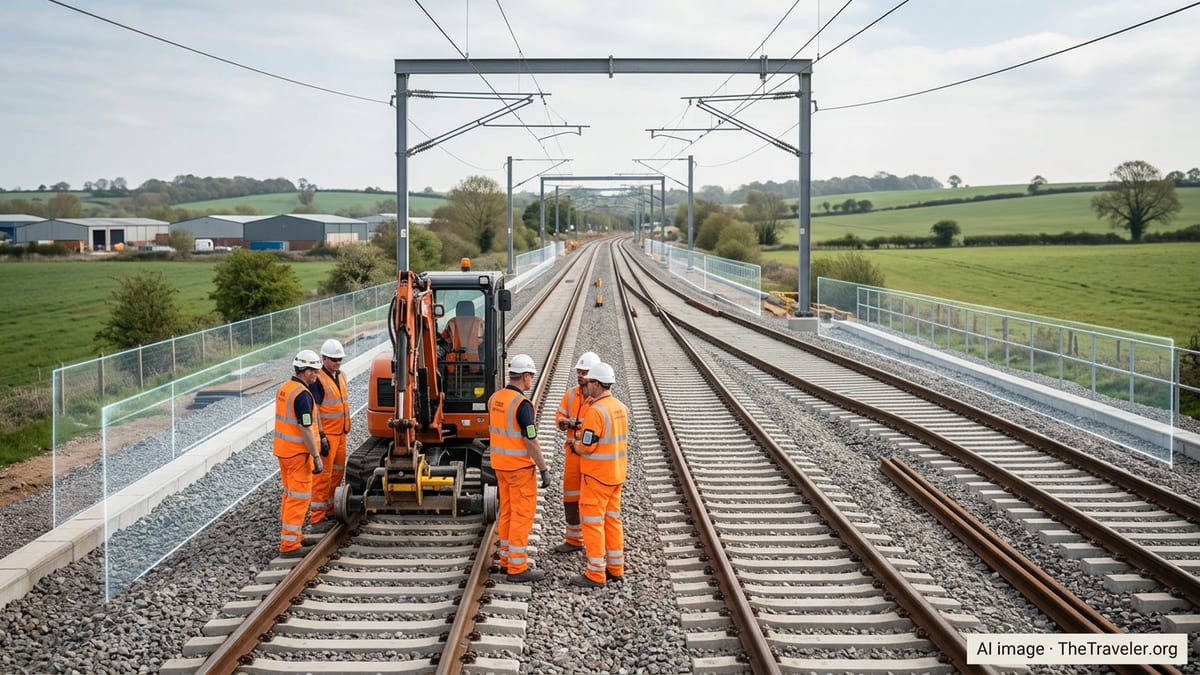
Space Technology Steps Onto the Railway
The collaboration links Tended’s virtual worksite platform with navigation and positioning capabilities originally developed for use in space. Publicly available information indicates that Tended has been working with European rail infrastructure managers to digitise work zones and create precise virtual boundaries around track sites, helping to separate workers and machines from open lines.
The European Space Agency, through its business applications and space solutions programmes, has encouraged the use of satellite navigation, Earth observation and secure communications in non-space sectors such as construction and transport. In railway environments, those technologies can provide highly accurate location data even across large, linear worksites where traditional methods of marking out safe areas can be slow and labour intensive.
Tended’s system is designed to turn this data into an operational “virtual worksite” that can be dynamically mapped and updated as construction progresses. Instead of relying solely on physical marker boards and paperwork, site teams can work against a live digital model of the protected area that is synchronised with on-track activities.
According to published coverage, the goal is to bridge a gap between modern rail construction practices and older safety processes, by using proven space-derived tools to support both planning and real-time decision making near the tracks.
How the Virtual Worksite Solution Operates
At the core of the solution is a digital twin of the worksite that defines the exact limits of where staff and equipment can safely operate. This virtual perimeter can be aligned with scheduled train movements, engineering access windows and local operating rules, providing a detailed picture of risk along the length of a project.
Workers are equipped with devices that interface with this virtual boundary. When a person or machine approaches the edge of the authorised zone, the system can trigger escalating alerts intended to prompt them to stop or move back into the protected area. Because the boundaries are derived from high-precision positioning data, they can be drawn close to open lines without the need for large physical buffers, which can sometimes restrict productivity.
Rail construction planners can use the platform to preconfigure different work phases, simulating how teams will move along the track and where potential conflicts with passing trains or adjacent projects might arise. By doing this in a virtual environment, they can refine access plans before staff arrive on site, potentially reducing the need for last-minute changes that can add cost and cause disruption.
The solution also captures positional and activity data during works, creating a record of how closely actual operations followed the planned safety envelope. This information can support post-project reviews and may help infrastructure managers refine standards for future jobs.
Implications for Rail Safety and Efficiency
Rail construction and maintenance often take place close to live lines, where even minor errors in positioning can have serious consequences. Public information from the rail sector shows that traditional controls such as marker boards, lookouts and line blockages are effective but can be complex to manage, especially on long or multi-stage worksites.
By introducing a virtual worksite environment powered by space-derived technology, Tended and ESA are aiming to make it easier to implement those controls with greater precision. The approach could help reduce the likelihood of staff inadvertently entering open lines and may also limit the need for conservative access arrangements that reduce the amount of productive work that can be carried out in a given possession.
There are also potential benefits for timetable reliability. If construction activities can be planned and executed more accurately within shorter windows, infrastructure managers may be able to reduce the number or duration of disruptive closures on key routes. For passengers and freight operators, this could translate into fewer unplanned delays linked to engineering work.
In addition, data gathered by the virtual worksite system can provide new insight into how construction teams actually move and interact with the infrastructure. Over time, this may inform changes to how worksites are designed, staffed and sequenced, with the aim of further improving both safety and productivity.
Supporting Greener, More Connected Transport Networks
European transport policy has increasingly focused on shifting more journeys to rail as a lower-carbon mode for both passengers and freight. To accommodate that shift, rail networks are undergoing extensive programmes of renewal, digital signalling rollout and capacity upgrades, all of which involve intensive construction activity around existing lines.
Space-enabled services have been highlighted by European institutions as a way to make such construction more efficient and less environmentally disruptive. By using precise positioning and remote sensing, project teams can reduce unnecessary rework, optimise access to sites and target resources where they are most needed, limiting the footprint of each intervention.
In this context, the Tended and ESA collaboration aligns with broader efforts to apply space technology to “green construction” and smarter infrastructure delivery. Virtual worksites can help limit the time that heavy equipment and support vehicles spend idling near the tracks, and can support more accurate planning of materials and workforce logistics, with potential knock-on benefits for emissions.
As more rail projects adopt digital twins and advanced planning tools, a space-tech powered virtual worksite could become one of the building blocks of fully integrated project control, connecting design offices, control centres and frontline teams along the route.
Next Steps for Deployment and International Interest
Reports indicate that Tended’s virtual worksite technology has already progressed through trials on parts of the United Kingdom’s rail network, supported by innovation programmes and technical input from industry partners. As the collaboration with the European Space Agency matures, further pilots and scaled deployments on live construction projects are expected to follow.
Other European rail infrastructure managers are watching developments closely, particularly those responsible for dense, mixed-traffic routes where construction windows are short and the margin for error is limited. The combination of satellite navigation, secure data services and trackside hardware has the potential to be adapted to a range of networks with different operating rules.
Beyond Europe, interest in digital safety and planning tools for rail is growing as governments invest in new lines and modernisation programmes. The space-tech powered virtual worksite model being advanced by Tended and ESA could serve as a reference for how to bring high-precision positional awareness into day-to-day rail construction on a global scale.
For travellers, many of these changes will be invisible, taking place behind the scenes during overnight possessions and carefully planned blockades. Over time, however, safer and more predictable construction around the tracks is likely to support more reliable, higher-capacity rail services, reinforcing the role of rail as a backbone of sustainable transport networks.