

More news on this day
Air travelers across Texas are facing extensive disruption as major airports in Dallas, Houston, Austin and San Antonio report hundreds of delayed departures and a smaller number of cancellations, creating a ripple effect for passengers connecting throughout the United States.
Get the latest news straight to your inbox!
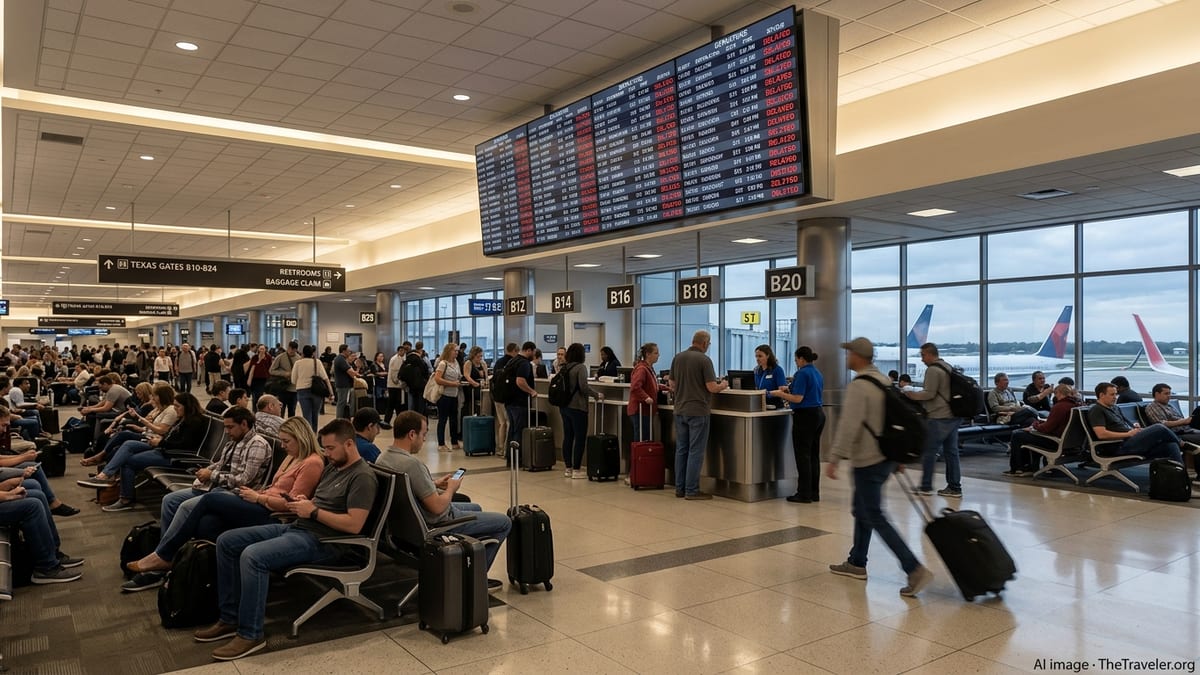
Delays Mount Across Texas’ Busiest Airports
Publicly available tracking data on Thursday indicates that more than 400 flights have been delayed across key Texas hubs, including Dallas Fort Worth International, Dallas Love Field, Houston’s George Bush Intercontinental and William P. Hobby, Austin Bergstrom International and San Antonio International. A smaller number of services have been cancelled outright, but the scale of delays is significantly higher, affecting both early morning and peak afternoon schedules.
Operational updates show that the disruptions involve a mix of mainline and regional operators, with PSA Airlines, United Airlines, SkyWest and several other carriers all listing affected services. The majority of impacted flights are domestic routes, linking Texas with other major U.S. hubs as well as regional destinations in the South and Midwest.
While the total number of cancellations remains limited compared with the volume of delays, even a relatively small group of scrapped flights can lead to missed connections, rebookings and extended time in terminals. As delayed aircraft and crews rotate through the network, knock on effects are being reported at out of state airports that rely on Texas connections.
Weather, Congestion and Airline Operations Combine
Recent travel patterns in Texas suggest that weather instability and air traffic congestion often interact with airline operational constraints to trigger days of heightened disruption. Thunderstorms and rapidly changing conditions in North and Southeast Texas have historically slowed arrivals and departures at Dallas and Houston, prompting temporary ground holds, diversions and spacing requirements in the skies above both metro areas.
Industry data and past federal on time performance reports show that airlines such as PSA and SkyWest, which operate large regional fleets on behalf of major carriers, can be particularly exposed to cascading delays when storms or congestion interrupt short haul schedules. When one leg runs late, subsequent flights using the same aircraft or crew can quickly fall behind schedule.
United Airlines, which maintains a significant hub operation at Houston’s George Bush Intercontinental and a strong presence in other Texas airports, has also experienced past periods of weather related disruption that contributed to elevated delay and cancellation statistics. Publicly available performance summaries from the U.S. Department of Transportation highlight how air carrier issues, national airspace constraints and late arriving aircraft all play a role in overall punctuality.
Impact on Passengers and Travel Plans
For travelers, the immediate impact of more than 400 delayed flights is being felt in longer waits at gates, missed connections and rebooked itineraries. Reports from passengers on social channels and travel forums describe extended tarmac holds in Houston and Dallas, diversions between Texas airports and uncertainty about departure times as airlines adjust to changing conditions.
Families beginning vacations, business travelers heading to meetings and students returning to or from college campuses in Texas all face the same core challenge: reduced predictability. Even delays of 30 to 60 minutes can cause downstream problems when connections involve tight layovers or when the last flight of the day is affected, leaving limited options for same day alternatives.
Airport terminals in Dallas, Houston, Austin and San Antonio are built to handle large volumes of passengers, but periods of disruption tend to push seating, concessions and customer service counters close to capacity. Travelers often cluster around departure boards, monitoring rolling schedule changes while weighing whether to stay at the gate, seek assistance desks or adjust ground transportation and hotel plans.
Airlines Adjust Schedules and Recovery Efforts
Operational data suggests that airlines are working within established recovery playbooks, combining schedule adjustments, aircraft swaps and revised crew assignments in an effort to stabilize operations through the afternoon and evening peaks. Regional partners such as PSA Airlines and SkyWest, which operate under the brands of larger carriers, play a central role in those efforts because of their dense networks of short haul flights into and out of Texas hubs.
Publicly available information shows that cancellations so far remain a fraction of the total number of scheduled departures, an indication that carriers are favoring delays over outright scrapping of flights where possible. By keeping services on the board, even with revised departure times, airlines can preserve more passengers’ same day travel options, although at the cost of longer waits and potential missed connections.
In recent years, major U.S. carriers have also placed greater emphasis on preemptive schedule changes prior to forecast weather events. When storms are predicted near Dallas, Houston or along major Texas flight paths, airlines sometimes trim schedules in advance, consolidating flights in order to reduce the risk of large, late breaking cancellation waves once passengers have already arrived at the airport.
What Travelers Can Do If Flying Through Texas Today
With delays affecting hundreds of flights across Texas, passenger advocates and frequent flyer communities consistently recommend proactive steps to minimize disruption. Travelers are generally advised to monitor their flight status closely through airline apps or departure boards, arrive at the airport earlier than usual and consider carrying essentials such as medications, chargers and snacks in hand luggage in case of extended waits.
Same day rebooking options can vary by carrier and ticket type, but public guidance from major airlines typically encourages passengers on significantly delayed or cancelled flights to use digital tools first, including mobile apps and automated self service options, before joining lines at airport desks. This approach can help avoid the longest queues during peak disruption periods.
Looking ahead, the current wave of delays across Dallas, Houston, Austin and San Antonio illustrates how quickly conditions can shift in one of the country’s busiest aviation regions. For anyone planning to connect through Texas in the coming days, building extra time into itineraries and choosing earlier flights where possible may offer additional flexibility if operations remain under strain.