

More news on this day
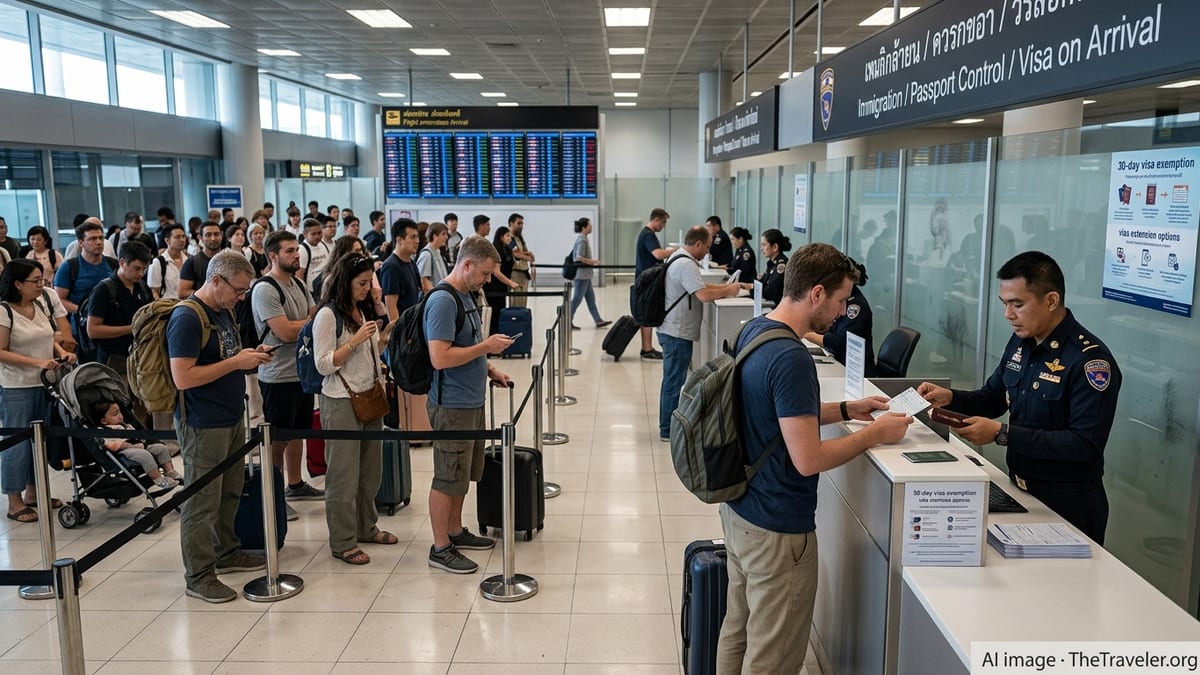
Thailand is reviewing a proposal to reduce its current 60-day visa-free stay to 30 days, a move framed as a response to mounting security concerns and the misuse of visa exemptions by transnational scam networks, while seeking to keep the country attractive to high-spending tourists.
Get the latest news straight to your inbox!
From Pandemic Recovery Tool to Policy Reassessment
The current 60-day visa exemption, introduced in July 2024, was designed to accelerate Thailand’s tourism recovery by allowing nationals of 93 countries and territories to stay for up to 60 days, with the option of a 30-day extension at immigration. Publicly available government announcements describe it as part of a broader push to stimulate travel demand and support the wider economy following the pandemic downturn.
Tourism data cited in local coverage indicates that the longer visa-free stay helped sustain visitor numbers and spending through 2024 and 2025. However, analysts note that the average leisure tourist typically spends around two weeks in the country, suggesting that the full 90-day potential stay in some cases far exceeds most travel patterns.
Reports in Thai and regional media now indicate that officials responsible for foreign affairs, security and tourism are reassessing whether such a generous window is still appropriate. According to this coverage, discussions have focused on whether a shorter initial stay might better balance Thailand’s economic reliance on tourism with growing concerns over overstays, irregular work and criminal activity.
Comments reported by domestic news outlets also suggest that policymakers are increasingly focused on attracting what they describe as “quality visitors,” including higher-spending holidaymakers and long-stay guests who enter on appropriate non-tourist visas, rather than individuals using visa exemptions to reside or work informally in the country.
Security Concerns and Cross-Border Scam Networks
The push to scale back visa-free stays is closely linked to heightened concern over cross-border crime. Coverage in regional media and travel industry briefings highlights that some foreign nationals have used the extended visa-exempt period to base themselves in Thailand while participating in online fraud, call-center scams and other illicit activities targeting victims across Asia.
These operations often exploit Thailand’s position as a regional transport hub and its historically flexible entry rules. While many scam networks are believed to be headquartered in neighboring countries, publicly available reports suggest that recruiters, money mules and technical support staff sometimes transit or reside in Thailand under the guise of tourism.
In response, immigration authorities have already begun tightening enforcement under the existing 60-day regime, scrutinizing repeated entries and closely examining visitors who appear to string together back-to-back visa-exempt stays. Legal analyses published by Bangkok-based law firms describe intensified checks at airports and land borders, with particular attention on patterns associated with informal work or long-term, visa-free residence.
Under the new proposal being discussed, a 30-day visa-free stay would still accommodate the vast majority of holiday trips but could make it more difficult for individuals tied to criminal enterprises to maintain a long, continuous presence without securing a more appropriate visa. Observers say the move aligns with a broader regional trend of using immigration rules as a frontline tool against transnational cybercrime and financial scams.
Balancing Tourism Growth With Tighter Controls
Any reduction in visa-free days carries potential implications for Thailand’s tourism-dependent economy, which remains one of the country’s main engines of growth. Industry groups have repeatedly emphasized that streamlined entry and flexible stays are key advantages for Thailand in a competitive regional market that includes destinations such as Vietnam, Malaysia and Indonesia.
According to travel trade commentary, many operators worry that shortening the standard visa-exempt stay could send an unwelcoming signal at a time when long-haul visitors in particular are just regaining confidence in Asian travel. Some businesses fear that repeat travelers who enjoy extended trips combining beach destinations, cultural sites and wellness retreats may reconsider their plans or opt for neighboring countries with more liberal entry conditions.
On the other hand, several tourism analysts quoted in local business coverage argue that the impact on genuine tourists may be limited if the rules retain a straightforward extension option. They note that a 30-day initial stay, combined with a relatively accessible 30-day extension at immigration offices, would still allow visitors to remain in Thailand for up to 60 days per trip, provided they follow the formal process.
Policy commentary published in regional outlets also suggests that the government is trying to signal that extended stays should occur on the correct visa types. Long-term stays for purposes such as study, retirement, remote work or business are increasingly expected to fall under dedicated visa categories, some of which have been promoted aggressively to attract higher-spending residents and investors.
Practical Implications for Travelers and the Tourism Industry
For now, reports indicate that the proposal to cut the visa-exempt stay to 30 days remains under review, and no implementation date has been announced. Travel advisory updates and consular notices continue to reference the 60-day visa exemption for eligible nationalities, though many now include caveats noting that the policy is under active discussion and may change.
Travel experts advise that if the reduction is approved, it is likely to apply only to arrivals after a specified enforcement date, with passengers who entered earlier retaining the conditions stamped in their passports on arrival. However, as with previous immigration adjustments, the exact transition rules would depend on the final wording of any official regulation or cabinet resolution.
For the tourism sector, the debate adds another layer of uncertainty just as visitor numbers are normalizing. Hotels, tour operators and airlines may need to adjust marketing strategies to highlight shorter but more experience-rich itineraries, while also educating guests on extension options and alternative visa routes for longer trips.
In the meantime, publicly available commentary from both tourism and security specialists underscores that Thailand is unlikely to abandon its fundamentally open stance to visitors. Instead, the proposed 30-day limit is being framed as an attempt to better align border policy with current risk assessments, closing loopholes exploited by cross-border scams while keeping the doors open to the millions of travelers who continue to see the country as one of the region’s most accessible destinations.