

More news on this day
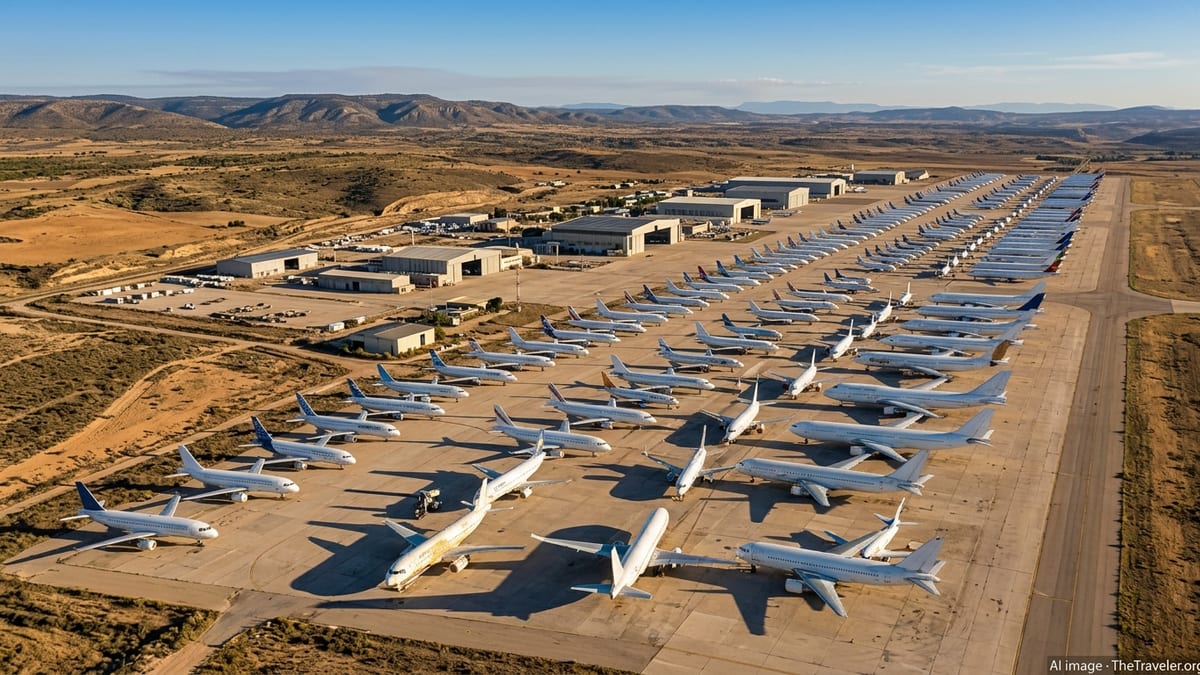
High on a semi‑arid plateau in eastern Spain, far from the nearest beach resort, rows of silent jetliners sit nose to tail in the sun, their engines wrapped and windows taped. This is Teruel Airport, an unusual hub in the Aragonese desert where aircraft come not for passengers, but to sleep, be overhauled or meet their end.
Get the latest news straight to your inbox!
A Desert Built for Sleeping Jets
Teruel Airport, officially known as Plataforma Aeroportuaria de Teruel, opened in 2013 on the site of a former military airfield in Spain’s Aragon region. Instead of vying for holiday traffic, it was designed from the outset as an industrial platform for aircraft storage, maintenance and recycling. Publicly available information shows that the airport has no regular commercial passenger services; its traffic consists almost entirely of aircraft arriving to be parked, serviced or dismantled.
The location is part of Teruel’s quiet appeal. The airport sits at around 1,000 meters above sea level on a dry inland plateau, offering low humidity, relatively stable temperatures and plenty of open space. These conditions are considered ideal for long‑term aircraft storage because they slow corrosion, reduce weather‑related wear and simplify maintenance checks during months or years on the ground.
During the pandemic, those wide concrete aprons and long taxiways suddenly filled. Industry coverage describes how more than 100 aircraft, including a notable share of the global Airbus A380 fleet, were parked in Teruel at the height of Covid‑19 travel restrictions. The sight of double‑deck superjumbos and long‑haul wide‑bodies lined up wingtip to wingtip turned the little‑known facility into a symbol of aviation’s sudden standstill.
Although most of those aircraft have since rejoined fleets or been ferried elsewhere, Teruel’s status as Europe’s largest aircraft parking and storage site has only solidified. It now functions as a kind of mechanical hibernation ground for jets between assignments, conversions or retirement decisions.
From Boneyard to High‑Tech Industrial Hub
Teruel is often portrayed as a European “aircraft boneyard,” but the activity on its aprons extends well beyond long‑term parking. The platform hosts major maintenance, repair and overhaul operations, with Tarmac Aerosave, part‑owned by Airbus, Safran and Suez, as one of the key operators. According to industry reports, the company now has capacity in Teruel for about 140 aircraft and 20 engines at any one time, and it has steadily expanded both its hangar footprint and workforce over the past decade.
In recent years Tarmac Aerosave has opened additional wide‑body hangars at Teruel, including facilities able to handle Airbus A380 heavy maintenance and end‑of‑life work. Aviation trade coverage indicates that the site now employs more than 230 people, with further recruitment planned in 2026 as demand for storage, maintenance and dismantling grows. The company has also flagged investment to double its dismantling surface area, with the goal of increasing annual aircraft recycling from around 25 to as many as 40 airframes a year.
The airport itself is being reshaped around this industrial role. The Teruel Airport Consortium has launched successive expansion phases to extend aprons and dedicated long‑stay parking zones. Officially released planning documents describe a Phase V development that will create additional parking for between 70 and 140 aircraft, depending on their size, as well as new infrastructure for airship and “New Space” projects. The scale of those works, backed by public and private investment running into hundreds of millions of euros in recent years, is positioning Teruel as a multi‑faceted aerospace campus rather than a simple storage yard.
Alongside conventional airliners, the desert facility is becoming a test bed for emerging technologies. Rockets, stratospheric airships and advanced telecommunications platforms have all been linked to Teruel in recent project announcements. This layering of space‑adjacent activity on top of storage and maintenance reflects how the airfield is evolving into a broader innovation hub serving Europe’s aerospace industry.
Why Airlines Send Aircraft to Sleep in Spain
The sight of long rows of parked jets can be unsettling for travelers, hinting at grounded fleets and uncertain futures. Yet for airlines, using a place like Teruel is often a rational fleet‑management decision rather than a sign of distress. When demand drops seasonally, when aircraft await heavy checks or cabin refits, or when leasing contracts lapse, parking an aircraft in a low‑cost, dry‑air environment can significantly reduce holding expenses.
Industry analyses point to per‑day storage rates that are typically lower at specialized facilities than at busy commercial hubs, where valuable apron space is at a premium. Teruel’s inland location, absence of passenger operations and generous runway length allow it to handle a mix of narrow‑bodies, wide‑bodies and very large aircraft without competing with holiday and business traffic. For airlines and lessors juggling dozens or even hundreds of frames, the ability to consolidate sleeping jets in one secure, maintenance‑capable desert site is a logistical advantage.
Technical considerations also play a role. Aircraft put into so‑called long‑term storage require careful preservation work, including engine and system protection, regular checks and occasional taxi or engine‑run procedures. Having on‑site maintenance teams and hangars means operators at Teruel can shift aircraft between deep storage, light line maintenance and heavy checks without repositioning flights to other airports. That integrated approach reduces both cost and complexity, making the desert facility attractive for carriers adjusting fleets after crises, engine issues or market changes.
This dynamic is visible in the ebb and flow of aircraft types seen in satellite images and enthusiast tracking data. Wide‑body jets that once flew transcontinental routes, high‑density A380s built for mega‑hubs and smaller narrow‑bodies cycling in and out of European low‑cost fleets have all passed through Teruel. Some emerge with fresh paint and cabins for new operators, while others quietly transition from storage rows to dismantling areas as parts donors.
What Teruel Means for Travelers Booking Their Next Flight
For passengers, the growth of Teruel raises a different, more personal question: could the next flight on their booking be spending part of its life parked in a Spanish desert? The answer, increasingly, is yes. Many aircraft stored or serviced at Teruel eventually return to frontline service with European, Middle Eastern, Asian or African carriers after undergoing maintenance, cabin refurbishment or livery changes.
Publicly available fleet records show that airframes shuttling between Teruel and major hubs in Frankfurt, Paris, London or the Gulf often resume regular schedules once their time in storage or overhaul is complete. Some have been converted from passenger to cargo configuration, reflecting the rise in air freight demand, while others reappear in the colors of new airlines after lease transfers or fleet rationalizations. From a traveler’s perspective, the aircraft’s sojourn in Aragon is usually invisible, noted only by enthusiasts tracking tail numbers.
The desert environment and specialized care in Teruel can, in some respects, extend an aircraft’s useful life. By slowing corrosion and concentrating heavy maintenance in one place, operators can keep older but still efficient jets flying safely for longer, even as manufacturers struggle to keep up with new aircraft deliveries. At the same time, the presence of large‑scale recycling operations on site means that when an airframe does reach the end of its economic life, up to 90 percent of its materials can be recovered or reused, according to industry benchmarks.
As global aviation grapples with supply chain constraints, engine reliability issues and pressure to decarbonize, the role of storage and recycling hubs like Teruel is likely to grow. Travelers may continue to board gleaming aircraft in Madrid, Munich or Dubai without ever thinking about where those jets sleep between jobs. Yet somewhere on a quiet Spanish plateau, far from the departure boards, the sleeping giants that make modern air travel possible are being stored, stripped, rebuilt and readied for their next assignment.