


Few things sour a trip faster than a severely delayed or cancelled flight, especially when hundreds of euros in potential compensation are at stake. Faced with unresponsive airline customer service and legal jargon about EU Regulation 261, many travelers turn to specialist companies that promise to fight on their behalf. One of the longest‑running names in this niche is EUclaim. But what does EUclaim actually do, how does its process work in real life, and is it really worth handing over a chunk of your compensation?
Get the latest updates straight to your inbox!
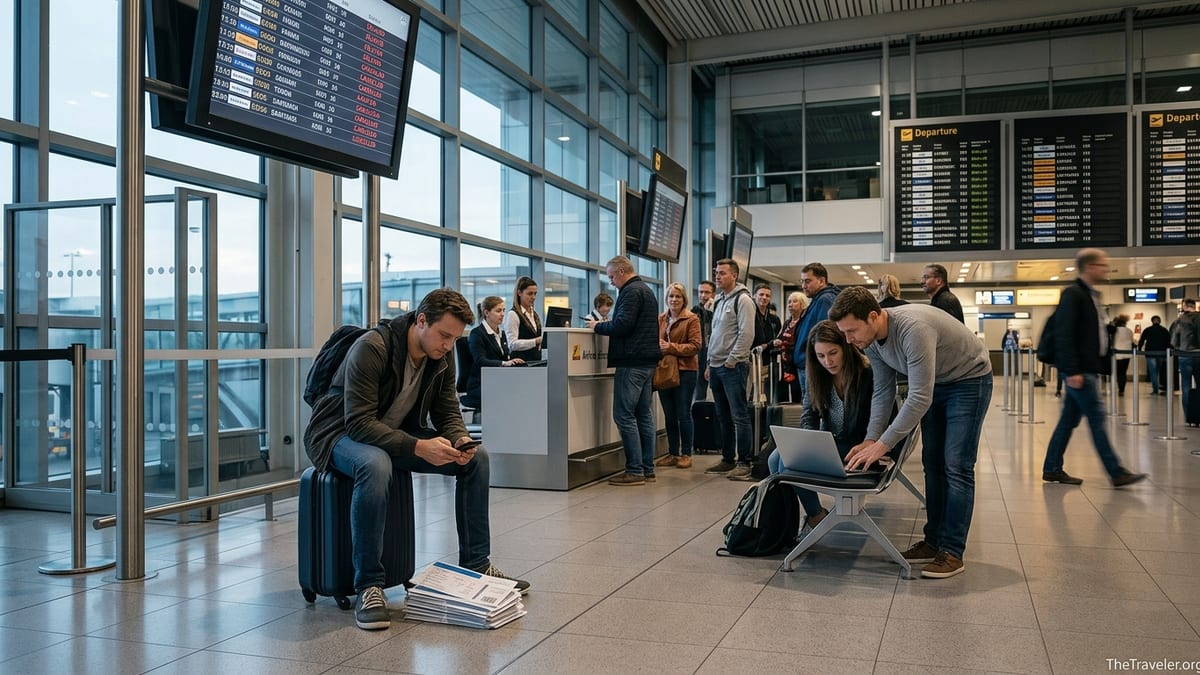
Who and What Is EUclaim, Really?
EUclaim is a Dutch legal services company that focuses exclusively on air passenger rights. It has operated since the late 2000s and works with passengers whose flights have been delayed, cancelled, or overbooked, or who missed a connection inside Europe or on certain routes to and from the region. Unlike a typical law firm, EUclaim is built as a high‑volume claims handler: it uses a large flight data engine, legal templates, and standardized procedures to manage thousands of cases at once, rather than crafting a completely bespoke legal strategy for each traveler.
The company positions itself as an expert on EU Regulation 261/2004, often shortened to EU261. This regulation entitles many passengers to fixed compensation, usually between about 250 and 600 euros, when their flight is significantly disrupted and the airline is responsible. EUclaim’s stated role is to check whether a passenger is covered by EU261 or the similar UK rules that now apply after Brexit, then push the airline to pay the compensation that the law provides.
In practice, this means EUclaim effectively replaces you in the back‑and‑forth with the airline. Instead of repeatedly emailing, filling out web forms, or arguing on the phone with carriers like Ryanair, KLM, Lufthansa, or Wizz Air, you sign an assignment or power of attorney and let EUclaim take over the communication. For many travelers, that is the main attraction: they no longer need to track deadlines, quote legislation, or escalate complaints to higher levels inside the airline.
Importantly, EUclaim is not the only company in this space. Competitors with similar models include German‑based Flightright, Baltic‑founded Skycop, and newer tech‑driven brands like AirAdvisor. All of them operate on some version of a contingency fee: if they fail, you pay nothing, but if they win, they keep a portion of the payout. Understanding EUclaim therefore also means understanding this broader business model and how it compares to doing it yourself.
How EUclaim’s Compensation Process Actually Works
For a typical traveler, the EUclaim journey begins online. You enter your flight number, travel date, departure and arrival airports, and what went wrong: a delay over three hours, a cancellation, denied boarding because of overbooking, or a missed connection. Behind the scenes, EUclaim checks this information against a detailed database of flight movements and known disruptions. That database is one of its trump cards: it lets the company quickly see if, for instance, your Amsterdam to Rome flight on KLM in April ran over four hours late due to a technical fault or if it was caused by bad weather that the airline can treat as an exceptional circumstance.
If the case looks promising, EUclaim invites you to submit a full claim. This step usually involves uploading your booking confirmation, boarding passes, and sometimes receipts for meals or hotels you had to pay for during the disruption. You also sign documents authorizing EUclaim to act in your name. From that point, the airline should communicate with EUclaim, not with you, although some travelers still receive the occasional automated email from the airline’s system and pass it on.
Once the claim is filed, the process can take very different paths depending on the airline and the complexity of the case. Some carriers settle straightforward cases relatively quickly. For example, a family flying from Madrid to Paris on an EU airline that arrived five hours late because of a crew issue might see EU261 compensation approved within a few months. Others are more combative and may deny liability even where EUclaim believes the law is on the passenger’s side. Then EUclaim must decide whether to push further, which can involve formal legal letters or even taking the airline to court in the airline’s home country.
Timelines vary widely. Online reviews show simple cases that EUclaim resolved in a matter of months, as well as complex disputes that dragged on for well over a year before a settlement or court decision was reached. It is not unusual for passengers to submit a claim after a disrupted holiday in, say, August and still be waiting the following spring. For travelers expecting instant results, this can be frustrating, but it reflects the reality that airlines often delay or resist paying until serious legal pressure is applied.
The No‑Win‑No‑Fee Model and What It Really Costs
EUclaim, like many competitors, promotes a no‑win‑no‑fee promise. In plain language, this means that if EUclaim fails to obtain compensation, you do not pay a service fee. The company typically recoups its costs by taking a percentage of any money it manages to recover from the airline. Based on past public fee schedules and industry comparisons, passengers can expect a significant cut of their compensation to go to the company, although the exact percentage and any additional file or legal fees may change over time and can differ by jurisdiction.
To understand the real impact, consider a concrete example. Imagine your long‑haul flight from New York to Amsterdam on a European carrier arrives more than four hours late for reasons under the airline’s control. Under EU261, that route often triggers 600 euros in compensation. If EUclaim successfully secures the full amount but charges a fee in the range many claim companies use, your share might end up roughly between 350 and 420 euros, depending on the exact percentage and whether taxes or extra legal costs are deducted. EUclaim keeps the rest as its fee for handling and, where necessary, litigating the case.
By contrast, if you had tackled the airline yourself and obtained the same 600‑euro payout after some time and effort, you would keep the entire amount. The trade‑off is clear: you pay with either money or time. For a traveler juggling work and family commitments, paying a few hundred euros to avoid months of emails and legal paperwork may feel like a fair price. For a student with more time than cash, pursuing the airline directly might be the better choice, especially if the disruption happened on a well‑regulated EU carrier with clear online claim forms.
It is also worth noting that no‑win‑no‑fee is not the same as “completely free until the end.” If an airline quietly pays you directly after EUclaim has already started working the case, or if you accept a voucher or alternative settlement without involving EUclaim, you can still be contractually obligated to pay EUclaim’s fee on that compensation. This catches some travelers by surprise, especially if they forget they signed an assignment. Before agreeing to any settlement directly with the airline, it is wise to check your contract with EUclaim to avoid paying twice or creating a dispute.
Real‑World Experiences: Success Stories and Frustrations
Looking at the real‑world experiences of passengers gives a more nuanced picture of how EUclaim performs than marketing claims alone. Public review platforms in 2025 and 2026 show EUclaim with thousands of reviews and an overall positive rating in the mid‑four‑out‑of‑five range, indicating that many people did receive money they might otherwise have lost. Travelers praise the company for handling cases with uncooperative airlines, including non‑EU carriers where the routes still fell under EU261 or its UK equivalent.
One common positive pattern is where an airline’s own systems feel like a dead end. For example, a traveler flying with a low‑cost carrier like Ryanair or Wizz Air may find that online forms are difficult to submit, or that the airline keeps citing vague “operational reasons” to deny compensation. In such situations, some passengers report that once EUclaim stepped in with formal letters backed by flight data and legal arguments, the airline became more responsive. The end result for those passengers was a cash transfer into their bank account after months of stonewalling.
There are, however, recurring frustrations. Some reviewers describe waiting a long time for updates, particularly after the initial claim submission. For more complex cases, especially where a court case is needed, passengers sometimes report silence for weeks at a time followed by short status notes. In one common scenario, a traveler applies after a technical issue delayed their flight in 2023; EUclaim accepts the case, the airline rejects the claim, and the matter drifts into a lengthy legal process that finally pays out in 2025. From the passenger’s perspective, the compensation may feel almost disconnected from the original trip.
A minority of travelers also express disappointment when they discover how much of the final compensation is withheld as fees. Someone who expected to receive around 400 euros for a mid‑range delay, for instance, may end up with barely more than 250 euros after EUclaim’s commission and any additional costs for legal proceedings. These cases do not necessarily mean EUclaim misrepresented its fees, but they underline the importance of reading the fee schedule carefully and calculating what you can realistically expect to receive in your bank account, rather than focusing only on the headline compensation figure.
EUclaim Versus Doing It Yourself
For many travelers, the real question is not whether EUclaim is legitimate, but whether it is the best option compared with filing a claim directly with the airline. From a purely financial standpoint, going directly to the airline usually yields a better outcome if you succeed. Under EU261, passengers regularly secure between 250 and 600 euros per person for eligible delays and cancellations, and when you claim yourself, you keep the full amount.
Take a concrete example. A couple from London flies to Barcelona on an EU carrier and arrives more than three hours late due to a crew scheduling issue. They each may be entitled to around 250 euros, for a total of 500 euros. If they fill in the airline’s online form, attach boarding passes, and quote EU261, they may receive the full 500 euros within a few weeks or a couple of months. If they instead go through EUclaim and the company charges a typical industry fee, the couple might end up with something closer to 300 to 350 euros between them, while EUclaim keeps the rest.
The advantage of using EUclaim becomes clearer in tougher cases. Suppose a traveler’s flight from a non‑EU airline between an EU capital and a third‑country hub, such as Amsterdam to Dubai, is cancelled at short notice. The airline denies responsibility, blaming air traffic control or “extraordinary circumstances,” and sends a brief rejection email when the traveler complains. Faced with legal uncertainty and a foreign jurisdiction, many passengers simply give up. In such cases, a claims handler like EUclaim, armed with years of case law and detailed flight data, may be far better positioned to argue that the airline is actually liable and, if necessary, escalate through national enforcement bodies or courts.
In other words, the value of EUclaim is often highest when your chances of getting compensation alone are low or when your time is extremely limited. If you are comfortable reading up on EU261, filling in detailed forms, and sending firm follow‑up letters or emails, you may not need a third party at all for straightforward disruptions on major European airlines. If you are not, then EUclaim offers a way to turn what might have been a total loss into at least a partial recovery, albeit at a price.
Key Risks, Limitations, and Fine Print
While EUclaim is a long‑established player with generally positive feedback, its service is not without risks or limitations. The first is simply eligibility. Not every delay or cancellation qualifies for EU261 compensation. Flights disrupted by severe weather, volcanic ash, sudden airspace closures, or strikes by third‑party staff are often treated as extraordinary circumstances where airlines are not obliged to pay. If EUclaim’s database shows that your flight was affected by such an event, it may decline your case from the outset, even though you might still be entitled to meals, refreshments, and accommodation that the airline should have provided on the day of the disruption.
A second limitation is time. EUclaim operates within national limitation periods, which vary from country to country. In some jurisdictions, you might have several years from the date of the flight to claim, while in others the window is much shorter. If you wait until the last moment, you could find that EUclaim either refuses the case as too risky or has too little time to pursue all legal avenues. Travelers who routinely put off paperwork after a stressful trip should be aware that delay can quietly erode their rights.
The fine print also matters when it comes to alternative solutions. Many airlines now offer vouchers, frequent‑flyer miles, or partial goodwill payments instead of, or in addition to, statutory compensation. If you accept one of these offers after EUclaim has taken over your case, you might still owe EUclaim its service fee because the company’s work contributed to the outcome. Similar issues can arise if a credit card company refunds you under its own dispute process. To avoid confusion, you should inform EUclaim of any parallel efforts you are making and check their terms for how such situations are handled.
Finally, while EUclaim itself is a known brand, the broader flight‑compensation industry also includes less reputable operators. Travelers browsing social media will find near‑identical advertising from many sites promising quick money for delayed flights. Experiences shared online occasionally describe companies that delay payments, impose hidden charges, or vanish when a case becomes difficult. One benefit of EUclaim’s longer track record and visible public reviews is that travelers can at least gauge its performance over time and in multiple languages, which is harder with a brand‑new operation.
How EUclaim Compares With Other Claim Services
To put EUclaim in perspective, it helps to look briefly at how it compares with rival services. Many of these companies share a similar core model: a web‑based claim checker, a no‑win‑no‑fee promise, and a focus on EU261 and related regulations. Differences arise mainly in fees, communication style, and willingness to pursue cases into court. German‑based Flightright, for example, has built a reputation for aggressively litigating against reluctant airlines in certain jurisdictions, while Baltic‑founded Skycop and newer platforms like MyflyRight or AirAdvisor emphasize technology‑driven claim assessment and multi‑language support.
EUclaim’s particular strength lies in its long experience and its reliance on extensive flight data. Industry sources describe its partnership with a specialized flight intelligence provider that tracks exactly how and why flights were delayed, including details of technical faults, crew changes, and weather patterns. This allows EUclaim to challenge airline excuses more effectively in borderline cases. A passenger who was told their delay was due to “operational reasons” might find that EUclaim can demonstrate it was actually a routine technical defect, which case law has often held does not exempt the airline from paying compensation.
On the other hand, some travelers may prefer alternatives that advertise lower fees or faster processes, especially for straightforward claims. A few newer companies market “express payouts,” where they buy your claim outright and pay you an immediate but reduced amount, taking the full risk of later recovering more from the airline. EUclaim generally sticks to a more traditional model: it only pays you after the airline has paid it or a court has awarded compensation. For risk‑averse travelers who would rather wait to maximize their payout, this can be acceptable. For those needing instant cash, it may be less attractive.
Ultimately, the choice between EUclaim and its competitors often comes down to personal priorities. If you value a track record, broad language support across Europe, and a strong data‑driven approach, EUclaim is a serious contender. If your top concerns are the lowest possible fee or the fastest cash, you may decide to compare fee schedules carefully and look at multiple review sources before committing to any one provider.
The Takeaway
EUclaim occupies a distinctive space between do‑it‑yourself claims and hiring a traditional lawyer. For many travelers, especially those facing stubborn airlines or complex international routes, it can unlock compensation that might otherwise remain out of reach. Its reliance on detailed flight data and expert knowledge of EU261 case law often gives it an edge in disputes where airlines are counting on passengers to give up out of frustration.
At the same time, EUclaim is not a magic solution. Its no‑win‑no‑fee model comes at a real cost, typically a significant share of any compensation you receive. The process can be slow, particularly when cases move toward litigation, and you may need patience and realistic expectations. Reading the terms carefully, understanding what you will actually receive after fees, and keeping EUclaim informed about any direct offers from airlines or credit card providers are essential steps to avoid disappointment.
For straightforward disruptions on major EU carriers, many travelers can still succeed by claiming directly with the airline, especially if they are willing to invest time in learning their rights and following up firmly. Where EUclaim shines is in the grey areas: contested responsibility, non‑EU airlines on EU routes, indifferent customer service, or passengers too busy or overwhelmed to pursue a claim themselves. In those cases, trading a portion of the payout for professional help can be a pragmatic choice, turning a frustrating travel day into at least some money back in your pocket.
FAQ
Q1. Is EUclaim a legitimate company or a scam?
EUclaim is a long‑established flight compensation service based in the Netherlands with many thousands of public reviews across several European markets. While experiences vary from very positive to occasionally frustrated, there is no evidence that EUclaim is a fake company or that it routinely withholds compensation without paying passengers. The main complaints tend to focus on long processing times or disappointment about how much of the compensation is kept as fees, not on outright fraud.
Q2. How much does EUclaim actually take from my compensation?
EUclaim works on a no‑win‑no‑fee basis and keeps a percentage of whatever compensation it recovers from the airline, sometimes plus additional costs for legal action. Exact figures can change over time and may depend on the country and case type, but travelers should expect that a substantial portion of the statutory compensation will go to the company. Before signing up, you should read the current fee schedule and calculate what you would likely receive personally from, for example, a 250‑ or 600‑euro claim.
Q3. How long does it usually take to get money through EUclaim?
Timelines vary widely. Simple cases, such as a clear three‑plus‑hour delay on an EU airline with no dispute about responsibility, can sometimes resolve in a few months once the airline accepts liability. More complicated cases, especially where the airline denies responsibility or where a court case is needed, may take a year or longer from the date you submit your claim. Travelers should be prepared for a process measured in months rather than weeks and should not rely on this money for immediate expenses.
Q4. Can I still use EUclaim if I already contacted the airline myself?
In many situations, yes. If the airline has rejected your claim or has not responded at all, you can usually still approach EUclaim and ask them to review the case. However, if the airline has already paid you or if you accepted a voucher or other settlement, your options may be limited, and EUclaim may decline the case or treat it differently. It is best to provide EUclaim with all previous correspondence so they can see what the airline has already said or offered before deciding whether they can help.
Q5. What kinds of flights does EUclaim normally handle?
EUclaim primarily handles flights that fall under EU261 or similar UK regulations. This generally includes flights departing from an EU or UK airport on any airline, and flights arriving in the EU or UK on an EU or UK‑based carrier. Examples include a delayed KLM flight from Amsterdam to New York, a cancelled Ryanair flight within Europe, or a missed connection on Lufthansa in Frankfurt. Some flights entirely outside Europe will not be covered, even if EUclaim can offer advice on other possible routes to compensation.
Q6. Does EUclaim help with lost baggage or seat downgrades?
EUclaim’s main focus is on compensation for delayed, cancelled, or overbooked flights and missed connections under EU261 and related rules. Issues like lost or damaged baggage, or downgrades from a higher to a lower cabin, are usually covered by different parts of aviation law and airline contracts. While the company may provide general information, it is not primarily known as a baggage or downgrade specialist. Travelers with those issues might need to deal directly with the airline or look for a specialist that clearly advertises those services.
Q7. What happens if the airline pays me directly after I sign with EUclaim?
If you have already authorized EUclaim to handle your case and the airline then pays you directly or offers a voucher or alternative settlement, you may still be contractually obliged to pay EUclaim its service fee. This is because the company’s work and legal pressure often contribute to the airline’s decision to settle, even if the money does not pass through EUclaim’s own bank account. To avoid confusion or disputes, you should inform EUclaim immediately if the airline contacts you with an offer once your case is underway.
Q8. Why would I use EUclaim instead of claiming directly with the airline?
Claiming directly with the airline is almost always cheaper because you keep 100 percent of any compensation you receive. However, the process can be time‑consuming and sometimes intimidating, involving legal arguments and persistence in the face of delays or rejections. EUclaim becomes attractive when you do not have the time or energy to fight, when the airline is unresponsive or operating from a foreign jurisdiction, or when your case is complex and you are unsure whether the law supports you. In those circumstances, giving up a share of the compensation in return for expert help can be a reasonable choice.
Q9. Can EUclaim guarantee that I will receive compensation?
No, EUclaim cannot guarantee a successful outcome. Even with detailed flight data and legal expertise, some cases involve genuinely extraordinary circumstances where airlines are not required to pay compensation, or tricky legal interpretations that may be resolved only in court. The no‑win‑no‑fee model means that if EUclaim fails to secure compensation, you generally do not pay its service fee, but it also reflects the reality that not every disrupted flight qualifies for a payout under EU261 or related rules.
Q10. Is EUclaim worth it for short‑haul or low‑value claims?
Whether EUclaim is worth it for shorter flights or smaller compensation amounts depends on your priorities. For example, if you are entitled to around 250 euros for a three‑hour delay on a short‑haul route and EUclaim keeps a substantial commission, you might end up with only a little more than 150 euros in your pocket. Some travelers prefer to learn the basics of EU261 and pursue such claims themselves to keep the full amount. Others, particularly those with busy schedules or low tolerance for bureaucracy, are satisfied to receive a reduced payout in exchange for not having to handle the process personally.