


More news on this day
Antarctica is often portrayed as a pristine frontier of science and ice, but a growing body of legal research and media reporting points to a more complicated reality: a small yet persistent pattern of crime unfolding at the bottom of the world.
Get the latest news straight to your inbox!
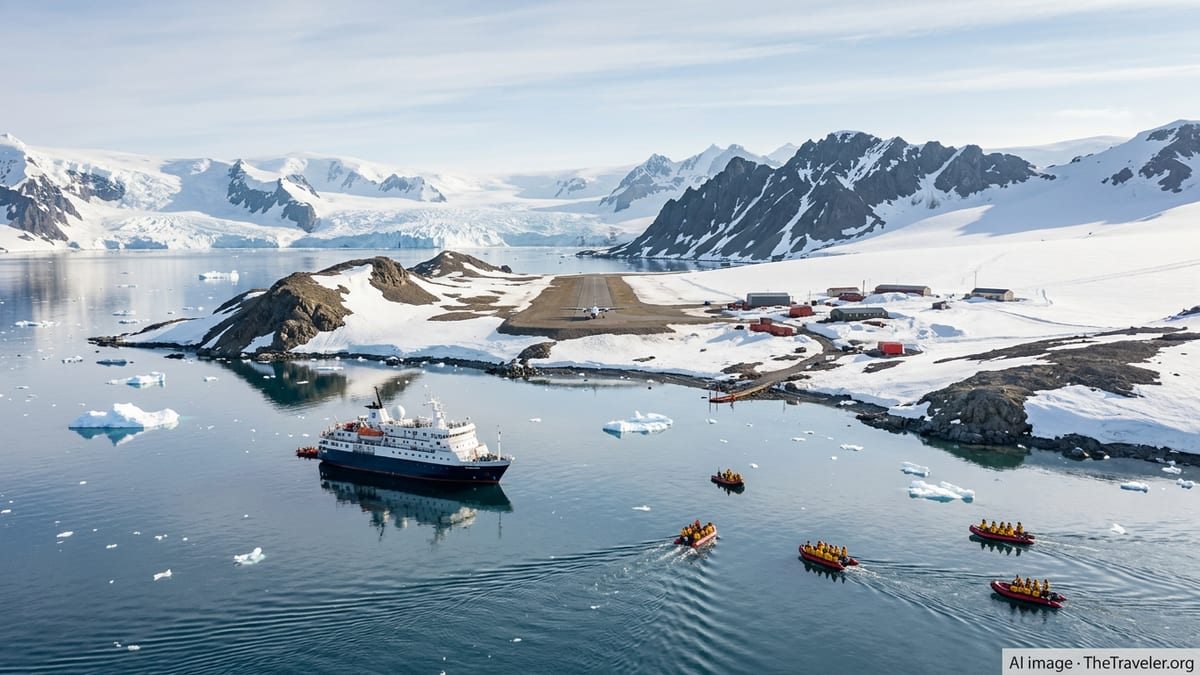
A remote continent with a real crime record
Publicly available records show that criminal incidents in Antarctica, while rare in absolute terms, are more frequent and more varied than many travelers and even policymakers might assume. Documented cases since the late twentieth century range from assaults and arson to drug use, wildlife abuse and at least one unresolved suspicious death at a major research station.
One of the earliest high profile examples cited in legal and academic reviews is a 1996 assault at the United States’ McMurdo Station, when a cook attacked a colleague with a hammer during the winter season. Later, in May 2000, Australian astrophysicist Rodney Marks fell ill and died at the Amundsen-Scott South Pole Station; a subsequent autopsy conducted in New Zealand found lethal levels of methanol in his body, and the case remains officially unexplained.
Other incidents include an attempted homicide at Russia’s Bellingshausen Station in 2018, when a researcher stabbed another in the station library, reportedly after tensions over long winter isolation. Reports of arson, fights linked to alcohol, and occasional drug use have surfaced across U.S., Russian and other national programs, typically buried in legal journals, investigative features or internal audits rather than headline news.
For those who imagine Antarctica only as a destination for expedition cruises and bucket list adventures, the emerging record reveals a more human story: a chain of isolated outposts, staffed by small, close-knit communities where stress, darkness and confinement sometimes boil over into criminal behavior.
Legal gray zones under the Antarctic Treaty
Behind each of these cases lies a complex question that has occupied legal scholars for decades: whose law applies when a crime takes place on a continent that no country owns. The 1959 Antarctic Treaty set the region aside for peace and science, essentially freezing territorial claims and creating what many analysts describe as a shared international space.
Article VIII of the treaty states that scientific personnel and observers are subject to the jurisdiction of their country of nationality, and later agreements encourage cooperation on investigations. Yet commentary from legal journals, government briefing papers and academic research notes that this framework still leaves gaps, particularly when incidents involve contractors, tourists or personnel from multiple nations operating at the same station.
Some countries, including the United States, South Africa and the United Kingdom, have passed domestic laws extending their criminal codes to citizens in Antarctica and assigning specific courts at home to hear such cases. Analysts point to U.S. statutes that treat certain crimes in Antarctica as if they occurred within special maritime jurisdiction, and to South Africa’s decision to place the continent under the authority of a magistrate’s court in Cape Town.
Even with these measures, practical enforcement remains challenging. Investigators, forensic teams and lawyers are thousands of kilometers away, transportation is limited by weather and cost, and evidence can degrade during the long journey back to national courts. As a result, many less serious incidents are handled informally on station through repatriation or employment consequences, while only the most serious cases reach national justice systems.
Alcohol, isolation and the psychology of polar crime
Researchers who study human behavior in extreme environments often highlight the same mix of factors when examining crime in Antarctica: prolonged darkness, intense cold, cramped living quarters and heavy workloads, all layered on top of separation from family and familiar support networks.
Wintering crews can spend months with no possibility of evacuation, sharing tight communal spaces where every disagreement is amplified. Reports and station histories describe long traditions of heavy drinking at some bases, a culture that has, over time, contributed to bar fights, harassment and other misconduct. In recent years, several national programs have publicly discussed tightening alcohol rules or adjusting station design to reduce flashpoints.
Mental health support has gradually improved, particularly as more women and a broader range of nationalities have joined Antarctic programs and raised concerns about harassment and safety. Nonetheless, publicly available audits and oversight reports still describe cases of stalking, sexual harassment and assault at research stations, often investigated after the fact once personnel have returned home.
The result is a paradoxical environment: one of the most controlled logistical theaters on Earth, yet one where small social systems can become volatile, and where the nearest backup is an ocean and a continent away.
From scientific backwater to legal test bed
What has changed in recent years is not only the number of people traveling south, but the way Antarctic incidents are viewed in wider legal debates. Academic work increasingly treats the continent as a real-world laboratory for questions about jurisdiction in shared spaces, similar to international waters, orbital stations and potential future settlements in space.
Law reviews and policy papers examine how treaty partners resolve disputes when a crime involves multiple nationalities, or when it occurs in parts of Antarctica that no state claims. Case studies of incidents at U.S., Russian, Chilean and New Zealand-administered stations are now used in classroom discussions about extraterritorial criminal law and the limits of national sovereignty.
For travel and tourism operators, this shifting attention has practical implications. The growth of cruise-based tourism and adventure travel has brought thousands of short-term visitors to Antarctic waters each summer, raising questions about how to investigate and prosecute serious offenses involving passengers or crew at sea or on shore landings. Industry guidelines and national permitting systems attempt to address these scenarios, but legal researchers continue to flag potential gaps.
As the number of people visiting and working in Antarctica increases, the continent’s patchwork of legal rules is being tested more frequently, turning once-obscure cases into reference points for international law far beyond the polar regions.
The next chapter in Antarctica’s hidden crime story
For now, recorded crime in Antarctica remains low in comparison with any city of similar population, and incidents rarely affect tourists or visiting travelers directly. The emerging “crime spree” is less a surge of violence than a slowly accumulating file of cases that reveal how fragile social order can be in the most isolated places on Earth.
Legal experts argue that these stories matter because they expose weaknesses in current systems before larger populations or commercial activities arrive. Several recent studies propose clearer rules for joint investigations, standardized evidence handling and better coordination between national prosecutors when incidents cross borders.
On station, program managers have introduced more structured codes of conduct, expanded reporting channels for harassment and assault, and, in some cases, reconsidered how alcohol is supplied. Enhanced pre-deployment training, mental health screening and diversity initiatives are increasingly framed as safety measures as much as workplace reforms.
For travelers reading about Antarctica as a destination, the quiet crime record is unlikely to deter visits, but it offers a more realistic portrait of the continent. Beneath the freeze-dried heroism and postcard landscapes lies a human outpost where law, psychology and geopolitics intersect, and where a handful of troubling cases have turned the world’s last wilderness into a testing ground for the future of crime and justice in shared spaces.