

More news on this day
Air travel across the United States faced another day of significant disruption today, with aviation data indicating 3,159 delays and 125 cancellations nationwide, striking key hubs in Atlanta, Chicago, Los Angeles, Houston, New York and other major cities and affecting operations at carriers including American Airlines, Delta Air Lines, United Airlines, Alaska Airlines, Republic Airways and several regional partners.
Get the latest news straight to your inbox!
Major Hubs Bear the Brunt of Nationwide Disruptions
The latest figures from widely used flight-tracking platforms show that the brunt of delays and cancellations is concentrated at the country’s largest connecting hubs, where even modest schedule changes can quickly ripple through the national network. Atlanta, Chicago, Houston, Los Angeles and New York all reported clusters of delayed departures and arrivals, with knock-on effects for flights across the United States.
In Atlanta, a critical connecting point for domestic and international traffic, delays stacked up across morning and early afternoon departures, pushing back departures on popular business and leisure routes. Chicago’s dual role as both an origin and through-hub for several major carriers meant that even a relatively small number of cancellations translated into widespread missed connections for travelers heading to secondary markets.
New York area airports, including services through John F. Kennedy International, LaGuardia and Newark Liberty, also showed elevated delay patterns, particularly on high-frequency shuttle and transcontinental routes. Flights linking New York with Los Angeles, Houston and Atlanta were among those reporting late departures, compounding congestion at both ends of the route.
Los Angeles and Houston, which handle a mix of coast to coast, Latin American and transpacific services, faced mounting schedule pressure as late-arriving inbound aircraft forced airlines to retime departures throughout the day. As a result, passengers at outstations such as smaller Midwest and Mountain West airports encountered late aircraft and revised boarding times even where local conditions appeared normal.
Airlines From Legacy Giants to Regionals Feel the Strain
Publicly available aviation dashboards indicate that the disruption has not been confined to a single carrier. American, Delta, United and Alaska all reported delayed services at key hubs, while regional and contract operators such as Republic and other feeder airlines also saw cancellations or extended ground holds.
For American Airlines, which maintains significant operations in hubs such as Dallas Fort Worth, Charlotte, Chicago and Miami, delays at partner airports and slot constrained fields amplified the operational challenges. Aircraft and crew rotations designed to run to the minute were forced into reactive rescheduling, leaving aircraft out of position and compressing recovery windows.
Delta Air Lines, anchored by its Atlanta megahub and substantial operations in New York and Los Angeles, likewise recorded clusters of delayed departures as inbound aircraft arrived behind schedule. Available performance data suggests that once early bank departures slip, subsequent waves of flights face tighter turnaround times, increasing the risk of further rolling delays.
United Airlines, with major bases in Chicago, Houston, Newark and Denver, and Alaska Airlines, focused heavily on West Coast operations, both appeared prominently in delay tallies. Regional partners such as Republic, which operate flights under the banners of larger network carriers, often feel the immediate impact when mainline schedules are adjusted, leading to cancellations on shorter routes with fewer daily frequencies.
Weather, Congested Airspace and Operational Constraints Combine
While specific causation varies by airport and hour of the day, published coverage and operational bulletins point to a familiar combination of factors underlying the disruption. Seasonal weather systems in parts of the eastern United States, routine low visibility and cloud ceilings at busy hubs, and traffic management initiatives designed to maintain safe spacing in crowded airspace all played a part in slowing down the network.
Where thunderstorms, low clouds or gusty winds intersect with peak travel banks, ground stops and metering programs often lead to extended taxi times and holding patterns for arriving flights. Even when individual storms are relatively short-lived, the backlog of aircraft waiting for departure slots and gates can take hours to clear, particularly at airports handling hundreds of daily movements.
Operational factors within airline control also contributed to the day’s statistics. Industry data and government reports regularly highlight the role of aircraft maintenance checks, crew rest limitations and tight aircraft utilization in turning minor issues into major disruptions. When a single aircraft is scheduled to complete several legs in quick succession, an early delay can cascade into missed connections and, at times, cancellations later in the day.
Air traffic control staffing constraints and ongoing construction at some major airports added further complexity. To manage runway closures, taxiway restrictions and periods of reduced arrival rates, airlines frequently adjust schedules or consolidate lightly booked services, which can appear in public data as same day cancellations or significant retimings.
Passengers Face Longer Queues, Missed Connections and Limited Options
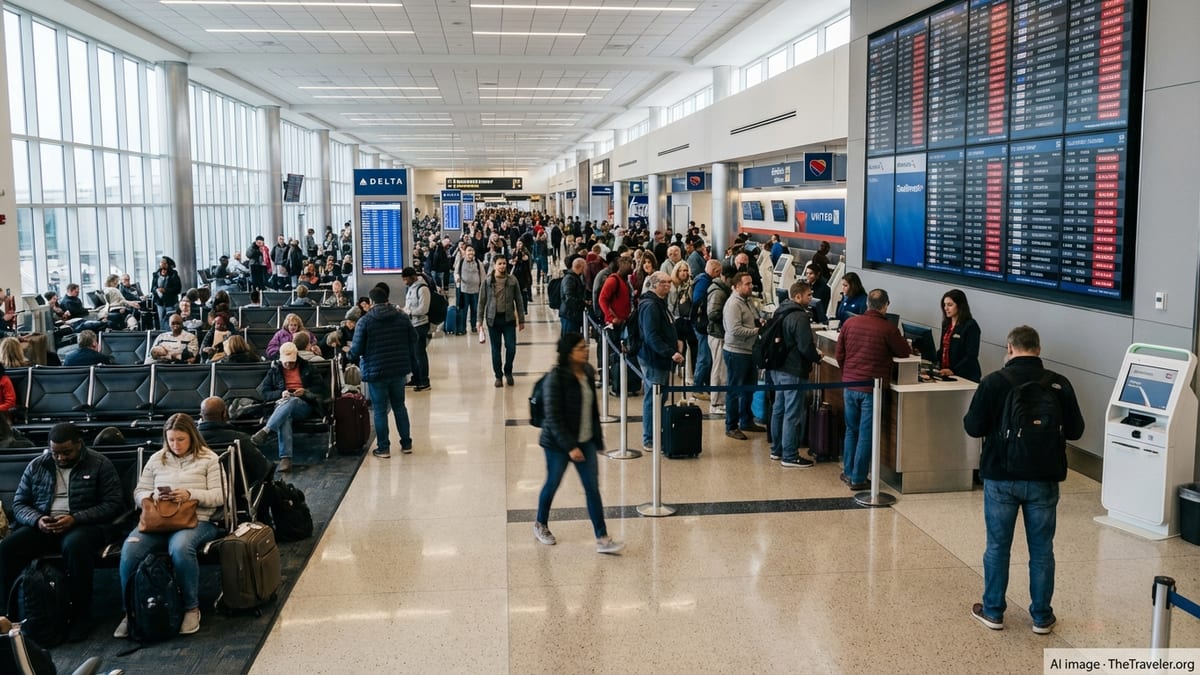
For travelers caught up in today’s disruption, the impact was felt most immediately in longer security and check in lines, crowded gate areas and extended waits on board aircraft already pushed back from the gate. At hubs such as Atlanta, Chicago and New York, passengers attempting to connect between flights encountered boards filled with delay notices, as well as rebooked itineraries that often required longer layovers or overnight stays.
Domestic travelers on routes served only a few times per day sometimes faced particularly limited options. When a flight to a smaller city is canceled outright, rebooking may involve detours through multiple hubs or travel on the following day. For international passengers, missed connections in the United States can translate into long delays in reaching onward destinations in Europe, Asia or Latin America.
Published guidance from consumer advocates notes that hotel and meal coverage varies significantly depending on the cause of a delay or cancellation, as well as the policies of each airline. Disruptions attributed to weather or air traffic control constraints often fall outside standard compensation frameworks, leaving many travelers reliant on travel insurance, credit card benefits or personal resources to cover incidental costs.
Digital tools such as airline mobile applications and airport display systems helped some passengers secure earlier rebooking or standby options, but heavily booked spring services limited the availability of open seats. In some cases, travelers were advised by online channels to consider nearby alternate airports or to accept routings through secondary hubs in order to depart on the same day.
What Today’s Numbers Reveal About a Fragile System
Although 125 cancellations and 3,159 delays represent only a small fraction of total U.S. daily departures, the concentration of problems at a handful of major hubs underscores the fragility of tightly packed schedules. Data from previous weeks and months has repeatedly shown that when hub operations in cities like Atlanta, Chicago, Los Angeles, Houston and New York slow down, knock on effects are quickly felt across the wider network.
Industry analysts frequently note that airlines, after years of optimizing fleets and crew schedules, operate with limited slack. Aircraft are scheduled for near constant use, and staffing is calibrated closely to expected demand. While this approach improves efficiency in normal conditions, it reduces the margin of error when weather or airspace restrictions intervene.
Regulatory filings and government consumer reports highlight that carriers, airports and federal agencies continue to debate the right balance between high utilization and resilience. Proposals range from infrastructure expansion and technology upgrades that could increase runway throughput, to schedule smoothing that might reduce peak congestion but result in fewer high frequency flight options for travelers.
For now, today’s tally of delayed and canceled flights serves as another reminder to passengers planning travel through busy U.S. hubs to allow extra time for connections, monitor flight status closely and remain prepared for itinerary changes, especially during seasons prone to fast changing weather patterns.