

More news on this day
Thousands of air travelers across Asia and the Middle East faced hours-long queues, missed connections and overnight airport stays today as a wave of 4,319 flight delays and 189 cancellations hit key hubs in Thailand, Singapore, Japan, the United Arab Emirates, India, Indonesia and China, disrupting operations for carriers including Etihad Airways, Japan Airlines, Air China and Thai Airways at major gateways such as Beijing, Tokyo and Dubai.
Get the latest news straight to your inbox!
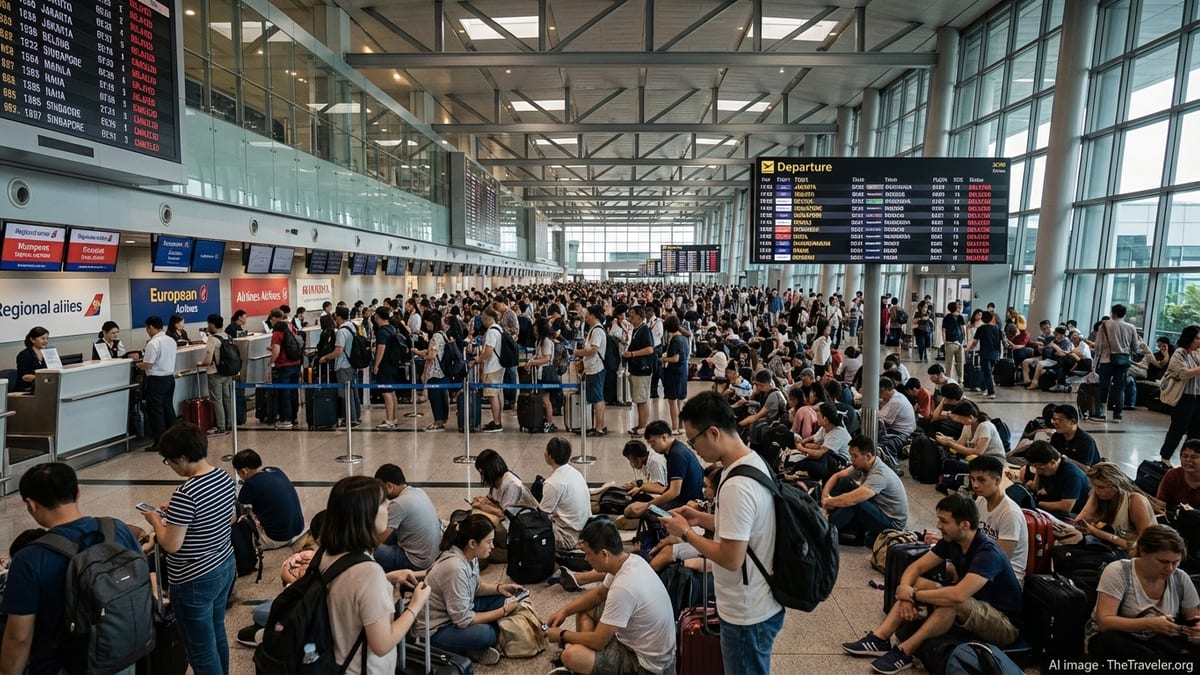
Regional Hubs From Bangkok To Beijing Under Strain
Publicly available tracking data and industry reports indicate that the most acute disruption is being felt at major transit hubs, where delays and cancellations quickly cascade through already busy schedules. Beijing’s capital-area airports, along with Shanghai, Chengdu and other Chinese megacities, have seen several hundred late departures and arrivals, compounding earlier waves of disruption reported across the country in recent days.
In Southeast Asia, Bangkok and other Thai gateways, together with Singapore’s Changi Airport and major Indonesian airports, have all logged elevated levels of late-running services. While exact causes vary by airport, observers point to a mix of weather interruptions, ongoing airspace restrictions tied to regional tensions, and tight aircraft and crew rotations that leave little margin when disruptions occur.
Japan’s primary international gateways around Tokyo are also experiencing knock-on effects. With Tokyo acting as a critical connection point between North America, Southeast Asia and Oceania, even a relatively modest rise in delays can quickly spread, particularly across evening and overnight banks of long-haul services.
Combined across the region, today’s 4,319 delays and 189 cancellations have left departure boards dominated by revised times, gate changes and rolling updates, making it challenging for passengers to plan even short- to medium-haul journeys with confidence.
Flag Carriers And Gulf Airlines Face Network-Wide Ripples
The disruption is being felt most acutely among airlines that depend on Asia’s big hubs for long-haul connectivity. Publicly available information shows that Air China has seen a sizeable share of its Beijing and Shanghai operations affected, while Thai Airways has faced schedule pressure at Bangkok as it juggles regional links and intercontinental departures.
Japan Airlines is contending with knock-on impacts at Tokyo, where slight delays on regional routes can jeopardize tightly timed connections for transpacific and European services. Similar patterns have been observed during previous disruption spikes, when minor schedule shifts during peak periods forced large-scale rebooking and aircraft swaps to keep long-haul services running.
In the Gulf, Etihad Airways is among the carriers dealing with a challenging operating environment as regional airspace closures and capacity caps continue to limit flexibility. Recent analyses of Middle East airspace restrictions have already highlighted the pressure on flights linking Abu Dhabi and Dubai with Asian destinations, and today’s delays underscore how sensitive those corridors remain when additional constraints emerge across Asia’s own networks.
Other international airlines with dense schedules into hubs such as Singapore, Bangkok, Tokyo and Beijing are also seeing their punctuality metrics eroded, as late-arriving aircraft struggle to turn around in time for onward journeys, extending the disruption well beyond the airports where problems first appear.
Complex Mix Of Weather, Airspace And Operational Challenges
While no single trigger fully explains today’s disruption totals, recent coverage across aviation and business outlets points to a convergence of factors reshaping flight operations in Asia. Intermittent storms and seasonal weather systems continue to affect several key hubs, forcing holding patterns, diversions and runway flow restrictions that can easily ripple through busy schedules.
At the same time, ongoing airspace closures and rerouting in parts of the Middle East have lengthened flight times on some Europe–Asia routes, requiring additional fuel, altered flight paths and, in some cases, schedule adjustments. Analysts have previously warned that prolonged closures over critical Gulf corridors could leave millions of passengers facing extended journeys and higher fares, particularly where alternative routings are already congested.
Operationally, airlines across the region are still fine-tuning capacity after a rapid rebound in demand. Industry reporting from India, Southeast Asia and North Asia in recent months has highlighted how staff shortages, maintenance bottlenecks and tight aircraft utilization can transform relatively minor schedule shocks into full-day disruptions, especially at airports already operating near capacity.
Where multiple pressure points coincide at the same time, as seen today, carriers have fewer options to recover quickly, and passengers bear the brunt through rolling delays and last-minute cancellations.
Passengers Face Missed Connections, Visa Issues And Extra Costs
For travelers, the practical impacts extend far beyond a revised departure time on a screen. Missed connections are emerging as one of the most common problems, particularly at large transfer hubs where passengers rely on tightly timed itineraries to move between regional and long-haul flights.
In some cases, travelers transiting through cities such as Dubai, Beijing, Bangkok or Tokyo find themselves unexpectedly needing overnight accommodation or short-stay visas when onward flights are no longer available on the same day. Consumer advocates note that such situations can lead to out-of-pocket expenses for hotels, meals and rebooked tickets, especially when disruptions are attributed to weather or airspace issues rather than carrier-controlled factors.
The timing of today’s disruption is also problematic for business travelers and those connecting to cruises, events or tours on fixed schedules. Missed embarkations and nonrefundable reservations can quickly turn a delay into a substantial financial setback, even for passengers who ultimately reach their final destination a day or two late.
Families traveling with children or elderly relatives are particularly vulnerable to long waits in crowded terminals, as rest facilities and seating fill quickly and rebooking queues stretch for hours at busy airline counters.
What Travelers Can Do As Disruptions Continue
With Asia’s aviation network still susceptible to weather, operational constraints and shifting geopolitical risks, industry analysts increasingly recommend that passengers build additional buffer time into itineraries that rely on complex connections through multiple hubs.
Publicly available guidance from consumer groups suggests monitoring flight status through official airline channels and airport information boards, and being prepared to adjust plans rapidly if early signs of disruption emerge. Travelers on multi-leg journeys are often advised to prioritize longer layovers in key hubs rather than the shortest possible connections, particularly when traveling through regions affected by airspace restrictions.
Travel insurance with robust coverage for delays, missed connections and trip interruptions is also becoming more relevant for long-haul passengers connecting through Asia and the Middle East. Policies that reimburse additional accommodation, meals and rebooking fees can cushion the financial blow when large-scale events, such as today’s wave of delays and cancellations, disrupt travel at short notice.
For now, today’s figures on delayed and canceled flights highlight just how interconnected Asia’s aviation system has become. When schedule problems strike simultaneously in Thailand, Singapore, Japan, the UAE, India, Indonesia and China, the resulting shock is felt far beyond Beijing, Tokyo or Dubai, reverberating through global travel plans for days to come.