

More news on this day
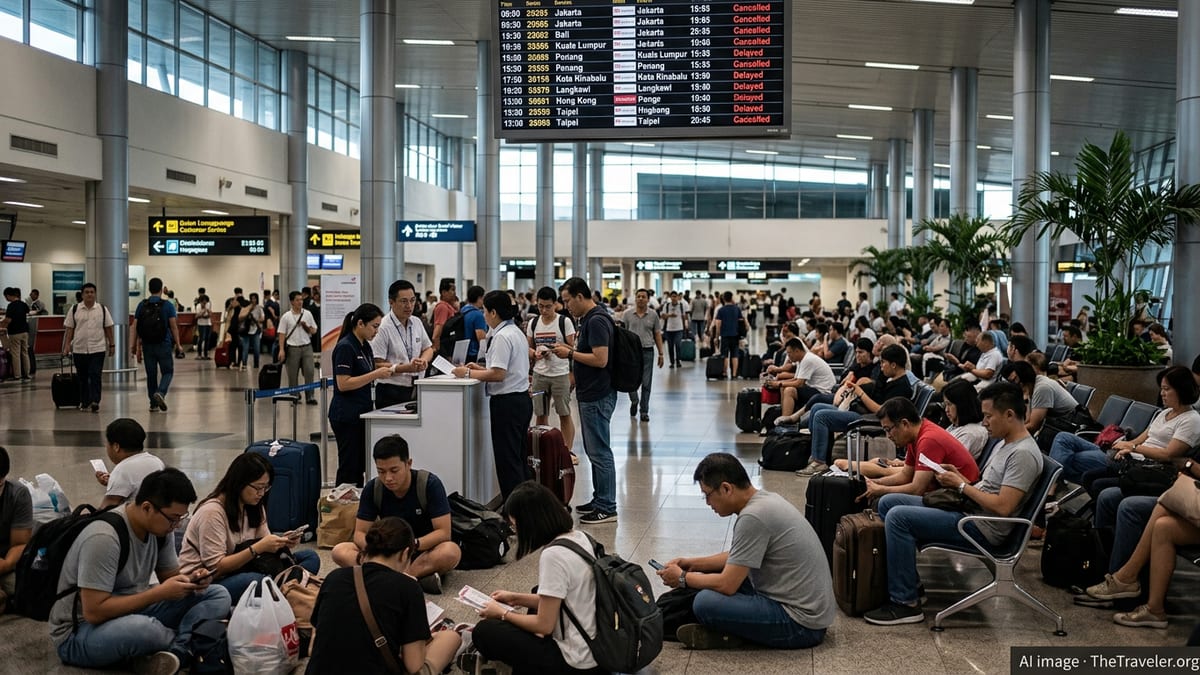
Thousands of travellers were stranded across Asia today as widespread aviation disruption led to thousands of delayed services and nearly two hundred cancellations at major hubs in Thailand, Hong Kong, Singapore, Malaysia, Indonesia and China, impacting leading carriers including Cathay Pacific, AirAsia, Singapore Airlines and Air China.
Get the latest news straight to your inbox!
Regional Hubs Grind Under Wave of Delays
Publicly available airport and flight-tracking data for today indicate that aviation networks across East and Southeast Asia experienced heavy disruption, with well over two thousand flights delayed and close to two hundred cancelled. The impact was felt most acutely at major international hubs that serve as gateways between Asia, Europe, the Middle East and North America.
Large Chinese gateways, including the Beijing airports and Guangzhou, recorded particularly high numbers of affected services, with several hundred delays and multiple cancellations reported at each location. Flight monitoring snapshots show dense clustering of late departures and arrivals throughout the day, reflecting knock-on congestion across domestic and international banks of flights.
In Southeast Asia, Jakarta, Bangkok, Kuala Lumpur and Singapore Changi also reported extensive delays, with local media and aviation trackers describing hours-long queues at immigration and check-in in some terminals. Travellers connecting onward to Europe, Australia and other Asian destinations were among the hardest hit as missed connections cascaded through tightly timed schedules.
Reports from travel industry outlets describe the situation as one of the most broadly distributed days of disruption in the Asia region this month, affecting a wide mix of leisure, business and transit passengers rather than being confined to any single market.
Flag Carriers and Low-Cost Giants Affected
The disruption cut across airline business models, affecting full-service flag carriers and low-cost operators alike. According to published coverage drawing on live operational data, services operated by Cathay Pacific, AirAsia, Singapore Airlines, Air China and a range of regional partners and subsidiaries were among those delayed or cancelled.
Cathay Pacific, which already faces network pressures from elevated jet fuel prices and ongoing route suspensions linked to the Middle East conflict, saw its schedules through Hong Kong further squeezed by the day’s congestion. Recent company statements and media reports highlight that the airline is trimming parts of its May and June programme in response to rising costs, leaving less flexibility to absorb additional same-day operational shocks.
Malaysia-based AirAsia and its regional affiliates, key players in short-haul travel across Southeast Asia, were also heavily exposed to today’s disruption due to their dense networks linking Thailand, Malaysia, Indonesia and Singapore. Even modest ground delays at one hub can rapidly ripple across their point-to-point systems, affecting aircraft rotations and crew duty limits.
Singapore Airlines and Air China, both central to long-haul connectivity for their home markets, faced delays that reverberated across intercontinental itineraries. Passengers connecting through Singapore and Chinese hubs on routes to Europe and North America reported extended waits, while airlines worked to re-time departures where possible to preserve onward connections.
Weather, Congested Skies and Geopolitical Headwinds
Travel and aviation news outlets across the region link today’s turmoil to a combination of adverse weather, already saturated airspace and the broader geopolitical environment. Recent coverage of April travel conditions in Asia points to repeated episodes of heavy rain, thunderstorms and low visibility at several major airports that have tightened operating windows and reduced runway throughput.
At the same time, airlines and air traffic managers are still adapting to airspace constraints and reroutings connected to conflicts in the Middle East, which have altered long-haul flight paths linking Asia with Europe and beyond. Industry data published in recent days show jet fuel prices remaining sharply elevated compared with late February, intensifying pressure on carriers as they attempt to maintain capacity while managing higher operating costs.
The combination of longer routings, tighter turnarounds and narrower buffers means that relatively routine weather or technical disruptions can now more easily cascade into widespread delays. When multiple hubs in China and Southeast Asia experience constraints on the same day, the knock-on effect can quickly become regional in scale, as seen in today’s figures.
Analysts quoted in recent aviation commentary note that Asia’s rapid traffic recovery over the past two years has outpaced the rebuilding of some operational resources, leaving airlines and airports more vulnerable to shock days with simultaneous weather and network challenges.
Passengers Face Missed Connections and Overnight Stays
For travellers on the ground, today’s statistics translated into long queues, missed events and, for many, unexpected overnight stays. Social media posts and local news reports from airports in Bangkok, Jakarta, Beijing and Singapore describe crowded seating areas, fully booked nearby hotels and lengthy waits for rebooking assistance at airline counters.
With capacity already tight on many regional routes, especially during peak evening departure waves, re-accommodating passengers from cancelled flights proved difficult. Some travellers were offered rerouting via alternative hubs, while others were advised that the next available seats would not be until the following day or later in the week.
Publicly available information from consumer rights bodies in the region underscores that compensation rules and care obligations vary significantly between jurisdictions and carriers. Passengers on international itineraries may have different protections compared with those on domestic sectors, and travellers are often encouraged by travel advisories to review airline conditions of carriage and local regulations before seeking redress.
Travel insurers are also likely to see a spike in claims arising from missed connections, additional accommodation costs and forfeited prepaid arrangements at destinations across Asia, particularly for complex multi-stop itineraries.
Signs of Ongoing Strain in Asia-Pacific Aviation
Today’s events add to a growing pattern of high-impact disruption days across the Asia-Pacific network in early 2026. Recent analyses by industry observers describe a system still in the process of stabilising after the pandemic-era capacity cuts, with some carriers only gradually restoring fleets, crews and secondary routes.
Announcements in the past weeks from major airlines, including Cathay Pacific, signal further tactical capacity adjustments in response to fuel price volatility and shifting demand on long-haul corridors. These measures, while designed to shore up financial resilience, can reduce the margin for error when irregular operations strike, especially at slot-constrained hubs.
Regional tourism boards and travel trade groups have expressed concern in recent commentary that repeated large-scale disruption may dent confidence among long-haul visitors considering multi-country itineraries across Asia. At the same time, strong demand indicators for routes connecting Asia with North America, Europe and Australia suggest that travellers remain eager to return, even as they face a higher risk of schedule changes.
For now, today’s wave of 2,699 delays and 186 cancellations serves as another reminder of the fragility of Asia’s interconnected air travel system, and of the challenges facing airlines, airports and travellers as the region navigates a period of heightened operational and geopolitical uncertainty.