

More news on this day
Thousands of air passengers across Europe faced severe disruption this week as authorities in Turkey, the United Kingdom, the Netherlands, France and Germany suspended 186 flights and delayed a further 1,462, snarling operations at major hubs including Istanbul, Amsterdam, London, Paris and Frankfurt.
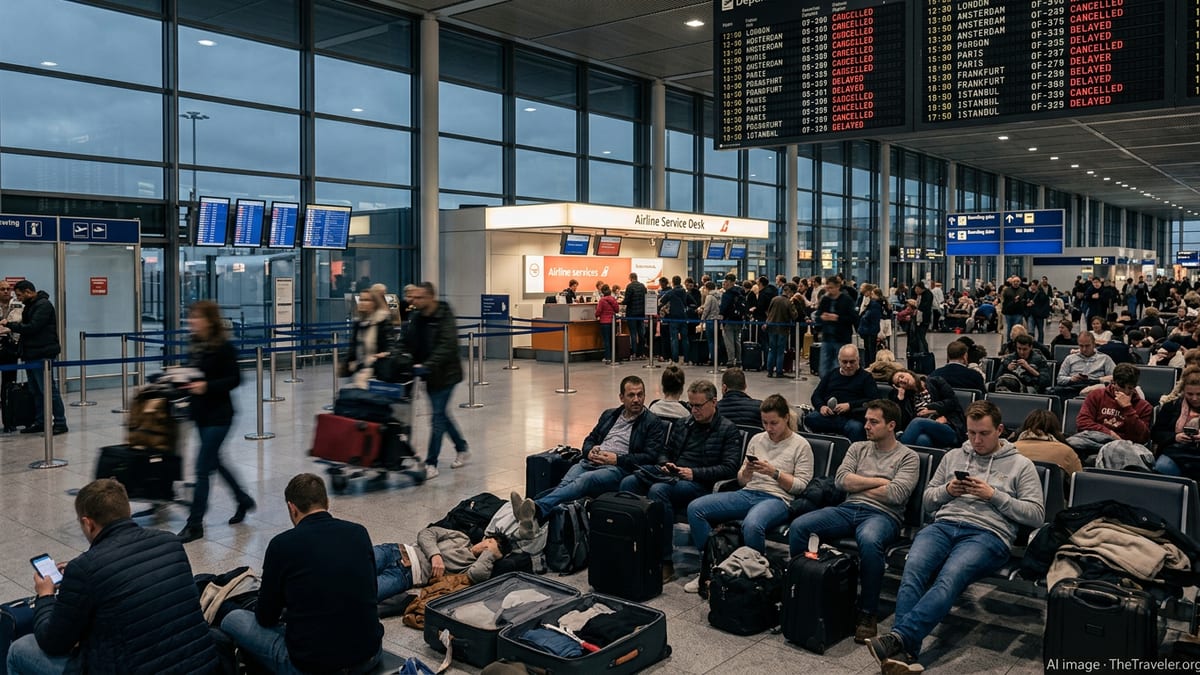
Wave of Cancellations Ripples Across Key European Hubs
The latest figures from European aviation data trackers show a tightly concentrated wave of disruption radiating across the continent, with cancellations and delays clustering at some of Europe’s busiest transfer points. London’s airports, Amsterdam Schiphol, Paris Charles de Gaulle, Frankfurt and Istanbul all reported significant schedule cuts in recent days, with knock-on effects spreading to regional airports in Scandinavia, southern Europe and beyond.
On a single 24 hour period, at least 186 flights were fully canceled and 1,462 were delayed as airport operators and airlines struggled to cope with a combination of airspace restrictions, lingering winter weather and staffing constraints in air traffic control and ground handling. While many flights eventually departed, often hours behind schedule, the scale of disruption quickly overwhelmed terminal facilities and customer-service channels.
Travel-analytics firms say the numbers only hint at the wider operational strain, since each canceled or heavily delayed rotation can affect several hundred onward connections across Europe, North America, the Middle East and Asia. For thousands of travelers, that meant missed cruises, forfeited hotel nights and unplanned overnight stays in airport hotels or city centers near the hubs.
British, SAS, Norwegian, Ryanair and Air France Among Hardest Hit
The disruption has cut across full-service and low-cost carriers alike. British Airways, SAS, Norwegian, Ryanair and Air France all reported clusters of delayed or canceled services as they attempted to rework rosters, reroute aircraft and navigate temporary restrictions on overflying parts of the Middle East and eastern Mediterranean.
British Airways and other UK carriers saw particular pressure on short-haul routes linking London with European capitals such as Amsterdam, Paris, Frankfurt, Zurich and Madrid. Each hour of outbound delay in the morning cascaded through the day’s rotations, forcing airlines to consolidate lightly loaded services and, in some cases, cancel late-evening departures entirely.
Scandinavian carrier SAS and low-cost rival Norwegian, heavily reliant on tight aircraft turnarounds at busy hubs, were also affected as congestion at airports such as Copenhagen and Amsterdam disrupted the timing needed to keep schedules intact. Passengers on Nordic routes reported aircraft waiting for extended periods on taxiways and long queues at de-icing and security checkpoints.
Air France, which has already been grappling with pressure on long-haul operations due to shifting flight paths between Europe and Asia, faced additional strain at its Paris Charles de Gaulle hub as short- and medium-haul routes into northern Europe and the UK were caught up in the broader European delays.
Istanbul, Amsterdam, London, Paris and Frankfurt Struggle With Knock-On Effects
Airport authorities at Istanbul Airport and Amsterdam Schiphol, two of Europe’s most important connecting hubs, reported sustained operational challenges as altered routings and displaced aircraft put extra pressure on already busy airspace. Istanbul, a key bridge between Europe, the Middle East and Asia, has seen increased traffic from airlines attempting to skirt closed or restricted airspace further south and east, complicating slot management and turnaround times.
In the Netherlands, Schiphol’s tightly scheduled operations left little slack to absorb waves of late arrivals, leading to aircraft holding patterns, delayed departures and last-minute gate changes. Travelers reported lengthy lines at transfer security and service desks as staff attempted to rebook missed connections.
London’s multi-airport system, including Heathrow and Gatwick, experienced similarly sharp spikes in delays, particularly during peak morning and evening departure banks. Even when weather conditions were relatively stable, small ground-handling bottlenecks quickly escalated in an environment where many carriers already run at close to maximum aircraft utilization.
Frankfurt, Germany’s primary hub, and Paris Charles de Gaulle in France also felt the strain, with a mix of long-haul disruptions and regional delays creating a patchwork of irregular operations. Aviation planners noted that as soon as one hub attempted to normalize schedules, fresh knock-on effects from partner airports elsewhere in Europe triggered new rounds of last-minute changes.
Middle East Airspace Closures and Winter Weather Add to Chaos
The timing of the latest European disruption coincides with continued closures and restrictions in key Middle Eastern airspace corridors following recent military tensions in the region. Those closures have forced airlines to reroute many Europe–Asia services via longer northerly or southerly paths, adding flight time, fuel burn and complexity to already stretched schedules.
Carriers that normally rely on the Gulf and Levant corridors to connect Europe with South and East Asia have had to replan entire route networks, with knock-on effects on crew duty times and aircraft positioning. As aircraft and crews arrive late into European hubs, the downstream impact on intra-European flights has been significant, particularly for airlines using the same aircraft for both long- and short-haul sectors.
Adding to the pressure, the tail end of the winter storm season has continued to affect parts of Western and Central Europe, particularly at higher-latitude airports in the UK, Germany and the Netherlands. Low cloud ceilings, gusty crosswinds and intermittent snow or freezing rain have required increased spacing between arrivals and departures, along with de-icing operations that slow aircraft turnaround.
Aviation analysts say the current situation exposes how little spare capacity exists in Europe’s air-traffic-management and airport systems. A combination of airspace disruption, weather and staffing shortages is enough to push the network to its limits, with consequences felt from regional holiday airports to global mega-hubs.
Passengers Face Long Queues, Confusion and Patchy Support
For passengers caught up in the disruption, the most visible impacts have been long check-in and security queues, crowded departure halls and difficulty obtaining timely information. Screens across major terminals cycled through rolling delays and gate changes, while airline call centers and online chat channels struggled to keep up with soaring demand for rebookings and refunds.
Some travelers reported sleeping on terminal floors or in makeshift waiting areas after hotel rooms near the busiest hubs quickly sold out. Families with children and elderly passengers found themselves in the longest lines, competing for rebooking assistance and meal vouchers as ground staff juggled complex re-accommodation tasks across multiple carriers and alliances.
Consumer advocates across several European countries reiterated that most travelers on flights departing from or arriving in the European Union, as well as those on EU carriers, are protected by EU passenger-rights rules that can entitle them to care, assistance and, in many cases, financial compensation. However, they also warned that compensation eligibility can depend on whether the disruption is considered within the airline’s control.
Travel experts advise affected passengers to keep boarding passes and receipts for out-of-pocket expenses, monitor airline apps frequently, and consider alternative routings via less congested hubs when possible. With no immediate resolution to the underlying airspace and capacity issues, they caution that Europe’s air travel network is likely to remain fragile in the days ahead.