

More news on this day
Severe thunderstorms over North Texas triggered major disruption at Dallas–Fort Worth International Airport on March 7, with 713 flight delays and 155 cancellations rippling across the U.S. air travel network and stranding thousands of passengers.
Thunderstorms Paralyze One of America’s Busiest Hubs
Dallas–Fort Worth International Airport, a primary gateway for domestic and international travel, spent much of Saturday operating under strict air traffic management programs as storms pushed across the region. According to operational data from flight tracking and aviation advisories, arrivals into DFW faced average delays of more than an hour, while departing flights encountered extended gate holds and taxi congestion as ground crews halted activity during lightning and heavy rain.
The severe weather forced controllers to space out arrivals, reduce the overall flow of traffic into the airspace and, at times, temporarily suspend operations on certain runways. That slowdown quickly cascaded into mounting delays, missed connections and aircraft out of position. By late afternoon, the disruptions had reached a tally of around 713 delayed flights and 155 outright cancellations linked to the Dallas area, highlighting once again how storms in North Texas can have rapid, nationwide consequences for air travel.
While thunderstorms are a seasonal reality for the region, Saturday’s combination of intense cells, shifting winds and operational safety restrictions proved especially challenging. Airlines were forced to repeatedly revise departure times, stack flights in holding patterns, and rework crew schedules as the storm system lingered over the metro area and along key arrival and departure corridors.
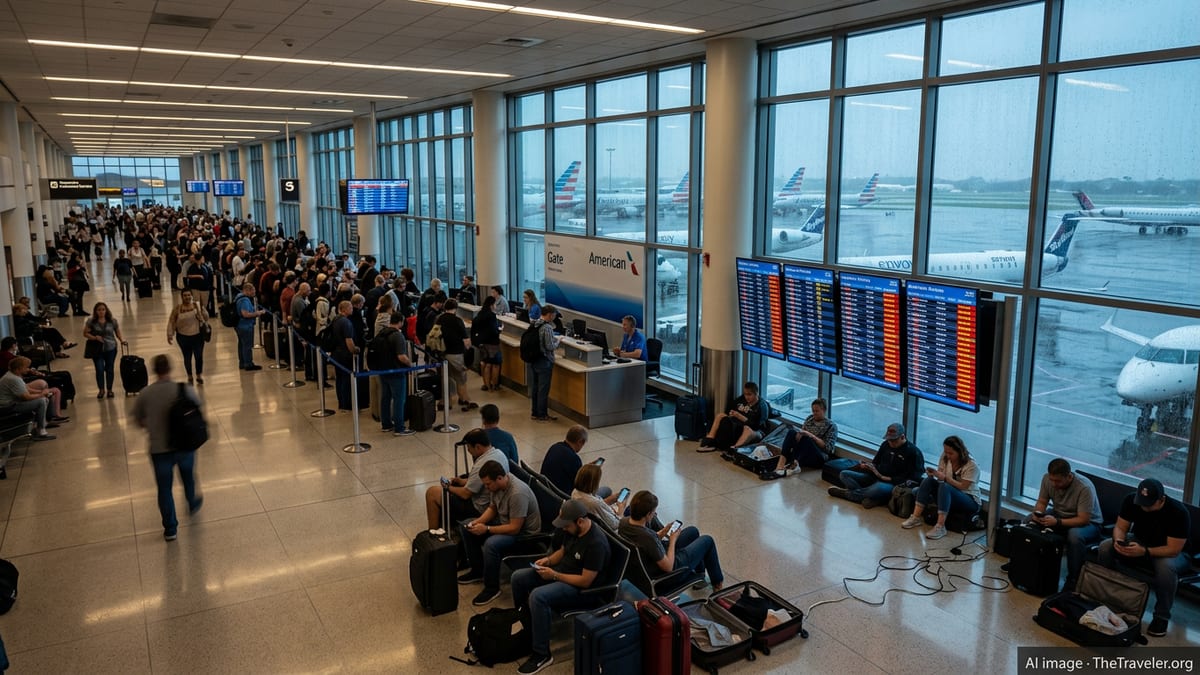
The impact extended beyond the airport perimeter. Major highways serving the complex experienced slowdowns as passengers circled for parking, were dropped off early in hopes of rebooking, or returned to the city after learning their flights would not operate. Inside the terminals, long lines formed at customer service counters and departure boards filled with red and yellow delay indicators.
American and Regional Partners Hit Hard
American Airlines, which operates its largest hub at Dallas–Fort Worth, faced the brunt of Saturday’s disruption. With a dense schedule of connecting services into and out of the airport, even modest slowdowns can create significant knock-on effects for the carrier. The scale of the thunderstorms and the traffic management restrictions in place meant that American and its regional affiliates were forced into widespread retiming and cancellation decisions throughout the day.
Regional operators flying under the American Eagle brand, including Envoy Air, SkyWest Airlines and PSA Airlines, were among those reporting significant operational impacts. These carriers operate many of the shorter domestic routes that feed American’s long haul and transcontinental services through DFW. When storms shut down or severely constrain operations at the hub, these regional flights are often the first to be trimmed or delayed to keep aircraft and crews positioned for later banks of departures.
Envoy Air and PSA Airlines, in particular, saw a wave of delays on flights linking smaller cities in the South, Midwest and interior West, where passengers depend heavily on DFW as their primary connecting point. SkyWest, which serves multiple major airlines but also operates American Eagle routes into Dallas, reported its own mix of delays and cancellations as aircraft were forced to hold, divert or wait for weather to clear before departure.
Other carriers serving Dallas–Fort Worth were not spared. Larger U.S. airlines and additional regional operators all reported schedule disruptions as they navigated ground stops, reroutes around active storm cells and constrained takeoff and landing windows. For passengers, that translated into crowded gates, rolling departure times and uncertainty about when they would reach their final destinations.
Nationwide Ripple Effects for U.S. Travelers
Because DFW functions as a central connecting hub, the disruption quickly spread far beyond Texas. Flights that were scheduled to arrive in Dallas from cities across the United States were held at origin airports, while outbound services that normally depart on tight turnarounds were pushed back or canceled altogether. As aircraft and crews failed to arrive on time in Dallas, subsequent flights in other parts of the country also began to suffer delays.
Travelers connecting through Dallas from the West Coast, Midwest and East Coast reported missed onward flights, overnight layovers and unplanned reroutes through alternate hubs. With so many aircraft arriving late and departure slots limited by the weather program, airlines were forced to prioritize certain routes, leaving lower frequency services and late-night connections with few options for same-day recovery.
Airports with strong scheduling ties to DFW, including major hubs in the central and eastern United States, experienced knock-on delays throughout the day. Even flights that ultimately departed close to schedule often carried large numbers of passengers who had been rebooked after missing earlier connections in Dallas, leading to full cabins and limited flexibility for additional standby travelers.
For many passengers, the practical consequences included extended waits on board aircraft during ground holds, hours-long queues for customer service assistance and difficulty securing hotel rooms as evening cancellations mounted. Some travelers chose to abandon their original itineraries entirely, turning to rental cars or intercity buses when it became clear that a same-day or even next-day flight option was unlikely.
What Stranded Passengers Can Do
With thunderstorms commonly cited as a safety issue outside an airline’s direct control, most carriers classify weather-related cancellations and lengthy delays differently from those caused by mechanical or staffing problems. That distinction can limit the compensation and amenities passengers are entitled to, even when disruptions are extensive. Travelers caught up in Saturday’s Dallas turmoil were often offered rebooking on the next available flight, but hotel vouchers and meal credits varied by carrier and specific circumstances.
Consumer advocates recommend that passengers affected by large-scale weather disruptions monitor their flight status frequently via airline apps and sign up for text or email alerts, especially when traveling through weather-prone hubs such as Dallas–Fort Worth in the spring and summer. When a cancellation becomes likely, reaching out simultaneously through multiple channels, including airport agents, call centers and social media teams, can improve the chances of securing an earlier rebooking option.
Experts also advise considering alternate routings that bypass storm-affected hubs, even if it requires an extra connection or a different airline. In some cases, travelers facing a long delay through Dallas may find faster options by rerouting through other major hubs that remain less affected by the day’s weather systems. Flexibility with departure airports, arrival airports and travel dates can significantly increase the likelihood of a workable solution.
For future trips, travelers who are particularly risk-averse may choose to build longer connection windows through Dallas during peak thunderstorm seasons or schedule nonstop flights whenever possible to avoid reliance on a single, weather-sensitive hub. Travel insurance policies that specifically cover weather disruptions can also provide some financial relief for additional hotel nights, meals and rebooked tickets when storms bring airports like DFW to a standstill.
Ongoing Monitoring as Storms Persist
Meteorologists warned that stormy conditions around North Texas could persist in waves, suggesting that operations at Dallas–Fort Worth may remain fragile into the evening and potentially into Sunday. Even as individual storm cells move out of the immediate area, airlines must work through a backlog of delayed departures and arrivals, reposition aircraft and reassign crews who may have reached duty time limits during the disruption.
Aviation analysts note that recovery from a major weather event at a hub of DFW’s size can take many hours even after the worst of the storms have passed. Aircraft stranded at outstations, pilots and flight attendants displaced from their intended rotations, and passengers scattered across multiple hubs all contribute to a complex puzzle that operations teams must solve before schedules can return to normal.
Passengers with Sunday or Monday departures involving Dallas are being urged to keep a close eye on their itineraries, arrive at the airport early and be prepared for continued schedule adjustments as airlines work to restore regular service. While some flights may operate as planned once weather clears, others could still see timing changes as carriers prioritize repositioning aircraft and handling the backlog of disrupted travelers.
For now, the storms over Dallas have offered another reminder of how vulnerable the modern air travel system remains to sudden weather shifts at a few key hubs. With hundreds of flights delayed or canceled and thousands of passengers facing an uncertain journey, Saturday’s disruption underscored the central role Dallas–Fort Worth plays in keeping the nation’s skies moving.