

More news on this day
Major cruise operators are quietly removing Tracy Arm Fjord from Alaska itineraries in 2026, following a 2025 landslide and tsunami near South Sawyer Glacier that highlighted ongoing safety risks in the narrow, ice-clogged channel.
Get the latest news straight to your inbox!
Geological Instability Forces a Rethink of Scenic Routes
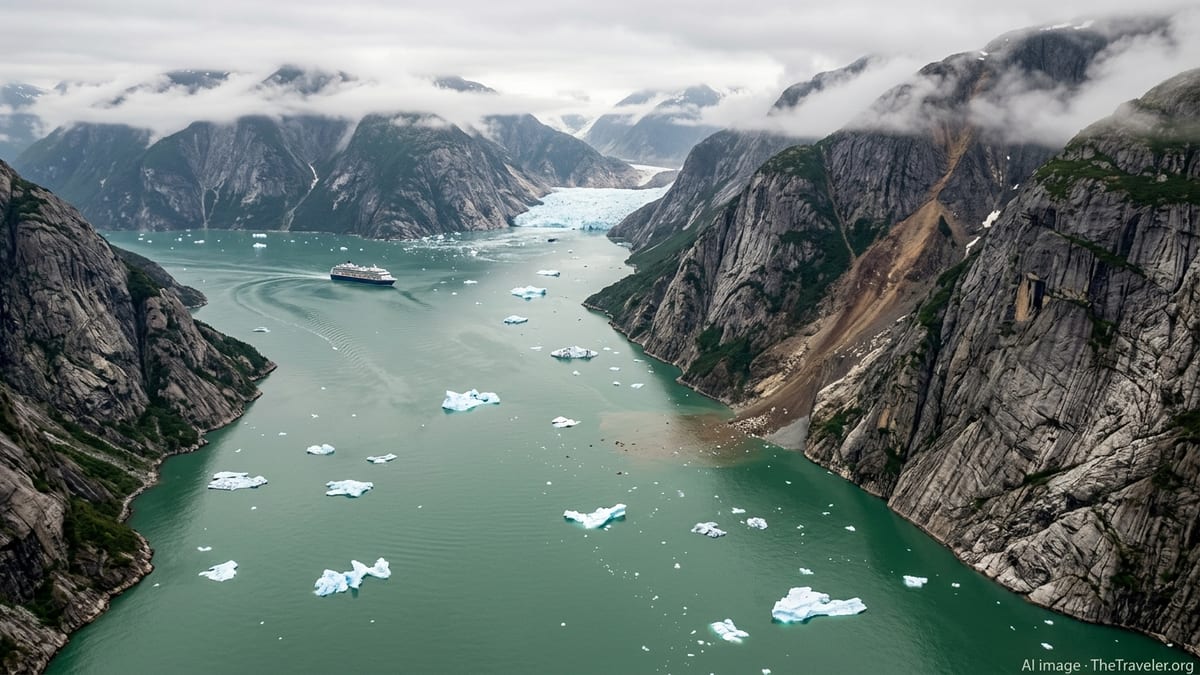
Tracy Arm Fjord, a dramatic, glacier-carved inlet south of Juneau, has long been a highlight of Inside Passage voyages, with ships threading between sheer granite walls and drifting ice toward North and South Sawyer glaciers. That experience was thrown into question on August 10, 2025, when a major slope failure near South Sawyer Glacier sent rock and ice crashing into the fjord, generating a powerful tsunami that raced across the waterway. Publicly available scientific briefings describe a wave that reached tens of meters in height, a near miss for cruise ships and tour vessels scheduled to be in the area that day.
The incident underscored long-standing concerns about the stability of steep, ice-sculpted slopes in warming high-latitude environments. Glaciological reports from federal research programs point to South Sawyer Glacier as a textbook example of how rapid ice loss, thawing permafrost, and saturated rock can combine to destabilize valley walls and trigger cascading hazards for people and vessels operating nearby.
While the 2025 tsunami did not directly strike a cruise ship, regional emergency planning documents circulated afterward describe the event as a warning shot for Southeast Alaska’s growing cruise industry. Risk assessments emphasize that the confined shape of Tracy Arm concentrates energy from landslide-generated waves, leaving little margin for error in an area that also contends with heavy ice and limited maneuvering room for large vessels.
Those findings, combined with routine ice hazards close to the glacier faces, have fed into a broader industry reassessment of how and when large ships should enter tidewater-glacier fjords such as Tracy Arm.
Cruise Lines Shift 2026 Calls to Endicott Arm and Other Fjords
Evidence from 2026 booking confirmations, excursion descriptions, and passenger communications indicates that major cruise brands are opting out of Tracy Arm next season, even when advertised itineraries still reference the fjord. Notices shared with guests in recent days describe “unstable ice and geological conditions” that currently preclude vessels from entering the fjord and explain that all 2026 departures marketed with a Tracy Arm experience will instead explore nearby Endicott Arm.
Endicott Arm, which terminates at Dawes Glacier, offers a similar blend of steep-walled scenery, waterfalls, and floating ice, and is already a common backup when ice or weather shuts down access to Tracy Arm. Cruise forums and operator materials for 2026 show Tracy Arm day-cruises and ship-launched glacier excursions being systematically reticketed as Endicott Arm sailings, preserving a glacier-viewing day while avoiding the most constrained reaches of Tracy Arm.
Some smaller expedition and adventure operators, which use compact ships or day boats, have historically continued visiting Tracy Arm later into the season when conditions allow. However, recent promotional language and consumer reports suggest that even these companies are pivoting more heavily toward Endicott Arm and alternative fjords in 2026, framing the change as a response to “dynamic” conditions in Tracy Arm and evolving best practices for passenger safety.
The result is that, for mainstream Alaska cruises in 2026, Tracy Arm is effectively off-limits. Travelers may still see the name in marketing materials, but on-the-water plans now overwhelmingly route ships toward less constrained glacier fjords where operators judge the combined risks from ice, waves, and slope instability to be lower.
Safety Concerns Extend Beyond the 2025 Tsunami
The 2025 landslide and tsunami are only part of the risk picture in Tracy Arm. Navigational studies of Southeast Alaska describe the fjord as a narrow, twisting corridor where ships must negotiate sharp bends, floating icebergs of varying size, and occasional “streams” of ice pouring out from the tidewater glacier faces. In these confined conditions, short-notice evasive maneuvers are difficult for large cruise ships, especially in poor visibility or heavy ice.
Climate-linked changes are also altering the hazard profile. Scientific summaries linked to the Arctic Report Card series note that rapid retreat and thinning of tidewater glaciers can destabilize adjacent slopes by reducing the buttressing effect of ice, while meltwater and rainfall increase pore pressure in rock and debris. South Sawyer Glacier is being cited as a clear example of this process, with the 2025 slope failure illustrating how quickly a seemingly static landscape can shift.
In parallel, marine mammal research and vessel guidelines highlight Tracy Arm as critical pupping habitat for harbor seals that haul out on ice floes near the glacier faces. Updated outreach materials from NOAA Fisheries, released in 2025, reiterate voluntary recommendations for vessels in Tracy Arm to avoid dense ice fields, remain well back from the glacier face, and limit presence in key areas during the peak pupping period from May to late June. While these measures are aimed at wildlife protection rather than passenger safety, they further constrain how and where vessels can safely and responsibly maneuver.
Taken together, these physical and regulatory factors are steering cruise planning toward more conservative routes. Cruise lines appear increasingly reluctant to promise guests a close-up view of South Sawyer Glacier when a sudden ice surge, slope failure, or seal concentration might force a last-minute retreat or extended delays.
What 2026 Alaska Cruise Passengers Can Expect Instead
For travelers booked on 2026 Alaska itineraries that once highlighted Tracy Arm, the practical impact is more about geography than about losing a glacier day altogether. Passenger messages and excursion updates generally describe a swap to Endicott Arm, where ships can approach Dawes Glacier when ice conditions cooperate. Scenic cruising there still includes towering cliffs, waterfalls, and drifting icebergs, along with opportunities to spot seals, whales, and bald eagles along the way.
Some itineraries also emphasize time in Glacier Bay National Park, College Fjord, or Hubbard Glacier as marquee glacier-viewing experiences. National Park Service publications underline Glacier Bay’s long-established system of managing ship entries and monitoring harbor seals, which offers a more structured framework for balancing visitor access and resource protection than exists in Tracy Arm.
For independent travelers starting or ending cruises in Juneau, day-boat operators are marketing flexible “fjord and glacier” outings that can pivot between Tracy Arm and Endicott Arm depending on real-time conditions and evolving guidance. Descriptions emphasize that final routing decisions will be made close to departure based on ice charts, weather, and safety considerations, reflecting a more dynamic approach than the fixed Tracy Arm promises common in earlier years.
Passengers who specifically chose their voyage for a South Sawyer Glacier encounter may feel disappointment, especially those who have followed Tracy Arm’s reputation as one of Southeast Alaska’s most photogenic fjords. Travel experts writing in cruise-focused publications recommend that guests monitor their booking portals and pre-cruise documentation carefully, as itinerary descriptions may lag behind operational changes and may still list Tracy Arm even when the working plan for 2026 is to avoid it.
A Test Case for Adapting to a Changing Alaska Coastline
The decision by cruise operators to keep Tracy Arm essentially off-limits in 2026 reflects a broader shift in how the industry responds to emerging environmental hazards. The rapid chain of events from an August 2025 landslide to widespread 2026 itinerary changes shows how quickly real-world incidents can translate into new routing norms when passenger safety is at stake.
Analysts following Arctic and sub-Arctic tourism point out that Tracy Arm is unlikely to be the last destination forced into a pause or significant rethink. As glaciers retreat, permafrost thaws, and precipitation patterns change, similar slope instabilities and ice hazards may emerge in other narrow fjords popular with cruise ships and tour vessels across Alaska and northern Canada.
At the same time, the Tracy Arm restrictions illustrate the flexibility built into Alaska cruise planning. Operators are leaning on a network of alternative fjords, bays, and glacier fronts to maintain the core promise of dramatic ice-and-mountain scenery, even as specific corridors are temporarily deemed too risky. For travelers, the key message in 2026 is that the glacier experience is likely to remain, but the exact glacier and the name of the fjord may be different than originally advertised.
How long Tracy Arm will remain effectively closed to large cruise ships is not yet clear. Available public documents and industry commentary frame 2026 as a cautious year, focused on monitoring slope stability, refining hazard models, and gathering more data. For now, Alaska’s cruise season is moving forward with a new understanding of the region’s changing geology and a willingness to leave one of its most iconic fjords off the schedule in the interest of safety.