

Connecticut may be a small state, but its rail network punches above its weight. Intercity Amtrak trains, state-supported CTrail services, and Metro-North commuter lines knit together cities along the Connecticut River Valley, the Long Island Sound shoreline, and the busy corridor into New York City. For residents and visitors alike, trains can be a faster, less stressful alternative to Interstate 95 or 91, especially as schedules, wireless connectivity, and connections continue to improve. At the same time, recent fare changes and periodic construction work mean it pays to understand how the system fits together before you board.
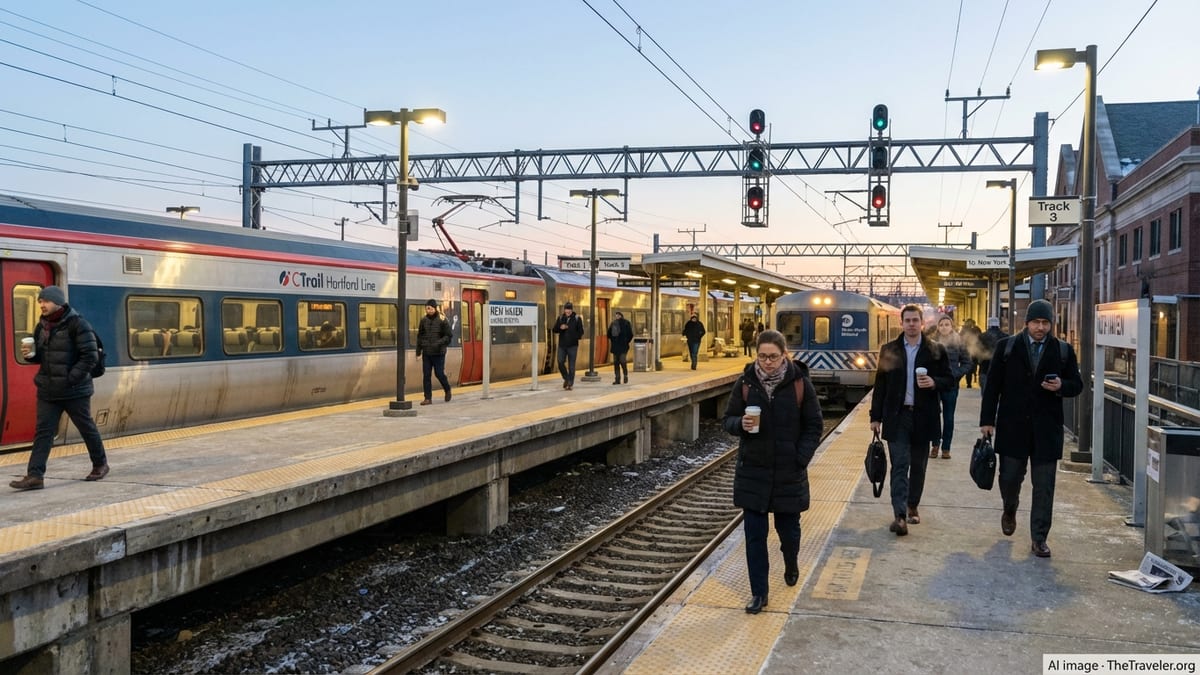
Understanding Connecticut’s Rail Network
Connecticut’s train network is built around three core service families: Amtrak’s intercity trains, the state-branded CTrail services, and Metro-North’s New Haven Line. Together they serve dozens of stations from Greenwich on the New York border to New London on the eastern shoreline and north up to Springfield, Massachusetts. For most travelers the question is not whether there is a train, but which operator and route offer the best combination of time, cost, and convenience.
Amtrak’s Northeast Corridor and its New Haven–Springfield route provide the backbone for long-distance and regional trips. The state of Connecticut, through CTrail, funds two key commuter-focused services that run over those same tracks: the Hartford Line between New Haven and Springfield and Shore Line East between New Haven and New London. Meanwhile, Metro-North Railroad operates intensive commuter service on the New Haven Line between New Haven and Grand Central Terminal in Manhattan, including several branch lines within the state.
Although multiple brands share some of the same tracks and stations, riders experience them as a single, interconnected system. In practice that means you can often board an Amtrak or CTrail train with the same ticket on certain corridors, transfer between CTrail and Metro-North on through tickets, and use local buses with add-on “Plus Bus” products. That integration has gradually improved in recent years, even as agencies adjust fares and schedules to keep pace with ridership and budget pressures.
For visitors, the variety of services can initially be confusing. A station like New Haven Union Station sees Amtrak, CTrail, Shore Line East and Metro-North trains, each with different fare structures and ticketing tools. Once you understand the basic geography and how the brands divide the work, though, planning trips becomes much easier.
Major Routes and Where They Go
Most rail journeys in Connecticut fall into three geographic corridors. Along the shoreline, the Northeast Corridor hosts frequent Amtrak trains and Shore Line East commuter runs linking communities between New Haven and New London, with connections onward to Providence, Boston, and New York. Inland, the Hartford Line parallels Interstate 91 from New Haven through Meriden, Berlin, Hartford, Windsor, and Windsor Locks to Springfield. To the southwest, Metro-North’s New Haven Line follows the coast between New Haven and the New York State line, serving major hubs such as Bridgeport and Stamford along the way.
The Hartford Line is a particular success story for regional rail. Operated as a partnership between Amtrak and CTrail, it offers frequent service throughout the day using a mix of state-supported CTrail trains and Amtrak Shuttles or Regional trains. Riders between New Haven and Springfield benefit from the “one-ticket/any train” arrangement, under which most Amtrak Springfield trains honor CTrail Hartford Line tickets and vice versa, subject to seat availability. That flexibility gives travelers more departure choices without forcing them to learn multiple fare systems.
On the shoreline east of New Haven, Shore Line East focuses on commuter and regional trips. Trains run between New Haven and New London, stopping at communities such as Guilford, Madison, Clinton, Westbrook and Old Saybrook. Some trains extend west of New Haven at peak times, but many riders connect there to Metro-North or Amtrak services for onward journeys. Because it shares the Northeast Corridor, Shore Line East offers attractive travel times, but schedules can vary depending on ongoing track work and seasonal demand.
In southwestern Connecticut, Metro-North’s New Haven Line provides dense commuter rail service into Manhattan. Stations from New Haven, Milford, Stratford and Bridgeport through Fairfield, Norwalk, Stamford, Darien, and Greenwich see a combination of local, semi-express, and in some cases new “super express” trains. Recent timetable changes have trimmed journey times between New Haven and Grand Central Terminal by up to around ten minutes on select express runs, making rail even more competitive with driving for daily commuters.
Tickets, Fares and Recent Changes
Ticketing strategy in Connecticut depends on how often you ride and whether your trip stays within a single corridor or crosses between services. For the Hartford Line, CTrail sells one-way, ten-trip, weekly, and monthly tickets, plus school monthly products for younger students. The system does not sell traditional round-trip tickets, so travelers purchase two one-way tickets instead, each valid in either direction on the route between the listed stations. Regular riders often gravitate toward ten-trip or monthly passes, which are structured to deliver better value than buying individual journeys.
Hartford Line fares vary based on distance between stations, but a few broad rules help. One-way tickets are valid for a limited window, typically around two months, while ten-trip tickets remain valid for about six months from purchase. Monthly tickets provide unlimited rides between the specified stations for a full calendar month, and new passes generally go on sale around the final week of the preceding month. School monthly tickets offer discounted travel for students 18 and under commuting to primary or secondary school, with proof of age and school identification required on board.
Discounts play a significant role across the network. On the Hartford Line, up to four children aged roughly 2 to 12 can ride with a paying adult for about one dollar each per trip, with additional children paying around half the adult fare. Children under age two travel free when accompanied. Seniors and riders with qualifying disabilities are typically eligible for approximately half-price one-way tickets with the appropriate identification. Personal care attendants can ride free when accompanying a passenger with a disability on CTrail Hartford Line trains. Other operators, including Amtrak and Metro-North, maintain their own discount structures, so travelers connecting between services should check each provider’s rules.
Connecticut riders should also be aware of recent and upcoming fare increases. Beginning in September 2025, CTrail Hartford Line, Shore Line East and Connecticut riders on Metro-North began seeing around a five percent fare rise, part of a two-step, roughly ten percent increase scheduled to continue into mid-2026. State transportation officials have framed the change as a way to help close budget gaps while preserving train frequencies. While the increases are significant for regular commuters, they are smaller than the potential cost of widespread service cuts, and agencies have signaled that protecting core schedules remains a priority.
How and Where to Buy Your Tickets
Buying train tickets in Connecticut has become substantially more flexible over the last few years. For the Hartford Line and Shore Line East, the CTrail eTix mobile app is the primary digital tool. Available for major smartphone platforms, it allows riders to purchase one-way, ten-trip, weekly, monthly, and some combined UniRail tickets, and to activate them before boarding. Weekly tickets typically become available midweek for the following Saturday through Friday period and may auto-activate at the start of their validity window, so it is worth paying attention to purchase dates.
At many stations, ticket vending machines provide an alternative to the app. These machines generally accept credit and debit cards as well as mobile wallet payments and cash. Passengers can buy most standard ticket types at these kiosks, including UniRail tickets that combine CTrail Hartford Line travel with either Metro-North’s New Haven Line or CTrail Shore Line East. This product is particularly useful for commuters who need a seamless ticket from inland cities such as Hartford or Meriden to job hubs along the coast or in New York City.
On-board ticket purchase is possible but best treated as a backup rather than the default. Conductors on CTrail Hartford Line trains can sell one-way tickets for passengers boarding without a valid fare, typically with a small surcharge. Riders paying on board are asked to have exact change or small bills, and only basic one-way tickets are available. If that rider then connects to a Metro-North New Haven Line train without having purchased a connecting ticket in advance, they may face another surcharge when buying on board the second train. Planning ahead usually saves money and avoids last-minute stress.
For trips involving Amtrak, long-distance segments, or premium services, it is generally essential to buy tickets directly through Amtrak’s own channels. Although Hartford Line tickets are honored on most Amtrak Springfield trains between New Haven and Springfield, long-distance trains such as the Vermonter require Amtrak-issued tickets. In busy periods, Amtrak trains can sell out reserved seats even on the corridor where CTrail operates, and in those cases conductors may not be able to honor CTrail tickets. Travelers should treat the one-ticket arrangement as a convenience that expands options rather than as a guarantee during peak demand.
Commuting and Connectivity: Metro-North and Local Links
For many Connecticut residents, the defining rail experience is the daily or occasional commute on Metro-North’s New Haven Line. The line links New Haven with Grand Central Terminal, serving every major shoreline community in between and offering transfers to branch lines toward New Canaan, Danbury and Waterbury. Peak service is designed around high-frequency, relatively fast runs into Manhattan in the morning and back to Connecticut in the evening. Off-peak trains still run regularly throughout the day and on weekends, making rail a viable option for leisure trips as well.
Recent investments have focused on both speed and on-board experience. Upgrades to signaling and track infrastructure have allowed Metro-North to introduce new super express trains that complete the New Haven to Grand Central journey in roughly an hour and a half on select runs. Those trains stop only at key hubs such as New Haven, Bridgeport, Stamford and then proceed directly to Manhattan, trimming around ten minutes or so from some previous express schedules. At the same time, a public-private partnership has funded improved wireless coverage along the corridor, with a network of new towers and small cells providing stronger LTE and 5G service for passengers using certain mobile providers.
Commuters who split their travel between CTrail and Metro-North can benefit from integrated products such as UniRail weekly and monthly tickets. These tickets, sold through CTrail vending machines, the CTrail eTix app, and Metro-North machines at many stations, combine Hartford Line segments with New Haven Line travel at a lower total cost than buying separate passes. For example, a rider commuting from Berlin to a job in Stamford can often travel on a single UniRail pass, simplifying both budgeting and the daily ticket-check process on board.
Local bus connections extend the reach of the rail network into neighborhoods away from stations. CTrail’s “Plus Bus” options on certain monthly tickets add local bus travel within cities such as Hartford, Meriden and New Haven. Some express bus routes, including the well-used service linking New Haven and Hartford along the interstate, accept specific Hartford Line rail tickets for through travel between designated stops. Although individual bus fare rules can be intricate, the overall trend in recent years has been toward closer coordination between rail and bus, with a view to presenting riders with a single, coherent network.
Planning Around Construction, Weather and Service Changes
Rail travel in Connecticut is generally reliable, but riders benefit from staying alert to temporary changes. The Hartford Line, in particular, has been the focus of significant infrastructure work, including projects to improve interlockings, bridges and new station facilities such as the one at Windsor Locks. During intense work periods, especially over weekends, the state and Amtrak have periodically replaced some or all Hartford Line trains with buses on sections of the route. When that happens, buses typically serve all intermediate stations and honor existing rail tickets, but journeys can take longer because of highway traffic and boarding times.
Shore Line East and Metro-North also see occasional schedule adjustments for track work. On the busy Northeast Corridor, infrastructure projects can lead to altered stopping patterns, reduced frequencies or modified departure times, sometimes announced only a few weeks in advance. Commuters may find that a familiar train becomes a bus connection for part of the journey on select weekends, or that some late-night or early-morning trips are temporarily suspended. Checking schedules before each trip, rather than relying solely on memory, is a practical habit.
Weather is another factor that can affect train operations, especially in winter. Heavy snowstorms and coastal storms have led agencies to reduce frequencies, operate on special schedules, or temporarily suspend sections of service for safety reasons. During severe events, officials often urge riders to avoid nonessential travel, and may shut down both rail and bus services until conditions improve. Because service restoration can be gradual and uneven across lines, riders should pay close attention to agency alerts and be prepared for crowding on the first trains back.
In response to these challenges, Connecticut agencies and Amtrak have expanded their use of digital tools and real-time updates. Official websites, smartphone apps and social media feeds now commonly provide alerts about weekend construction blocks, bus substitutions, weather-related service reductions and significant incidents along the line. While perfection is elusive, these tools give rail users much more timely information than in the past. Savvy travelers combine them with traditional strategies such as allowing extra time for tight connections and traveling earlier in the day when schedules are disrupted.
Practical Tips for a Smooth Trip
A bit of preparation goes a long way when traveling by train in Connecticut. Whenever possible, check the latest schedule for your specific date, pay attention to service advisories, and confirm whether any part of your journey involves a substitute bus. If you rely on the Hartford Line, Shore Line East or Metro-North for daily commuting, it is worth signing up for email or text alerts tailored to your usual routes, so that overnight changes or early-morning incidents reach you before you leave home.
Arriving at the station early is another simple but effective habit. At major hubs such as New Haven Union Station, Hartford Union Station, Stamford, and Bridgeport, platforms can be busy in peak periods and trains may board from different tracks depending on operations. Giving yourself ten to fifteen extra minutes allows time to find the correct platform, purchase or activate your ticket, and position yourself near the appropriate car. On lines where doors do not open at every car for shorter platforms, conductors may direct you to move through the train, so being a bit early reduces the rush.
On board, keep your ticket or mobile pass ready for inspection and respect conductor instructions about seating, quiet cars and safety. If you are using a mobile ticket, make sure your phone is charged and that the QR code or activation screen is accessible even if wireless coverage momentarily drops. For families, the generous child discount policies on CTrail and some connecting services can make rail a cost-effective and more relaxed option than driving, especially on busy weekends when traffic around coastal towns or shopping destinations can back up for miles.
Finally, think about how you will complete the “last mile” at each end of your trip. Many Connecticut stations provide bike racks, parking garages or shared-mobility zones, and an increasing number are served by local buses whose timetables are coordinated with peak-hour trains. In urban centers, walking routes from stations to nearby offices, hotels and attractions are usually straightforward, and staff at station information points can often suggest the simplest path. Planning those short segments in advance turns what might have been a stressful transfer into an easy, predictable part of the journey.
The Takeaway
Train travel in Connecticut offers a compelling mix of speed, convenience and environmental benefits, linking key cities and towns along both the shoreline and the Connecticut River Valley. With Amtrak, CTrail and Metro-North working together more closely than in the past, riders enjoy better integration across services and more options for tickets that match their travel patterns. At the same time, recent fare adjustments and ongoing construction underscore the importance of planning ahead and staying informed.
Whether you are a daily commuter from Stamford, an occasional traveler heading from Hartford to New Haven, or a visitor using the rails as part of a wider New England itinerary, understanding how the system is structured pays dividends. Knowing when a Hartford Line ticket will be accepted on an Amtrak train, how UniRail passes can simplify multi-operator commutes, or why a particular weekend involves bus substitutions can make the difference between a smooth journey and a frustrating one.
As rail agencies continue to invest in faster schedules, better wireless coverage and upgraded stations, the trajectory for Connecticut’s trains is broadly positive. For travelers willing to learn the basics of routes, ticket types and service patterns, the network opens up the state in a way that is hard to match by car alone. With a bit of preparation and a flexible mindset, the rails of Connecticut can become a reliable backbone for work, school, and leisure trips alike.
FAQ
Q1. What are the main train routes in Connecticut?
The primary routes are the Hartford Line between New Haven and Springfield, Shore Line East between New Haven and New London, and Metro-North’s New Haven Line into New York City, supplemented by Amtrak’s regional and long-distance services.
Q2. Do I need separate tickets for CTrail and Amtrak on the Hartford Line?
Most Amtrak Springfield trains between New Haven and Springfield accept CTrail Hartford Line tickets, and Hartford Line trains accept valid Amtrak tickets on that corridor, but long-distance trains such as the Vermonter require Amtrak-issued tickets.
Q3. How have train fares in Connecticut changed recently?
Beginning in late 2025, fares on CTrail Hartford Line, CTrail Shore Line East and Connecticut riders on Metro-North started to rise by roughly ten percent in two phases to help close funding gaps while preserving service levels.
Q4. What is a UniRail ticket and when should I use it?
A UniRail ticket combines travel on CTrail Hartford Line with either Metro-North’s New Haven Line or CTrail Shore Line East on a single pass, typically at a lower combined price than buying separate tickets, making it ideal for commuters crossing between inland and shoreline routes.
Q5. Are there discounts for children, seniors and riders with disabilities?
Yes. On the Hartford Line, up to four children aged roughly 2 to 12 can ride for about one dollar each with a paying adult, additional children pay about half fare, seniors and many riders with disabilities usually receive approximately 50 percent discounts, and personal care attendants can often ride free when accompanying a passenger with a disability.
Q6. Is it better to buy tickets on the app, at machines, or on board?
The best value is usually through the CTrail eTix app or station ticket machines, which sell most ticket types without surcharges. Buying on board is possible but often includes a small extra fee and offers fewer ticket options.
Q7. How reliable is Connecticut train service during bad weather?
Service is generally resilient, but major snow or coastal storms can lead to reduced schedules, temporary suspensions, or bus substitutions. Agencies encourage riders to check real-time alerts and avoid nonessential travel during severe events.
Q8. How early should I arrive at the station before my train?
Arriving about ten to fifteen minutes before departure is a good rule of thumb, especially at larger stations, so you have time to find the correct platform, activate mobile tickets, and board without rushing.
Q9. Can I use my Connecticut train ticket on local buses?
Certain monthly Hartford Line tickets include a Plus Bus option for local bus travel in cities such as Hartford, Meriden and New Haven, and a few express bus routes accept specific Hartford Line tickets, but most bus services require separate fares unless explicitly bundled.
Q10. What is the fastest way to travel by train from New Haven to New York City?
The fastest regular option is usually a Metro-North super express on the New Haven Line, which on select runs completes the New Haven to Grand Central trip in roughly an hour and a half, stopping only at major intermediate stations.