

Arizona is a big state with even bigger distances. From the sprawl of metro Phoenix to the red rocks of Sedona and the Grand Canyon’s remote overlooks, how you move around can shape your entire trip. Understanding car rentals, public transit options and the realities of driving in the desert will help you build an itinerary that is both efficient and safe.
Getting Oriented: How Arizonans Get Around
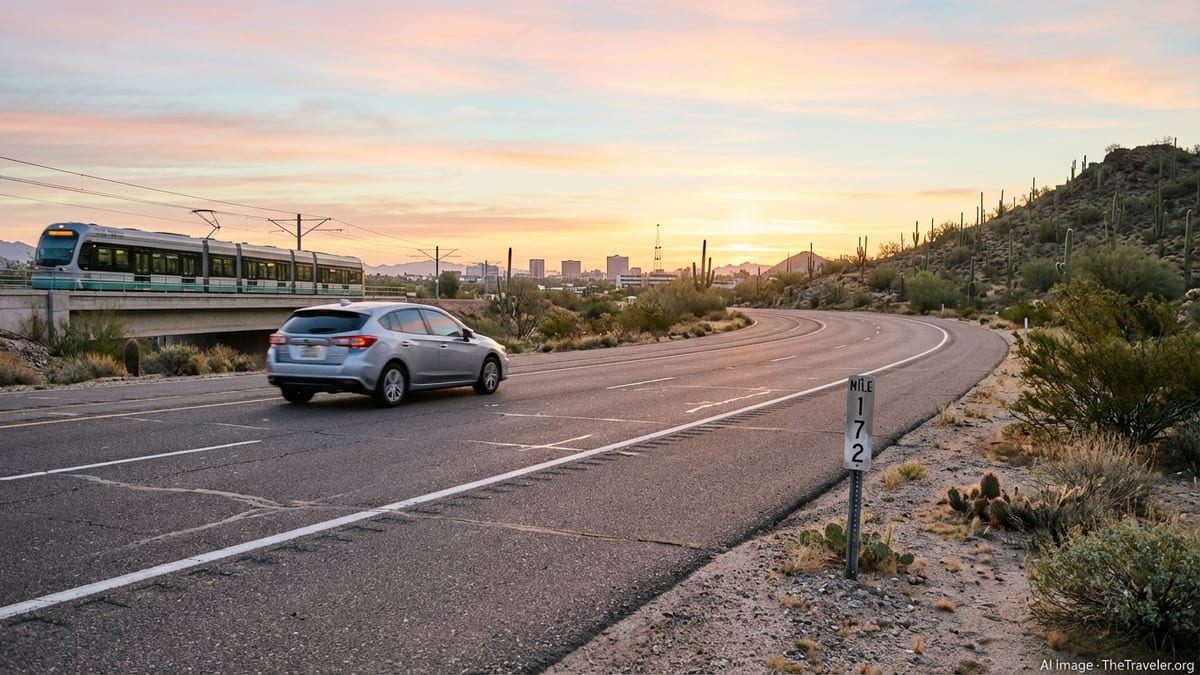
Arizona is built around the car. Outside a few core urban areas, low-density development and long distances mean that most residents and visitors rely on personal vehicles or rentals. Highways spread across the state like spokes, connecting Phoenix, Tucson, Flagstaff and smaller communities with national parks and tribal lands. For travelers, this often means that a rental car or car share is the most flexible way to explore, especially if you plan to visit multiple regions.
At the same time, Arizona’s largest cities have steadily expanded their public transportation networks. Phoenix and its surrounding Valley cities continue to invest in light rail extensions and bus service, while Tucson has modern streetcars and a regional bus network that links major neighborhoods and the University of Arizona. These systems work well for certain itineraries, especially if you plan to stay mostly in one metro area and along busy corridors.
Because of the desert environment, timing and preparation matter more than in many other destinations. Summer temperatures in Phoenix routinely climb above 100 degrees Fahrenheit, and monsoon storms can briefly make highways treacherous. Winter can bring snow and ice at higher elevations around Flagstaff and the Mogollon Rim. Thinking ahead about fuel, water, and route choices is just as important as deciding whether you will rely on a car, transit, rideshare or a mix of all three.
Before you finalize your travel plans, it helps to understand what each transportation mode can realistically offer. From age rules on car rentals to the latest hands-free driving laws and the frequency of local trains and buses, a little knowledge will make your Arizona trip smoother and safer.
Car Rentals in Arizona: What Travelers Need to Know
Arizona’s airports are major gateways for rental cars. Phoenix Sky Harbor International Airport serves as a hub for all major national brands, with a consolidated rental car center connected by shuttle. Tucson International Airport and Flagstaff Pulliam Airport also host multiple rental companies, although fleets there may be smaller and availability more limited at peak times such as spring training or winter holidays. In resort destinations like Scottsdale or Sedona, you will find a mix of airport desks, neighborhood branches and hotel delivery options.
Age requirements and fees are a key concern, especially for younger travelers. Most large companies in Arizona allow rentals starting at age 21 for standard vehicle classes, and a few will rent to drivers as young as 20 at specific locations. Drivers under 25 almost always pay a daily young renter surcharge, which can add a substantial amount to the bill over a week-long trip. Policies on minimum age, fees and vehicle restrictions change regularly, so it is wise to check the current details for your exact pickup location before you book.
Rates vary widely depending on season, demand and vehicle type. Phoenix can be busy during winter visitor season, Cactus League spring training and major events, which often pushes prices up. Booking early, being flexible about pickup times and considering compact or mid-size vehicles can help manage costs. In some cases, peer-to-peer car-sharing platforms provide additional options, especially for renters who do not meet traditional age or credit requirements, though those services come with their own insurance and fee structures that should be reviewed carefully.
Standard rental contracts in Arizona typically include basic liability coverage, but collision damage waivers, supplemental liability and roadside assistance are often offered at the counter. Whether you need them depends on your existing auto policy, credit card benefits and risk tolerance. Many credit cards provide secondary collision coverage if you decline the rental company’s damage waiver, but they may exclude certain vehicle types or lengths of rental. Because long rural stretches and high summer temperatures can be hard on tires and batteries, it is worth paying attention to what roadside help is included so you know whom to call if something goes wrong.
Driving in Arizona: Laws, Conditions and Safety
Arizona’s driving laws are generally familiar to U.S. visitors, but there are some important details. A statewide hands-free law now makes it illegal to hold or support a mobile phone or similar device while driving. The law covers texting, scrolling, watching videos and other handheld uses. Drivers can still use phones in true hands-free mode, such as through dashboard mounts or Bluetooth systems, and they can tap to start or end a call or navigation, but police can stop and cite drivers seen holding a device while a vehicle is in motion. Fines increase for repeat offenses, and distracted driving can also lead to more serious charges if it results in a crash.
Speed limits on Arizona’s rural interstates are often higher than in many other states, and enforcement can be strict, particularly in work zones and near tribal communities. In cities, loops such as the 101, 202 and 303 around Phoenix carry heavy traffic at peak times, and congestion can build without much warning after crashes or dust storms. Defensive driving is essential, especially when merging onto fast-moving freeways or descending from high-elevation areas where grades are steep and runaway truck ramps are common.
Desert conditions present unique safety challenges. In the low deserts around Phoenix, Yuma and Lake Havasu City, summer heat can be extreme. It is prudent to carry extra water, keep your fuel tank comfortably above empty and check coolant and tire pressure before long drives. At higher elevations, including Flagstaff, Prescott and the White Mountains, winter storms can bring snow and black ice between late fall and early spring. Road closures and chain requirements are less common than in some mountain states, but sudden changes in traction can surprise drivers unaccustomed to winter conditions.
Arizona’s monsoon season, typically from mid-June through late September, adds another layer of complexity. Brief but intense thunderstorms can create localized flooding and spawn dust storms that sharply reduce visibility on highways like I-10 and I-8. State safety campaigns advise drivers to pull entirely off the road if they encounter a dust wall, turn off lights and take feet off the brake to avoid being mistaken for a moving vehicle. Flash floods in normally dry washes can also cut off side roads, especially in remote or canyon areas. Paying attention to weather forecasts and avoiding low-lying crossings after heavy rainfall can greatly reduce risk.
Key Routes, Scenic Drives and Long-Distance Travel
For many visitors, Arizona’s highways are part of the adventure. Interstate 10 connects Phoenix to Los Angeles in the west and to New Mexico and Texas in the east, passing through desert landscapes and agricultural valleys. Interstate 17 climbs sharply north from Phoenix to Flagstaff, serving as the main corridor to Sedona, Prescott turnoffs and the high country. Interstate 40 runs east–west across the northern part of the state, overlapping historic stretches of Route 66 through communities such as Kingman, Seligman and Winslow.
Beyond the interstates, state routes offer some of the Southwest’s most memorable drives. State Route 89A between Sedona and Flagstaff winds through Oak Creek Canyon, combining tight curves, steep grades and sweeping views. State Route 64 provides access to the South Rim of the Grand Canyon from Williams and Flagstaff, while U.S. 89 serves as a major north–south spine to Page, Lake Powell and onward toward Utah’s national parks. These roads are generally well maintained but can be slow during peak tourist seasons or in winter weather.
Fuel and services are abundant along major corridors in and around Phoenix and Tucson, but they can be sparse in remote regions. Travelers heading toward the Navajo Nation, Monument Valley, the Arizona Strip or lesser-known backroads should not rely solely on the next town on the map having multiple gas stations or 24-hour services. Keeping at least a half tank of fuel, downloading offline maps and letting someone know your route and estimated arrival time are simple precautions that pay off in rural areas with patchy cell coverage.
For those who prefer to leave the driving to someone else, long-distance buses and tour companies connect many of Arizona’s most popular destinations. Intercity coach services typically link Phoenix, Tucson, Flagstaff and some border and reservation communities, with onward connections into neighboring states. Tour operators based in Phoenix, Las Vegas and gateway towns run day trips and multi-day tours to the Grand Canyon, Antelope Canyon and other landmarks, which can be useful for travelers uncomfortable driving mountain roads or renting a car.
Public Transit in Phoenix and Tucson
Greater Phoenix has the state’s largest public transportation system, operated by Valley Metro in partnership with member cities. The light rail system, now operating as a two-line network, runs through downtown Phoenix, east through Tempe and into Mesa, with recent extensions pushing service deeper into residential areas. Trains generally run every 12 minutes on weekdays during much of the day, with slightly less frequent service early mornings, late evenings and on weekends. Streetcar service in Tempe complements the light rail, particularly around Arizona State University and nearby districts, and has seen improved frequency in recent service updates.
Valley Metro’s bus network fills in where the rails do not reach, covering major arterial streets across the metro area. High-frequency routes connect downtown Phoenix to surrounding suburbs, employment centers and shopping corridors, while express and rapid buses use freeways to move commuters during peak hours. For visitors staying near the rail line or along major bus corridors, transit can be an efficient way to reach downtown attractions, sports venues, campuses and the airport train connection without worrying about parking or traffic.
Tucson’s transit is anchored by Sun Tran, the regional bus system, and Sun Link, a modern streetcar line that runs between the University of Arizona, downtown Tucson and the west side of the city. Recent updates include a new mobile app designed to provide real-time tracking, trip planning and service alerts, making it easier for riders to see bus occupancy and adjust their plans. The bus network reaches many residential areas and key destinations, though headways can be longer than in Phoenix, so planning around schedules remains important.
Fares in both Phoenix and Tucson are generally affordable by national standards. Riders can pay per trip, use passes or, in some cases, tap smart cards and mobile tickets for convenient transfers. Free or reduced fares may be available for youth, seniors and people with disabilities through local programs, subject to eligibility rules. Service levels and fare structures can and do change, often as cities respond to ridership trends, budget conditions and federal funding, so checking the latest information shortly before your trip is always wise.
Without a Car: Rideshare, Taxis and Micro-Mobility
Travelers who prefer not to drive have more options in Arizona’s urban centers than in rural areas. Rideshare services operate across Phoenix, Tucson and many surrounding communities, providing convenient point-to-point transportation at virtually any hour. Wait times are usually short in central neighborhoods and around airports, though they can lengthen during large events, late-night hours or in more distant suburbs. Traditional taxis are available at airports, major hotels and some downtown stands, and can be booked by phone or dedicated apps in the larger cities.
Within central Phoenix, Tempe and downtown Tucson, short trips can sometimes be covered by micro-mobility options such as shared e-scooters and bikes, depending on current city regulations and vendor contracts. These services tend to cluster around dense pockets with bars, restaurants, campuses and entertainment districts and may be paused or limited in certain areas for safety or parking reasons. Riders are generally expected to follow local traffic laws, yield to pedestrians and avoid riding on sidewalks where prohibited.
For travelers with mobility impairments or specific accessibility needs, both Valley Metro and Sun Tran provide paratransit services that offer door-to-door or curb-to-curb transportation within certain service areas and times. Eligibility usually requires an application and verification process, which is easier to complete if you plan ahead. Many standard bus and rail vehicles are also equipped with ramps, priority seating and space for mobility devices, but it is sensible to confirm accessibility details and operating hours in advance if you will rely heavily on these services.
Even if you plan to rent a car for most of your trip, combining modes can make sense. You might drive between cities, then park at a hotel and use light rail, buses or rideshare to move around busy downtown cores where parking is expensive and traffic is dense. In college areas such as Tempe or around the University of Arizona, a mix of walking, transit and occasional rideshare trips it often more efficient than hunting for short-term parking with a rental car.
Practical Tips for Safe, Smooth Driving
Whether you are a visitor or a new resident, a few habits will make driving in Arizona more comfortable. First, respect the climate. In summer, avoid leaving people or pets in parked cars, even for a few minutes, and use sunshades to reduce interior temperatures. Check your rental or personal car for a functional spare tire, jack and basic emergency kit, including water. If you are heading into remote areas, consider carrying extra drinking water per person, sun protection and a paper map in case your phone loses signal or battery power.
Second, plan your timing. In Phoenix, weekday rush hours can make key freeway segments slow, particularly on approaches to downtown and along sections of I-10, I-17 and the Loop system. If you have flexibility, traveling outside typical commuting windows can trim significant time from your drive. In northern Arizona, winter daylight is short and wildlife crossings more common at dawn and dusk, so scheduling longer drives in the middle of the day improves visibility and reduces stress on unfamiliar mountain roads.
Third, take local hazard warnings seriously. Signs that say “Do Not Enter When Flooded” or “Zero Visibility Possible” reflect real risks, especially during monsoon season. Never attempt to drive through moving floodwaters, even if the water appears shallow; depths can be deceptive and road surfaces may be damaged beneath the flow. If you encounter a dust wall or heavy storm, slowing down early, increasing following distance and exiting the highway entirely when safe are better options than pressing forward with limited visibility.
Finally, stay attentive to evolving rules. Enforcement of hands-free laws, impaired driving regulations and speed limits remains a priority for state and local agencies, and campaigns throughout the year remind drivers of their responsibilities. Technology in vehicles is advancing quickly, but systems marketed as driver assistance still require full human attention under Arizona law. Treat cruise control, lane keeping and similar features as aids, not replacements, and keep your hands on the wheel and eyes on the road regardless of how modern your rental might be.
The Takeaway
Getting around Arizona rewards a bit of advance planning. For many itineraries, especially those that link Phoenix, Tucson, Sedona, Flagstaff and the Grand Canyon, a rental car offers the greatest freedom to stop where you like and travel on your own schedule. Understanding age requirements, insurance choices and the realities of desert driving helps you budget accurately and avoid unwanted surprises at the rental counter or on the highway.
At the same time, Arizona’s public transit systems in Phoenix and Tucson can be valuable tools, particularly if you are staying along light rail or major bus corridors and want to bypass parking headaches in busy urban cores. Combining transit, rideshare and walking for local trips, then using a car only when you truly need it, can reduce both costs and stress. For travelers who cannot or prefer not to drive, tour operators, intercity buses, rideshare and micro-mobility fill in many gaps, especially in the state’s largest cities.
Safety should anchor every decision. From respecting hands-free laws to preparing for monsoon storms and high-country snow, being realistic about conditions and your own comfort level will keep your journey enjoyable. As long as you choose the right mix of transportation for your plans, allow extra time for long distances and listen to what the desert and the weather are telling you, Arizona’s roads and rails will carry you to some of the most striking scenery in the American Southwest.
FAQ
Q1. Do I really need a car to visit Arizona’s major attractions?
In most cases a car is the most flexible way to link multiple regions, but you can combine tours, intercity buses, transit and rideshare if you stay mostly in cities and on well-served tourist corridors.
Q2. What is the minimum age to rent a car in Arizona?
Most large rental companies rent to drivers 21 and older, and a smaller number allow rentals starting around age 20 at specific locations, usually with daily underage surcharges.
Q3. Is it legal to use my phone while driving in Arizona?
Arizona law generally prohibits holding or supporting a phone or similar device while driving, although limited hands-free use through mounts or integrated systems is allowed.
Q4. How bad is traffic in Phoenix and Tucson?
Traffic in Phoenix can be heavy during weekday rush hours and around special events, while Tucson usually has moderate congestion; timing your drives outside peaks helps significantly.
Q5. Is public transit in Phoenix good enough for visitors without a car?
If you stay near the light rail, Tempe streetcar or major bus corridors, Valley Metro can work well for many city trips, though service thins out late at night and in outlying suburbs.
Q6. Can I rely on buses and trains to reach the Grand Canyon?
There are limited intercity buses and tour services to the Grand Canyon, but schedules are infrequent, so many visitors find renting a car or joining an organized tour more practical.
Q7. What should I know about driving during Arizona’s monsoon season?
Expect brief but intense storms, possible dust walls and flash flooding; check forecasts, avoid flooded crossings, and be prepared to pull off the road and wait conditions out.
Q8. Are Arizona roads dangerous in winter?
Low desert areas usually stay clear, but high-elevation routes near Flagstaff, the Mogollon Rim and mountain passes can see snow, ice and occasional closures, especially overnight.
Q9. How safe is it to drive long distances between Arizona cities?
Interstate and major state highways are generally well maintained, but distances can be long and services sparse in some stretches, so carrying water, keeping fuel topped up and resting often are important.
Q10. Are rideshare and taxis widely available in Arizona?
Rideshare and taxis are common in Phoenix, Tucson and larger towns, but availability drops sharply in rural areas, so travelers there should not rely on them as a primary option.