

Before I ever set foot in Venice, I felt like I already knew the city. Not from guidebooks, but from arguments. In Facebook travel groups, on Reddit threads, at hostel bars from Tulum to Tbilisi, Venice was the destination that always split the room. Half the travelers called it a magical fever dream that everyone should see once in their lives. The other half warned it had become an overcrowded theme park that should be avoided entirely. After years of listening to both sides, I finally went to see for myself. Now I understand why this city keeps starting fights among people who love travel more than anything.
The City Everyone Thinks They Know
Venice is one of those places that exists in your imagination long before you arrive. For most of us, the mental slideshow is predictable: a gondola gliding under the Rialto Bridge, a couple sipping spritzes by the Grand Canal, a masked figure at Carnival disappearing into the fog. Social media has only intensified that fantasy. Scroll Instagram in high season and you will see the same shot over and over: someone in a flowing dress on the edge of a canal, no one else in sight, the city seemingly theirs alone.
The reality hits early, usually at Santa Lucia train station. I arrived on a bright September afternoon and walked out into a solid wall of people. Suitcases clattered over stone, tour leaders held aloft colored umbrellas, and the vaporetto queues for the number 1 and 2 lines spilled across the entire waterfront. The famous view of the Grand Canal was still there, gleaming and impossible, but it was framed by selfie sticks, rolling bags, and families trying to keep each other in sight.
In recent years Venice has become one of the world’s textbook examples of overtourism. The city of around 50,000 residents now welcomes millions of visitors each year, with day trippers arriving by train, bus, and cruise ship. Authorities have tried to push back by banning large cruise ships from the historic center, limiting tour group sizes, and introducing a variable day-tripper fee on peak days, generally between about 5 and 10 euros depending on demand. Yet the crowds keep coming, and Venice keeps dividing opinions like almost no other destination I have visited.
By the time I checked in to my small guesthouse near Cannaregio, I had the same question everyone else seems to have about Venice: is it still worth it, or has it crossed an invisible line from living city to open-air museum?
When the Postcard Is Real
My first morning in Venice, I set an alarm for 5:30 a.m. I had read endless advice from repeat visitors insisting that the only way to find the city’s soul was to beat the day trippers out of bed. When I stepped into the alley, the air was cool and smelled of damp stone and coffee. Shop shutters were still down. The only other people around were workers rolling delivery carts over bridges and a man in a navy jacket folding linen into the back of a small boat.
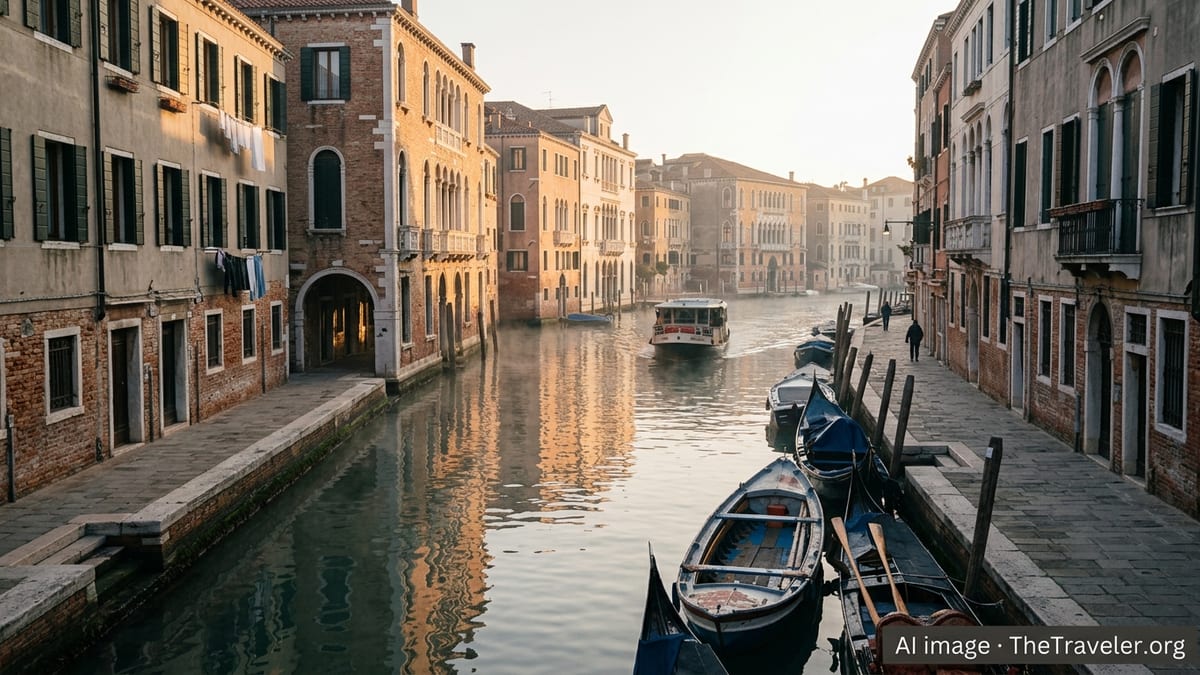
By the time I reached the Rialto Bridge, the sky was turning milky pink. The empty stone steps looked like a movie set after everyone had gone home. Below, the Grand Canal was almost still. A single vaporetto slid past, leaving long ripples against the moored water taxis. Without the crowds and the chatter, the details finally came into focus: the chipped paint on the palazzi, laundry hanging above a side canal, the sound of a church bell echoing off water and stone.
Later that morning, I crossed St Mark’s Square just as a tour group arrived behind me following a raised flag. Within ten minutes, the square transformed. More groups poured in from the waterfront, each clustering in tight circles as guides explained the history of the basilica through whisper headsets. Cafes that had been half empty at 8 a.m. were now filling with visitors paying premium prices for coffee and a seat at one of Europe’s most famous piazzas.
This is when the arguments about Venice start to make sense. If you see the city only in that late morning crush around St Mark’s and the Rialto, it is easy to dismiss it as a tourist factory that no longer resembles a real place. But if you also get to drift through the calli at sunrise or walk home through Castello late at night when you mostly hear locals talking from open windows, a different Venice emerges. Both versions are true, and most travelers only ever meet one.
The Overcrowded Theme Park, Up Close
I had promised myself I would not get cynical about Venice, but the city does not make it easy. Around noon one day, I followed the classic route from the train station down toward the Rialto, then on to St Mark’s. It is the same path taken by an overwhelming share of first-time visitors, and you can feel it in your body. The streets funnel into narrow corridors where you move at the speed of the slowest person in front of you. Hand-painted signs on the walls read “Per Rialto” and “Per San Marco” and the crowd follows them like a current.
On that walk I counted three shops in a row selling the same stack of cheap carnival masks and plastic gondolas. Many of the traditional artisan stores that once defined Venice have given way to fast souvenirs and generic fast food. One local I spoke to in a small bacaro near the Arsenale told me his rent had doubled in five years, driven up by the growth of short-term vacation rentals. He served me a plate of cicchetti for a few euros each and shrugged when I asked if he thought tourism would ever slow down. “They keep coming,” he said, “so the city keeps changing.”
Official efforts to manage the flow can feel invisible when you are trapped in a crowd on the bridge to the Rialto market. Venice’s day-tripper fee, which on many peak dates is set at 5 euros for anyone entering the historic center without an overnight booking, is a symbolic attempt to make visits more sustainable, but it has not dramatically reduced visitor numbers. Locals complain of crowded vaporetti, overflowing trash, and an old town that feels more like a backdrop for influencer videos than a neighborhood.
From a traveler’s perspective, the pressure shows up in other ways too. Basic rooms in central Venice commonly top 200 euros a night in high season, and a simple sit-down lunch near major sights can easily cost three times what you would pay in less visited Italian cities. Gondola rides, officially regulated at a standard rate, can still come with informal “extras” once you are seated. It is these everyday frictions that leave some visitors feeling they have overpaid for an experience that did not match the dream in their heads.
The Moments That Silenced My Inner Critic
And yet, for every frustrating moment, Venice gave me something I will be thinking about for years. One afternoon, I skipped the main thoroughfare and wandered north toward the quiet backstreets of Cannaregio. I crossed a narrow bridge where two schoolkids were sitting with their feet dangling over the side, arguing in rapid Italian. Around the corner, an old woman was watering geraniums on a windowsill. I stopped at a tiny bar where a glass of local wine and a crostino topped with baccalà mantecato cost less than a takeaway coffee near St Mark’s.
Later that day, I boarded a public vaporetto out toward the outer islands. The ride itself felt like a crash course in daily Venetian life: commuters with grocery bags, a pair of workers in neon vests, tourists packed in with phones held high. As we pulled away from the dense maze of the historic center, the perspective shifted. Venice from the water looks fragile and improbable, a cluster of stone and brick barely hovering above the lagoon.
On my last evening, I joined the slow parade of locals and visitors doing passeggiata along the Zattere promenade. The light turned golden, and the church facades across the canal glowed. A group of teenagers practiced skateboard tricks near the water; a dog trotted along licking quickly melting gelato from a child’s hand. It was somehow both ordinary and surreal. I realized that the people who swear Venice is the most beautiful city in the world are not necessarily blind to its problems. They have just had enough of these small, piercingly perfect moments to tip the scale in its favor.
Standing there, I understood that both the love letters and the angry rants about Venice are written about the same place. The difference is often timing, expectations, and whether you are willing to walk even two streets away from the main flow.
How Venice Forces Travelers to Pick a Side
I have noticed that travelers rarely sound neutral about Venice. Mention Lisbon or Vancouver and you will hear measured opinions. Mention Venice and voices sharpen. It has become a kind of Rorschach test for what people value when they travel. If you crave authenticity, local life, and space to breathe, it is easy to see only the cruise groups and the trinket stands and declare the city “ruined.” If you think of travel as a chance to stand before the world’s great icons, you might argue that some crowding and commercialization are a small price to pay for the chance to watch the sun hit the domes of Basilica di Santa Maria della Salute.
Part of the divide comes from how different your experience can be depending on practical choices. Travelers who visit for a few hours on a summer weekend, stepping off a bus or a cruise ship around 10 a.m. and leaving before sunset, will mostly encounter the city at its most strained. They will queue for entry to St Mark’s Basilica, jostle for a photo on the Rialto, and search in vain for a reasonably priced lunch with a canal view.
By contrast, those who stay two or three nights in a neighborhood like Castello or Dorsoduro, walk the long way around to avoid the busiest arteries, and use early mornings or late evenings for the headline sights, often come away with a completely different story. They are more likely to chat with a barista who remembers their face, stumble upon a quiet campo where children play soccer, or find a workshop where a craftsman still repairs gondolas by hand.
Venice also brings big ethical questions uncomfortably close. The same tourism that has helped keep its churches restored and its waterbuses running has also pushed locals out and strained the lagoon. Some travelers respond by boycotting the city altogether, choosing smaller lagoon towns or less famous Italian cities instead. Others decide that the best response is not to avoid Venice but to show up differently: staying in locally owned accommodation instead of anonymous chains, visiting in shoulder seasons, and accepting that they might have to pay a small entry fee because the city simply cannot absorb infinite visitors without consequence.
Planning a Visit When Opinions Are This Split
When I started planning my own trip, the conflicting advice was dizzying. A friend who had visited in July said he would never go back, citing thirty-minute queues for crowded vaporetti and walkways so packed that his family could not keep their child’s stroller moving. Another friend who traveled in late October called it the highlight of her year and sent me photos of near-empty canals in the morning mist. They were in different cities, but the GPS tags insisted otherwise.
In the end, I treated Venice not like an item to “tick off” but like a fragile place I would be borrowing for a few days. I booked a small family-run guesthouse in a residential area, accepted that my nightly rate would be higher than in nearby mainland Mestre, and chose dates outside the August crush. I bought a multi-day vaporetto pass instead of relying on single tickets, which made it easier to explore quieter corners like the island of Giudecca without overthinking each fare.
On the ground, I tried to follow the kind of common sense guidelines that residents and responsible tourism groups have been repeating for years. I carried my trash until I found a bin, avoided blocking bridges and narrow alleys to check maps, and skipped any restaurant where staff stood outside waving laminated menus with photos. Instead, I looked for blackboards with handwritten specials in Italian and a mix of locals and visitors at the tables, even if that meant walking five or ten minutes away from the main sights.
None of this guaranteed a perfect experience. There were still crowded moments, overpriced coffees, and a few side streets where vacation rentals seemed to outnumber permanent homes. But those adjustments tilted the balance enough that I could glimpse the Venice so many travelers are still willing to defend in long comment threads: a vulnerable, extraordinary city that can still move you if you meet it halfway.
The Takeaway
By the time I wheeled my bag back to the train station, my feelings about Venice were as mixed as the conversations that had pushed me there in the first place. I understood the people who say the city is overrun and overcommercialized. I had walked through those bottlenecked streets and winced at the souvenir stalls that felt indistinguishable from those in any other overvisited city on earth.
But I also understood the people who speak about Venice in almost embarrassingly romantic terms. I had watched dawn break over the Grand Canal, listened to the echo of footsteps in an empty campo, and eaten simple seafood pasta that tasted like it had been invented that morning. I had watched a local father guide his toddler over a bridge, pointing to the boats below as if rehearsing a story his family had told for generations.
In the end, Venice is polarizing precisely because it is still extraordinary. If it were truly “ruined,” no one would bother arguing about it. We debate this city because it forces us to confront what we expect from travel in an age where almost everywhere is accessible and almost everything is Instagrammed before we arrive. Do we want untouched places, or do we want famous ones? Are we willing to pay more, plan smarter, and accept a few rules to help fragile destinations survive?
Leaving Venice, I did not feel certain that everyone should go. But I did feel certain that, if you do, you owe it more than a rushed afternoon and a complaint about the crowds. Go early, stay late, choose carefully, and remember that behind every beautiful facade is a community trying to stay afloat in more ways than one.
FAQ
Q1. Is Venice still worth visiting given the overtourism?
Yes, Venice can still be deeply rewarding if you manage expectations, avoid peak dates and midday crowds, and spend time outside the busiest routes around St Mark’s and the Rialto.
Q2. When is the best time of year to visit Venice to avoid the worst crowds?
Generally, the shoulder seasons of late March to May and late September to early November offer fewer crowds than peak summer, though weekends and holidays can still be busy.
Q3. How can I experience a quieter side of Venice?
Stay in neighborhoods like Cannaregio, Castello, or Dorsoduro, explore early in the morning or late at night, and wander beyond the main signs pointing to the Rialto and St Mark’s.
Q4. What is the Venice day-tripper fee and will I have to pay it?
On selected busy days, visitors who do not stay overnight may need to pay a small entry fee to access the historic center. Overnight guests typically register through their accommodation instead.
Q5. Is it better to stay in Venice itself or on the mainland?
Staying in the historic center costs more but lets you experience early mornings and evenings when Venice is quieter. Mainland options like Mestre are cheaper but miss that atmosphere.
Q6. Are gondola rides in Venice really worth the price?
Gondola rides are expensive, but some travelers consider them a once-in-a-lifetime experience. Others prefer cheaper alternatives like riding public vaporetti along the Grand Canal.
Q7. How can I be a more responsible tourist in Venice?
Choose locally owned stays and restaurants, visit outside peak times, respect residents by keeping noise down, dispose of trash properly, and avoid blocking narrow bridges for photos.
Q8. Will I need to book major sights in advance?
It is wise to book timed entry for popular attractions such as St Mark’s Basilica or the Doge’s Palace, especially in high season, to reduce waiting times and guarantee entry.
Q9. Is Venice suitable for budget travelers anymore?
Venice can be expensive, but budget travelers can save by staying slightly farther from the main sights, using public transport passes, and eating at simple bacari instead of tourist menus on main squares.
Q10. How many days should I spend in Venice?
Two to three full days give enough time to see key sights, explore quieter neighborhoods, and take a boat trip to nearby islands without feeling rushed.