

More news on this day
American travelers heading into the busy spring and summer seasons are facing an unusually volatile mix of airport gridlock, European labor unrest and severe weather, as new disruptions emerge alongside lingering crises around the world.
Get the latest news straight to your inbox!
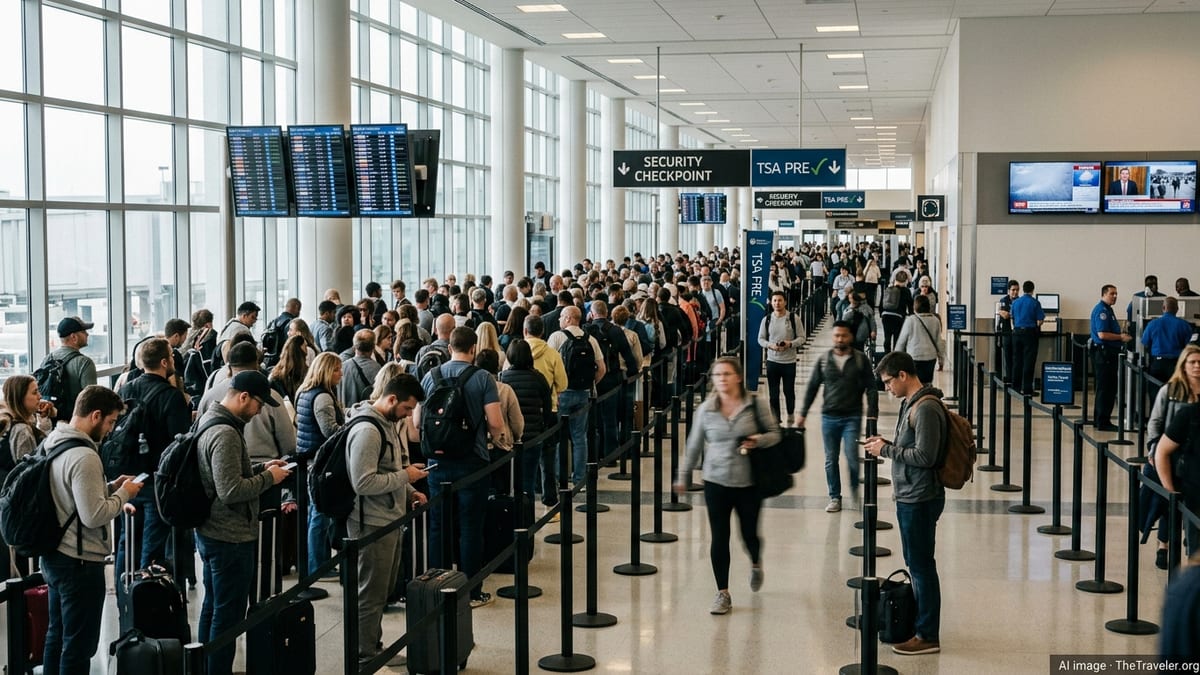
TSA Turmoil Extends Airport Waits Across the United States
A partial shutdown of the U.S. Department of Homeland Security that began in mid-February 2026 continues to strain Transportation Security Administration staffing at major airports, producing multi-hour security lines at peak times. Publicly available information shows that some large hubs, including Houston’s George Bush Intercontinental and Atlanta’s Hartsfield-Jackson, have reported wait times stretching toward three hours during busy periods as officers work without normal pay.
Recent federal actions directing emergency funding to TSA are expected to restore paychecks as early as Monday, March 30, 2026, according to published coverage, but analysts caution that the worst of the bottlenecks may not clear immediately. Travel experts cited in national reporting suggest it could take days or weeks for schedules, staffing and passenger patterns to normalize, especially as spring break and Easter traffic peaks.
Reports from local outlets and traveler accounts show a patchwork of conditions: some regional airports are operating close to normal, while others are contending with unpredictable surges and partial checkpoint closures. Industry groups have urged travelers to build in significantly more time for screening at major hubs and to pay close attention to airport and airline advisories as the shutdown continues.
Security practices are also in flux. In some locations, immigration officers have been redeployed to assist at airports, a move that has prompted debate about training and security protocols. While the measure is intended to relieve pressure on front-line TSA teams, aviation analysts warn that it underscores how fragile the system has become when funding lapses occur.
Spain’s Airport Strikes Enter a New Phase
In Spain, months of industrial action among ground-handling and baggage workers have evolved into a new wave of targeted stoppages in 2026, raising the risk of disruption at airports popular with American visitors. Strike-tracking services and European travel advisories show that previous nationwide rolling strikes by Ryanair’s handling contractor Azul Handling, affecting bases such as Madrid, Barcelona, Málaga and Palma de Mallorca, are feeding into a broader pattern of unrest.
While some of the most disruptive 2025 nationwide strikes officially ended on December 31, 2025, fresh tensions remain around pay, conditions and contract changes linked to airport operator tenders. More recently, attention has shifted to infrastructure-related action: a strike affecting the automated baggage-handling system at Madrid-Barajas began in March 2026 and is currently scheduled to occur every Thursday and Sunday through May 31, 2026. Advisories indicate that while flight operations are expected to continue, baggage delivery and transfers may be slower, particularly during busy bank holiday and summer getaway periods.
Regional coverage from Spain also highlights periodic strike calls at other major airports such as Palma de Mallorca and Milan-linked hubs that serve Spanish routes, with walkouts by ground staff and airport management personnel. Even when minimum service rules limit outright cancellations, passengers can face long waits at check-in and baggage claim, plus higher risks of missed connections.
For Americans planning summer trips to Spain, this creates a more complex risk landscape. Travel planners are advising staggered itineraries that allow additional time between connecting flights, greater use of carry-on baggage where possible, and careful monitoring of airline notifications in the days before departure, especially for routes reliant on low-cost carriers and third-party handlers.
Cyclone Threat in North Queensland and Wider Weather Risks
In the Southern Hemisphere, a tropical cyclone warning issued by Australia’s Bureau of Meteorology in mid-March 2026 for parts of North Queensland is the latest reminder that severe weather can quickly derail travel plans. The warning zone currently covers coastal stretches between Lockhart River and Cape Tribulation, with a broader watch area extending toward communities such as Kowanyama and Weipa, locations that serve as jumping-off points for reef and outback excursions.
Local reporting describes expectations of destructive winds, dangerous surf and heavy rainfall that could affect road access, regional flights and marine tourism, including trips to sections of the Great Barrier Reef. Even if the system weakens before landfall, flooding and debris can disrupt transport for days, particularly along low-lying coastal roads and remote airstrips that lack redundancy.
This cyclone alert arrives on the heels of other high-impact storms earlier in 2026, including a major blizzard in North America and a severe winter storm system in parts of northern Europe that temporarily shut rail lines and grounded flights. Together, these events highlight a season of heightened meteorological volatility that is complicating long-haul planning for travelers moving between hemispheres.
Travel risk specialists recommend that visitors heading to cyclone-prone regions in the coming weeks monitor official meteorological bulletins, confirm flexible booking options and avoid tight same-day transfers between international arrivals and domestic or ferry services. In some cases, travel advisories for coastal or island destinations may shift rapidly if forecast tracks change, affecting cruises, resort operations and excursion schedules.
Middle East Airspace Tensions and Rerouted Flights
Beyond weather and labor issues, airspace restrictions in parts of the Middle East continue to influence long-haul routings between the United States, Europe and Asia. Security-focused travel advisories released in early March 2026 describe a landscape of intermittent missile and drone threats, as well as shifting no-fly or caution zones over parts of the region.
Flag carriers and regional airlines have already announced selected route suspensions or detours to avoid higher-risk corridors, with some European and Asian connections now requiring longer flying times or additional fuel stops. Aviation analysts note that while most schedules are still operating, timetable changes can cascade into missed connections, aircraft shortages and sporadic delays at hub airports far from the conflict zones themselves.
For U.S. passengers, the most immediate effects are likely to be longer flight times and altered routings on journeys that cross the Middle East, including popular one-stop itineraries to South Asia, East Africa and the Indian Ocean. Some travelers may find their itineraries rebooked through alternative hubs, while others could encounter last-minute schedule adjustments as airlines respond to new security assessments.
Travelers are being encouraged to pay particular attention to itineraries involving overnight connections, tight minimum connecting times and separate tickets on different carriers. Experts stress the value of booking through a single airline or alliance where possible, to increase the chances of automatic rebooking if a leg is cancelled or significantly delayed because of airspace changes.
Europe’s Ongoing Rail and Weather Disruptions
Rail networks, often used by Americans to connect between major European gateways, are also under pressure. In early January 2026, a powerful storm system informally known as Storm Goretti brought heavy snow, freezing rain and strong winds to parts of northern Germany and neighboring countries. Publicly available summaries report that national rail operator Deutsche Bahn temporarily suspended many long-distance services in northern regions, urging passengers to postpone nonessential travel.
While that specific storm has passed, repair work, residual timetable changes and a backlog of maintenance tasks have continued to affect punctuality on some cross-border routes. As a result, travelers arriving in Europe this spring may find fewer direct trains and more frequent rolling delays on corridors that connect major airports with cities such as Hamburg, Berlin and Amsterdam.
Elsewhere on the continent, a series of strong Mediterranean storms has recently brought heavy rain and high winds to parts of Cyprus and the eastern Mediterranean. Local forecasts have warned of rough seas and hazardous conditions for small vessels, with knock-on effects for island ferries and coastal excursions that are popular add-ons for longer European trips.
Travel planners suggest that visitors building multi-country itineraries for 2026 keep rail segments flexible, allow additional time between flight arrivals and train departures, and consider travel insurance products that explicitly cover weather-related disruption. In some cases, substituting a short-haul flight for a same-day rail leg may offer more resilience when storms or infrastructure issues hit key corridors.