

More news on this day
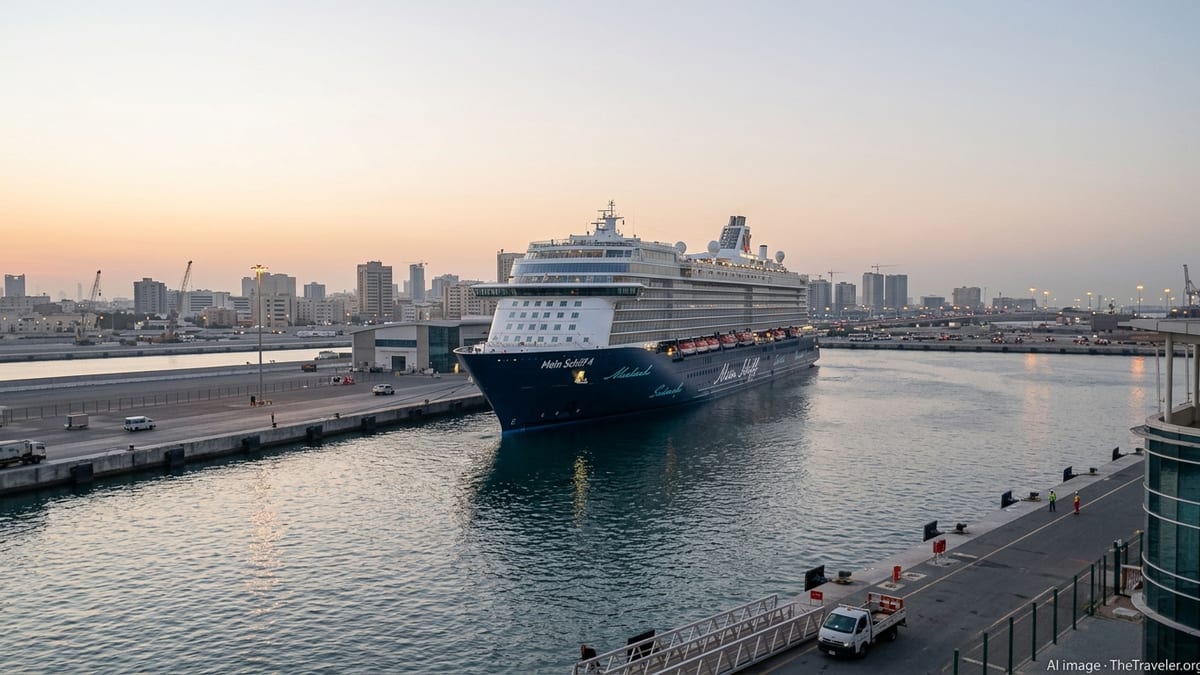
TUI Cruises has cancelled multiple voyages of Mein Schiff 4 after the ship became trapped in the Arabian Gulf during a fast‑moving security crisis that has disrupted maritime traffic across the region and left thousands of cruise passengers scrambling to adjust their travel plans.
Get the latest news straight to your inbox!
Mein Schiff 4 Trapped in Arabian Gulf as Security Crisis Deepens
Mein Schiff 4 was operating winter itineraries in the United Arab Emirates and wider Arabian Gulf when the regional situation deteriorated sharply in late February and early March 2026. Missile exchanges involving Iran, Israel and Western forces, along with reported drone incidents near key Gulf ports, led to a rapid tightening of security protocols for commercial shipping and cruise operations.
Published coverage of the crisis indicates that the closure of the Strait of Hormuz to passenger traffic effectively sealed cruise ships inside the Gulf. Mein Schiff 4, together with sister ship Mein Schiff 5 and vessels from other brands, was unable to proceed with scheduled sailings or reposition out of the region. Maritime security advisories issued in early March warned of elevated risks across the Arabian Gulf, the Gulf of Oman and adjacent waters, prompting operators to reassess their deployment plans.
Reports from maritime and cruise industry outlets describe a complex environment in which sea lanes that had recently been marketed as an emerging cruise hotspot suddenly became high risk. While container lines and tankers have faced their own restrictions and reroutings, the presence of thousands of holidaymakers on cruise ships has added an extra layer of sensitivity to risk assessments and insurance decisions.
Satellite tracking data referenced in trade coverage shows Mein Schiff 4 remaining near major UAE ports while authorities and the cruise line evaluate options. For now, the ship’s mobility is constrained by both the closure of the Strait of Hormuz and the broader military posture in the region.
Multiple Sailings Cancelled as TUI Prioritises Safety
In response to the fast‑changing security picture, TUI Cruises has systematically cancelled a series of scheduled sailings for Mein Schiff 4. Publicly available information from cruise industry news outlets shows that departures in early March were among the first to be pulled, including several short Gulf itineraries that had been marketed to the German‑speaking source market.
Subsequent advisories extended the pause, with the company cancelling all voyages on Mein Schiff 4 up to and including the departure originally planned for 23 March 2026. Sister ship Mein Schiff 5, also caught in the region, has seen its own programme curtailed, reflecting a broader halt of Arabian Gulf operations for the brand. The cumulative effect is that TUI’s winter Middle East programme has, for practical purposes, been suspended for the remainder of the current season.
Travel trade bulletins and TUI Group updates emphasise that the decisions are being framed around guest and crew safety, as well as the uncertainties associated with reopening key passages. With the Strait of Hormuz still assessed as high risk and the timeline for any normalisation unclear, the company has opted for clarity by cancelling near‑term cruises rather than relying on short‑notice changes.
The cancellations have affected guests who were due to embark in Gulf ports such as Dubai and Abu Dhabi, as well as travellers who had booked back‑to‑back itineraries or longer packages linking the Middle East with Europe. Many of those passengers have now been shifted onto alternative arrangements or are awaiting confirmation of refunds and rebooking options.
Repatriation Efforts and Passenger Impact
With Mein Schiff 4 unable to continue regular sailings, TUI Cruises moved quickly to repatriate passengers already on board when the crisis escalated. Industry reports describe an extensive logistical operation involving charter flights from Gulf and Saudi airports to major German gateways, organised to bring stranded guests home after itineraries were cut short.
Accounts from affected travellers shared in public forums depict disrupted holiday plans, curtailed shore excursions and sudden changes to return journeys. Many passengers disembarked in the United Arab Emirates or neighbouring countries earlier than expected, trading planned sea days for last‑minute flights and hotel stays while new travel arrangements were finalised.
Travel insurers and tour operators have also been drawn into the response, handling claims and questions tied to trip interruption, missed ports and cancelled cruises. In many cases, packages had been sold as all‑inclusive Gulf getaways, meaning that flight, hotel and cruise components all needed to be untangled once the itineraries collapsed.
Despite the upheaval, publicly available commentary suggests that most passengers were eventually able to return to their home countries, although some reported delays and long waits at regional airports. The episode has underscored how quickly leisure travel can be affected when geopolitical tensions spill over into critical maritime chokepoints.
Knock‑On Effects for Middle East Cruise Tourism
The decision to leave Mein Schiff 4 in the Arabian Gulf and cancel multiple sailings highlights the vulnerability of the region’s still‑developing cruise sector to external shocks. Over the past decade, Gulf states have invested heavily in new cruise terminals, port infrastructure and destination marketing, positioning winter cruising in the Arabian Gulf as a growth pillar for tourism.
Recent weeks have shown how fragile that growth can be. Coverage from European and regional outlets describes a sharp drop‑off in sailings, with several global brands suspending or reducing their Gulf operations in parallel with TUI. Port calls to destinations such as Dubai, Abu Dhabi, Doha and Bahrain have been scaled back or cancelled entirely, leading to lost revenue for local attractions, retailers and transport providers that depend on cruise footfall.
Tourism analysts cited in published reports warn that a prolonged closure of the Strait of Hormuz could push cruise lines to rethink their deployment over multiple seasons, not just for the remainder of winter 2025–26. Some itineraries that once relied on smooth passages through both the Red Sea and the Gulf are now being redesigned around alternative hubs, while others are being delayed or shelved.
At the same time, the experience gained during the ongoing Red Sea security crisis has given cruise planners a playbook for rapidly rerouting ships around high‑risk zones. For TUI Cruises, that has already translated into longer repositioning voyages via southern Africa on other ships in the Mein Schiff fleet, bypassing the Suez Canal and the most sensitive choke points.
Longer‑Term Fleet Adjustments and Traveler Considerations
Even before the latest escalation in the Arabian Gulf, TUI Cruises had begun adjusting itineraries to reflect a more volatile security picture in the wider region. The company has previously announced changes to Red Sea and repositioning cruises, opting to route ships around the Cape of Good Hope and extend sailing times rather than transit waterways seen as high risk.
Industry observers now expect those strategies to be refined further in light of the current crisis. While Mein Schiff 4 remains in the Gulf awaiting a safe window to move, planning for future seasons is likely to place greater emphasis on flexibility, with additional buffer days, alternate ports and more conservative route choices built into schedules.
For travellers, the episode serves as a reminder to examine the small print of cruise bookings more closely, including terms on force majeure, itinerary changes and cancellation rights. Travel experts note that booking through tour operators or packages that include strong consumer protections can help reduce financial exposure when geopolitical events disrupt plans.
As of late March 2026, there is no clear timeline for when Mein Schiff 4 will be able to resume regular itineraries outside the Arabian Gulf. Until maritime conditions improve and key passages reopen to passenger traffic, TUI Cruises is expected to maintain its suspension of affected sailings, leaving would‑be Gulf cruisers to consider alternative destinations in the Mediterranean, Canary Islands or Caribbean for upcoming holidays.