

More news on this day
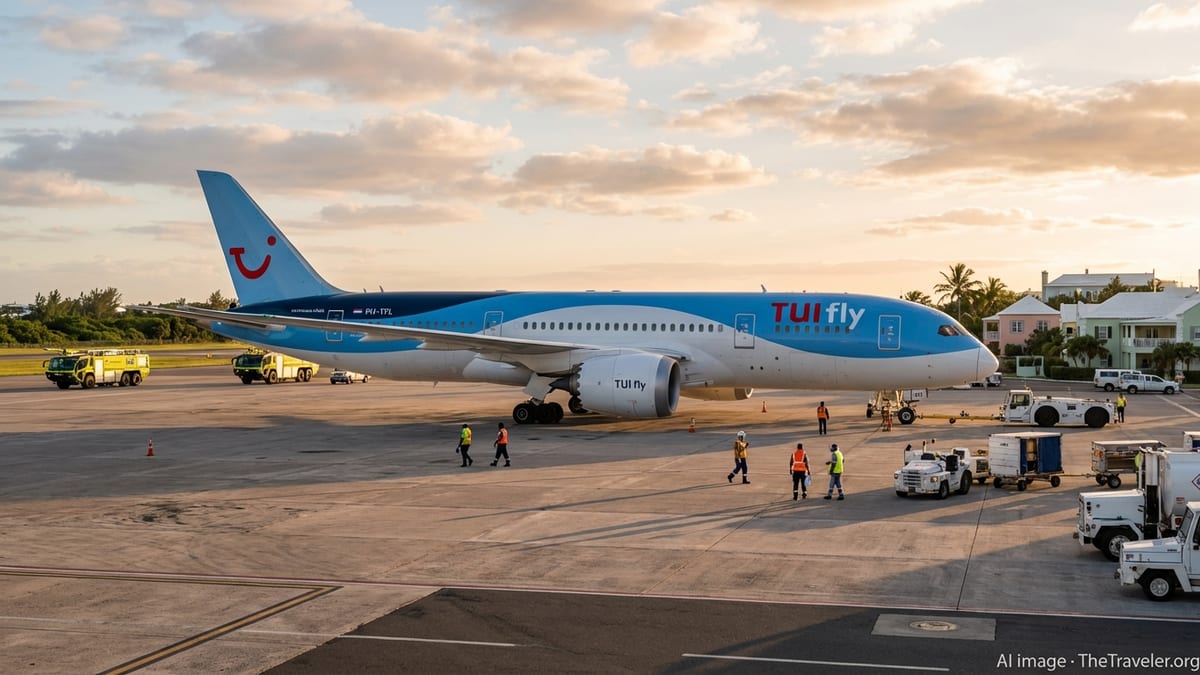
A TUI fly Netherlands flight from Amsterdam to Montego Bay made an urgent diversion to Bermuda after a reported in-flight issue, forcing an emergency landing that left holidaymakers facing an unexpected overnight disruption to their Caribbean-bound journey.
Amsterdam–Jamaica Holiday Flight Forced to Divert
TUI fly Netherlands service OR511 departed Amsterdam Schiphol bound for Montego Bay with a full load of winter sun seekers when the crew requested an unscheduled diversion to Bermuda. Flight tracking data showed the Boeing 787 turning away from its transatlantic routing and heading south-east toward L.F. Wade International Airport, where it landed under emergency protocol.
According to preliminary information from aviation data services and local reports, the crew cited a technical issue on board and opted to divert as a precaution while the aircraft was over the North Atlantic. The exact nature of the problem has not yet been confirmed by the airline, but there were no immediate indications of fire or loss of cabin pressure.
Passengers reported a firm but controlled landing in Bermuda, with the aircraft met on arrival by airport emergency vehicles positioned alongside the runway. The 787 taxied to a remote stand, where safety checks were carried out before passengers were disembarked.
Safety Protocols Trigger Emergency Response in Bermuda
Emergency services in Bermuda activated their established airport response plan as the inbound aircraft declared an emergency. Fire and rescue teams, along with medical personnel, were placed on standby along the runway ahead of the landing, in line with standard international procedures for precautionary diversions.
Airport officials indicated that the aircraft landed safely and that no injuries were reported among passengers or crew. After a brief inspection at the runway, the jet was escorted to a parking position where engineers and ground staff conducted an initial assessment while passengers remained on board.
Following standard safety protocols, disembarkation began only after authorities cleared the aircraft for ground handling. Travelers were then guided into the terminal for immigration processing, additional security checks and onward assistance from airline representatives.
Passengers Face Overnight Disruption and Rebooking
The diversion abruptly interrupted what was expected to be a straightforward long-haul holiday flight from the Netherlands to Jamaica, leaving passengers facing uncertainty about when they would reach Montego Bay. With no immediate onward connection available from Bermuda, TUI fly Netherlands began arranging hotel accommodation and meal vouchers for affected travelers.
Several passengers described queues at the service desks as airline staff worked to provide updates, organize overnight stays and explore options for either dispatching a replacement aircraft or repairing the grounded jet. Families traveling with children and older passengers were prioritized for hotel transport, according to accounts shared from the terminal.
For many on board, the delay means lost hours or even a full day of paid-for resort time in Jamaica. Under European air passenger regulations, travelers on the flight are expected to be entitled to care, and depending on the final cause and length of the disruption, potentially to financial compensation, though this will hinge on whether the technical issue is deemed extraordinary.
Focus on Airline Maintenance and Long-Haul Reliability
The incident again places attention on the challenges of long overwater routes between Europe and the Caribbean, where operators such as TUI fly Netherlands rely on twin-engine widebody jets and stringent maintenance and dispatch standards. When technical warnings arise mid-Atlantic, pilots are trained to divert to the nearest suitable airport rather than continue to destination.
Aviation safety specialists note that precautionary diversions such as the one involving flight OR511 highlight the layered approach to risk management in commercial aviation. Modern aircraft are designed with multiple redundancies, and crews are encouraged to adopt a conservative stance whenever system anomalies appear during flight.
While such episodes can be alarming for passengers, industry data indicates that unscheduled landings for technical checks are relatively frequent compared with the very low incidence of serious accidents. Many diversions are later traced to sensor faults or components that are replaced out of caution before the aircraft returns to service.
Bermuda’s Role as a Mid-Atlantic Diversion Airport
Bermuda’s L.F. Wade International Airport has long served as an important diversion point for transatlantic flights operating between Europe, North America and the Caribbean. Its location, runway length and rescue capabilities make it a designated alternate for several airlines crossing the North Atlantic, particularly when routing takes them south of traditional North Atlantic Tracks.
On days like the OR511 diversion, the island’s tourism-focused gateway temporarily shifts into a safety hub for international carriers, with local authorities and airport staff working alongside inbound airline crews to manage unexpected arrivals. After emergency situations are stabilized, the focus turns to passenger welfare, aircraft maintenance and coordination with foreign aviation regulators.
The TUI fly Netherlands jet involved in the incident is expected to remain in Bermuda until engineers and the airline’s technical teams determine it is either fit to continue or must be substituted. Until then, hundreds of passengers will be waiting for their journey to Jamaica to resume, a reminder of how even routine leisure flights can be quickly reshaped by the realities of operating complex aircraft across vast oceanic distances.