

More news on this day
A Turkish Airlines flight from Istanbul to Vancouver made an emergency landing in Vienna on Thursday after the crew declared a general in-flight emergency and diverted the Boeing 777 over central Europe.
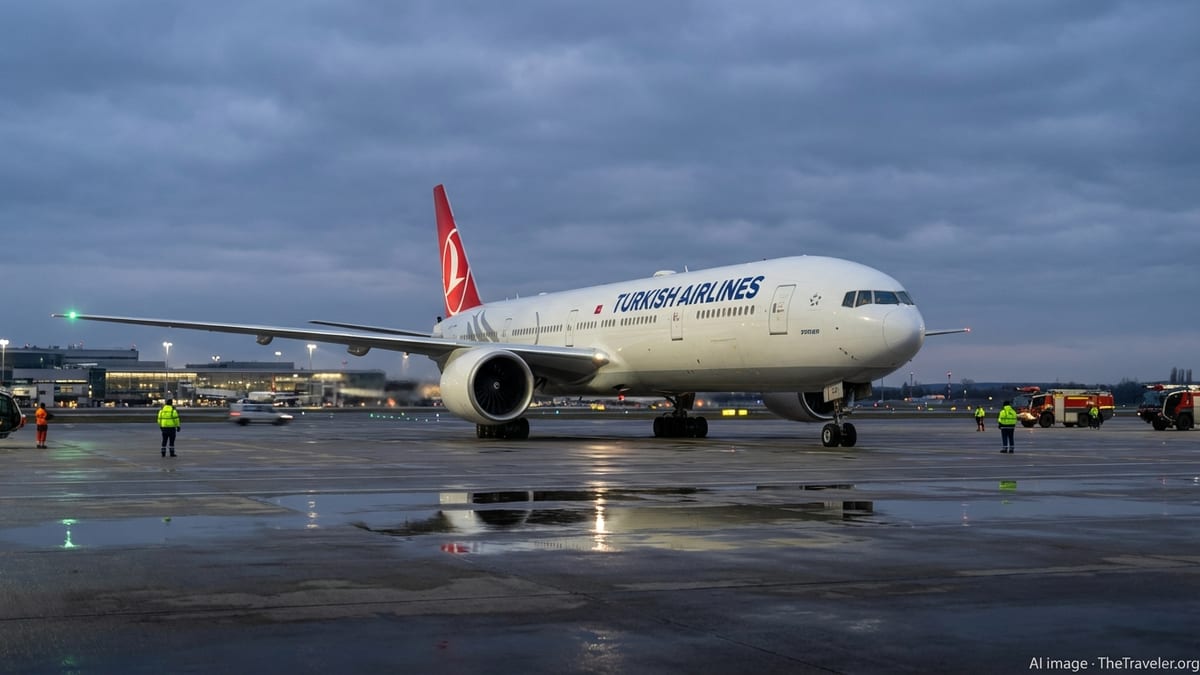
Mid-Route Diversion Triggers Emergency Response in Vienna
Flight TK75 departed Istanbul Airport on February 26, 2026, operating a scheduled long-haul service to Vancouver when the crew reported an in-flight problem while cruising over Europe. The aircraft, a Boeing 777-300ER registered TC-LJJ, had been airborne for roughly two hours when the situation developed, prompting the pilots to halt the transatlantic leg of the journey.
According to flight-tracking data, the crew transmitted the 7700 emergency squawk code and immediately requested priority handling from air traffic control. Controllers in the region then cleared surrounding airspace and coordinated a diversion to Vienna International Airport, one of the nearest major hubs capable of receiving a fully loaded wide-body jet.
The aircraft performed a controlled descent and approached Vienna under emergency conditions, where local fire, medical and airport response teams were placed on standby. Initial reports indicated that the landing was completed safely, with no immediate reports of injuries among passengers or crew.
Turkish Airlines had not yet publicly detailed the precise nature of the emergency at the time of writing, and authorities in Austria were continuing to gather information on the incident.
Squawk 7700 and What It Means for Air Travelers
The 7700 transponder code is used globally in commercial aviation to indicate a general emergency. When a flight crew selects this code, it serves as a universal alert to all relevant air traffic control units that the aircraft requires immediate attention, whether due to a technical issue, a medical situation on board, or another serious operational concern.
Once an aircraft is squawking 7700, controllers prioritize that flight over other traffic. Standard procedures include providing the most direct routing, removing conflicting aircraft from its path, and arranging for emergency services to be ready on the ground. While alarming to passengers, this system is designed to streamline decision-making and ensure that any developing risk is managed as quickly and safely as possible.
The code itself does not specify the type of problem, only that the situation meets the threshold for an in-flight emergency as assessed by the cockpit crew. In the case of TK75, the declaration of an emergency and subsequent diversion to Vienna were precautionary measures consistent with global aviation safety norms.
Aviation analysts note that such diversions, though relatively rare compared with the number of long-haul flights operated daily, are evidence of safety systems functioning as designed. Modern commercial aircraft and airline procedures are built around layers of redundancy, monitoring and rapid response for precisely these scenarios.
Why Vienna Was Chosen as the Alternate Airport
Vienna International Airport is one of central Europe’s key aviation hubs and a designated diversion option for long-haul flights transiting the region. For a fully loaded Boeing 777 operating a lengthy route between Istanbul and Vancouver, the choice of diversion airport must account for runway length, ground support capabilities and the availability of emergency services.
In this case, Vienna offered long runways suitable for wide-body aircraft at or near maximum landing weight, extensive technical and maintenance support, and a robust emergency response infrastructure. Its geographic position relative to TK75’s route meant that the crew could reduce airborne time quickly once the emergency was declared, limiting exposure while ensuring a controlled approach.
Such decisions are typically made rapidly in coordination between the flight crew, airline operations control and air traffic control. The overriding priority is to reach the nearest suitable airport, rather than the originally scheduled destination, when new risk factors emerge during flight.
After landing, the aircraft would normally be directed to a remote stand or designated bay where emergency teams can assess the situation. From there, ground personnel and airline engineers begin the process of determining what led to the emergency declaration and whether any further action is required.
Impact on Passengers and Ongoing Operations
Passengers traveling on TK75 were expected to face significant disruption to their journeys as the airline evaluated the aircraft and considered onward travel options. In diversion cases such as this, airlines typically arrange for rebooking on later services, accommodation if required, and assistance with missed connections once the immediate safety concerns have been addressed.
For travelers bound for Vancouver, options may include a replacement aircraft from Vienna, rerouting via another North American hub, or re-accommodation on subsequent Turkish Airlines services once the operational picture becomes clearer. Specific arrangements often depend on the timing of the diversion, aircraft availability and regulatory requirements.
Emergency landings can be unsettling experiences, particularly on long-haul flights far from the final destination. However, industry data consistently show that such events are managed within strict safety frameworks, with crews extensively trained to handle rare but high-stakes scenarios. Reports from Vienna indicated that TK75’s diversion and landing were carried out in a controlled manner, consistent with those training standards.
While airlines and investigators work to clarify what triggered the emergency declaration, the incident underscores the complexity of global long-haul operations and the importance of having multiple contingency plans in place along every route.
Route Profile: Istanbul to Vancouver on Turkish Airlines
The Istanbul to Vancouver service, operated as TK75, is one of Turkish Airlines’ key long-haul links between its hub on the shores of the Bosphorus and Canada’s Pacific coast. The route, typically flown several times a week, covers a distance of nearly 9,600 kilometers and is usually scheduled at around 11 to 12 hours of block time.
Turkish Airlines deploys its Boeing 777-300ER fleet on the route, offering a high-capacity wide-body configuration suited to both business and leisure demand across Europe, the Middle East and North America. The service forms part of the airline’s broader strategy to position Istanbul as a global connecting hub between Asia, Europe and the Americas.
Long-haul services such as TK75 are planned with multiple alternate airports along the route, precisely to account for scenarios like the one that unfolded over Europe. Dispatchers and flight planners consider weather patterns, en route airspace constraints and the availability of diversion fields when mapping out each flight.
The emergency diversion of TK75 to Vienna will likely prompt a detailed internal review by the airline and close coordination with aviation authorities. Once technical evaluations and safety checks are complete, operations on the Istanbul–Vancouver corridor are expected to continue, with the incident serving as a case study in the application of established safety procedures on one of the world’s busiest intercontinental networks.