

More news on this day
The escalating U.S.-Iran conflict has shattered the normally seamless flow of global aviation, forcing mass flight cancellations, sudden diversions and prolonged delays across major Middle Eastern hubs from Dubai and Doha to Tel Aviv and Beirut, with ripple effects now disrupting journeys on nearly every continent.
Get the latest news straight to your inbox!
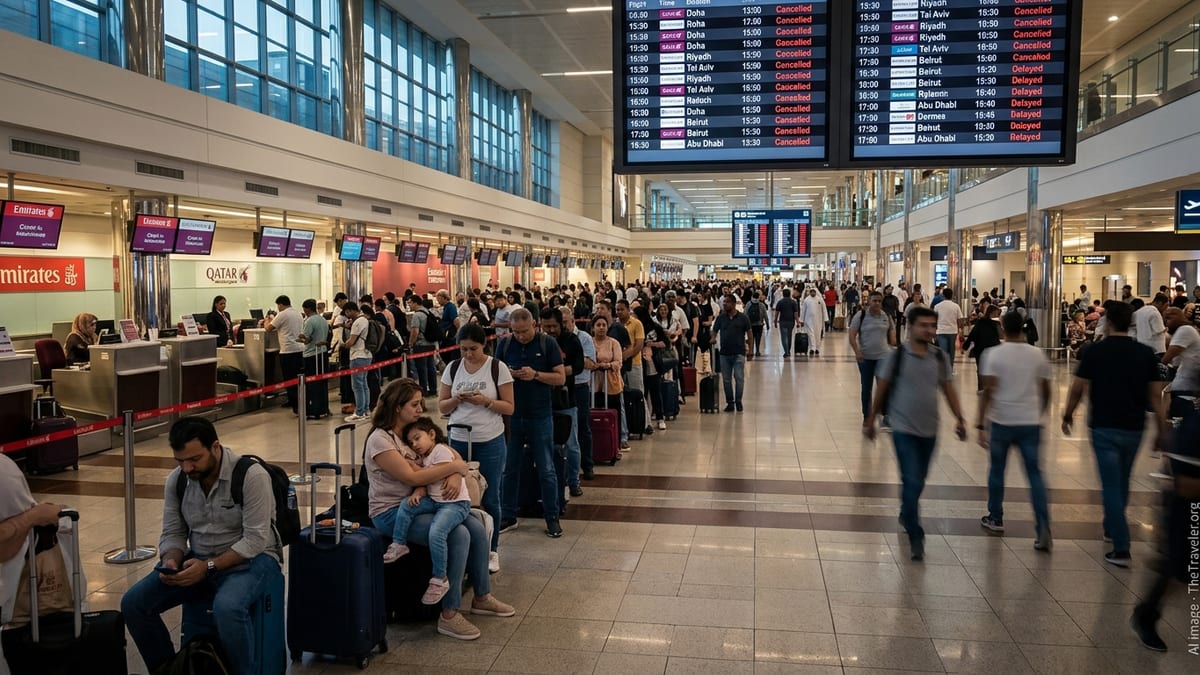
Airspace Closures Turn Gulf Megahubs Into Bottlenecks
What began as targeted military strikes at the end of February has rapidly evolved into one of the most severe aviation crises since the pandemic, as countries across the Middle East imposed sweeping airspace closures and restrictions. Publicly available information indicates that Iran, Iraq, Israel, Lebanon, Qatar, Kuwait, Bahrain, the United Arab Emirates and parts of Saudi Arabia have all introduced full or partial shutdowns at various points, effectively sealing off or constricting some of the world’s busiest flight corridors.
The impact on Gulf megahubs has been immediate and dramatic. Dubai International and Abu Dhabi International, normally among the top global transit airports by international passenger volume, have experienced days of near standstill after missile and drone attacks in the vicinity and precautionary closures of surrounding airspace. Reports from regional outlets describe terminals temporarily closed, sections of infrastructure damaged and only limited emergency or evacuation flights permitted while safety assessments continue.
In Qatar, operations at Doha’s Hamad International Airport were sharply curtailed when national airspace was closed following Iranian strikes on targets in and around the country. According to recent travel advisories and published coverage, authorities later reopened navigation on a highly restricted basis, prioritizing repatriation and cargo flights, but regular commercial schedules remain significantly reduced.
Riyadh’s King Khalid International Airport has also seen fluctuating levels of activity, with industry bulletins and risk assessments pointing to a pattern of reduced frequencies, rolling delays and intermittent cancellations as airlines react to changing threat evaluations and limited routing options through Saudi skies.
Tel Aviv, Beirut and Beyond: Regional Gateways Cut Off
Beyond the Gulf, key Eastern Mediterranean gateways have become flashpoints for aviation disruption. Tel Aviv’s Ben Gurion Airport has faced repeated shutdowns and schedule suspensions as the wider Israel-Iran confrontation intensifies. Historical incidents of missile fire near the airfield had already made international carriers cautious, and the current conflict has pushed many airlines to pause Tel Aviv services entirely or drastically curtail frequencies.
In Lebanon, Beirut-Rafic Hariri International Airport has seen multiple waves of cancellations and suspensions by Gulf and European carriers. Travel industry reports note that some airlines have halted Beirut flights for weeks at a time, citing security concerns and the difficulty of planning reliable schedules while regional airspace patterns shift from day to day.
These suspensions have deep local consequences. Beirut and Tel Aviv both serve as critical links for business travel, diaspora visits and religious tourism, connecting Europe and North America to destinations across the Levant. With services sharply reduced, passengers are being forced onto complex multi-leg journeys that depend on the few remaining hubs still offering relatively stable operations.
Secondary airports around the region, from Jordan to Cyprus, have absorbed some of the displaced traffic as airlines search for safer alternatives and emergency diversion points. However, aviation analysts cited in recent coverage warn that these smaller facilities lack the capacity and connectivity to fully replace the role of major hubs, ensuring that bottlenecks and rolling disruptions will persist.
Global Airlines Reroute, Cancel and Absorb Soaring Costs
For airlines far beyond the Middle East, the conflict has become a test of resilience and operational flexibility. Carriers from Europe, North America and Asia have adopted a mix of responses: outright cancellations of flights into the region, route suspensions to specific cities such as Tel Aviv, Beirut and select Gulf destinations, and widespread rerouting of long-haul services to avoid Iranian and neighboring airspace.
Industry reporting describes thousands of flights cancelled since the initial U.S. and Israeli strikes on Iran, with aviation data firms estimating that more than half of all planned services in the wider region have been affected on peak disruption days. Gulf-based giants that rely on through-traffic via Dubai, Abu Dhabi and Doha have cut frequencies, consolidated flights and shifted routings around closed flight information regions, often at the expense of schedule reliability.
For Europe–Asia itineraries that once crossed Iran, Iraq and the Gulf, airlines are now threading narrow corridors over the Caucasus or detouring south via Egypt, the Red Sea and parts of the Arabian Peninsula. Travel and aviation outlets report additional flight times of two to five hours or more on some routes, leading to higher fuel burn, extra crew costs and logistical challenges such as unscheduled technical stops for refueling.
Airlines in India and across South and Southeast Asia have also announced cancellations and rerouted services to Dubai, Abu Dhabi and other Gulf points as local regulators urge carriers to avoid higher-risk airspace. Contract-of-carriage rules typically classify the conflict as a force majeure event, and consumer advocates note that this often limits passenger entitlement to compensation, even for severe disruptions.
Stranded Passengers Face Uncertainty From Dubai to Doha
For travelers on the ground, the crisis has manifested as a confusing patchwork of last-minute text alerts, abruptly changed departure boards and multi-day waits in hotel rooms or airport lounges. Reports from news organizations and travel publications describe hundreds of thousands of passengers stranded or delayed around Dubai, Abu Dhabi, Doha, Riyadh and other regional hubs in the days following the first strikes.
At the height of the closures, some long-haul flights from North America and Europe turned back to their origin airports after hours in the air when destination airspace suddenly became unavailable. Others diverted to secondary European or Central Asian cities to refuel and await clearer routing options. Travelers arriving in the Gulf have sometimes found onward connections canceled with little warning as security assessments shifted mid-journey.
Limited evacuation and repatriation flights have started to move some tourists, migrant workers and business travelers out of the region, but capacity remains far below normal. Airlines are generally urging passengers not to go to the airport unless they hold a newly confirmed booking, and many are waiving change fees, offering flexible rebooking windows or allowing refunds within specific travel periods, according to publicly available airline advisories.
Travel insurers and consumer groups are reminding passengers to scrutinize policy terms, as coverage for war-related disruptions varies widely. Some policies may reimburse additional accommodation and transport expenses, while others exclude conflicts altogether, leaving many travelers to absorb the financial impact of extended stays and rearranged itineraries.
Long-Term Questions for Middle East Connectivity
Beyond the immediate turmoil, the U.S.-Iran conflict is raising deeper questions about the resilience of a global air network built around Gulf super-hubs. For more than a decade, cities like Dubai, Abu Dhabi and Doha have positioned themselves as indispensable crossroads linking Europe, Africa and the Americas with South and East Asia. Current disruptions are exposing the vulnerability inherent in concentrating so much of the world’s long-haul connectivity through a relatively compact and geopolitically sensitive region.
Aviation analysts quoted in recent business coverage suggest that airlines may reassess their dependence on certain corridors and explore more diversified routing strategies, even if that means sacrificing some efficiency in normal times. Carriers already experimenting with longer polar or trans-African routes could accelerate these shifts if security advisories and insurance requirements keep parts of Middle Eastern airspace constrained for an extended period.
For Gulf and regional carriers, the crisis poses both a financial and reputational challenge. While these airlines have built brands around reliability and seamless global connections, they are now operating within a highly uncertain environment shaped by factors beyond their control. Some have already begun marketing flexible booking policies and emphasizing safety-driven decision-making in public statements to reassure travelers planning future trips.
Travel planners and corporate travel managers are closely monitoring developments, weighing whether to postpone nonessential journeys to destinations such as Dubai, Tel Aviv, Riyadh, Doha, Beirut and Abu Dhabi. Until airspace patterns stabilize and schedules become predictable again, industry observers expect a continued period of reduced demand, higher operating costs and a fragmented global route map that reflects the enduring shadow of the U.S.-Iran confrontation.