

More news on this day
Thousands of passengers were left sleeping on terminal floors across Dubai, Abu Dhabi, Sharjah and Ras Al Khaimah on Saturday after sweeping airspace closures forced a shutdown of the United Arab Emirates’ aviation network in the wake of US-Israel strikes on Iran.
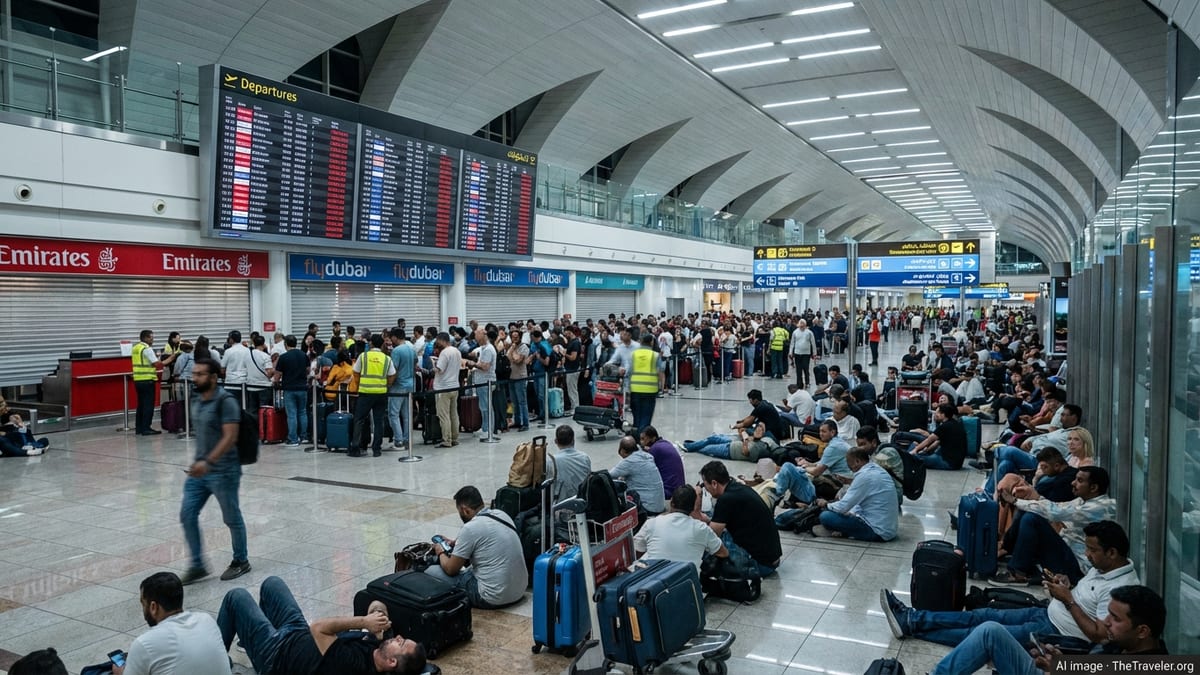
Gulf Airspace Closure Turns UAE Hubs into Holding Pens
The UAE’s General Civil Aviation Authority announced a temporary but sweeping closure of national airspace as a precautionary safety measure amid a rapid escalation of regional missile exchanges. The move instantly choked off one of the world’s busiest aviation corridors linking Europe, Asia and Africa, pushing the country’s airports into an unprecedented operational freeze.
Dubai Airports confirmed that all flights at Dubai International (DXB) and Al Maktoum International (DWC) were suspended until further notice, urging travelers not to come to the terminals and instead seek updates directly from their airlines. Aviation data providers and airport operators reported hundreds of cancellations and delays within hours, part of a wider regional tally that industry analysts said could climb well beyond 1,200 flights as the disruption ripples through global schedules.
Similar scenes unfolded in the capital, where Zayed International Airport in Abu Dhabi halted most international departures after alarms sounded across terminals during Iranian retaliatory strikes. Airport staff struggled to manage frightened crowds as passengers rushed towards exits before being told to remain inside for safety amid reports of missile debris falling in parts of the city.
In Sharjah and Ras Al Khaimah, smaller but strategically important low-cost hubs, operators reported blanket cancellations on services into and out of the UAE. With neighboring Gulf states including Qatar, Kuwait, Bahrain and Oman also closing airspace, there were few viable diversion points left, leaving aircraft crews and passengers effectively marooned on the ground.
Emirates, FlyDubai and Air Arabia Forced into Sudden Standstill
Home carrier Emirates, which normally operates hundreds of daily long haul departures through Dubai, announced a full suspension of operations to and from its main hub, citing multiple regional airspace closures. The decision effectively removed one of the world’s largest international networks from circulation overnight, leaving scores of widebody jets parked on aprons and thousands of transit passengers with no onward options.
FlyDubai, the city’s low cost sister airline, also halted all flights, compounding the disruption for regional travelers who rely on the carrier for short haul connections across the Middle East, Central Asia and parts of Europe. Customer service teams were inundated as stranded passengers queued at help desks to secure rebooking or refunds, many reporting that the earliest alternative itineraries involved detours via Asia or Europe days later.
In Abu Dhabi, Etihad Airways confirmed widespread disruption and said all flights scheduled to depart the capital were suspended until at least Sunday afternoon local time, with many arrivals cancelled or instructed to return to their origin airports. Air Arabia, which maintains bases in Abu Dhabi, Sharjah and Ras Al Khaimah, cancelled its UAE services as airspace restrictions broadened, wiping out a dense network of low cost links to India, North Africa and the Caucasus.
International carriers from Europe and Asia added to the tally as they axed or diverted services that would normally overfly Iran, Iraq and the Gulf. With premium and leisure passengers bound for Dubai, Abu Dhabi and Doha suddenly without a hub, travel agents reported a scramble to rebook via alternative corridors, often at sharply higher fares and with journey times stretching to 30 hours or more.
Passengers Sleep in Terminals as Information Drips In
Across the UAE, social media images and eyewitness accounts on Saturday showed families camped on the floor, long lines at food outlets and departure boards dominated by red cancellation markers. At Abu Dhabi’s Zayed International Airport, travelers described scenes of panic as alarms rang and announcements repeatedly urged calm while offering little clarity on when flights might resume.
In Dubai, one of the world’s most tightly choreographed aviation hubs, the sudden standstill left crews and ground staff working through the night to manage mounting crowds. Airport authorities deployed extra security personnel and volunteers to direct passengers to designated waiting areas, while hotels near the terminals quickly filled with travelers able to secure emergency accommodation.
For many, the greater frustration lay in the uncertainty. Airline call centers and chat channels were overwhelmed as passengers struggled to obtain reliable timelines amid a fast moving security situation. Some carriers issued broad travel waivers, allowing customers to rebook or request refunds without penalty, but the lack of spare capacity across alternative routes limited practical options for immediate travel.
Among those most affected were migrant workers and budget travelers from South Asia and Africa who use UAE hubs as their primary gateway to jobs and families abroad. With pay cycles and visa timelines tightly linked to travel dates, extended delays risk financial and administrative complications that could stretch long after airspace reopens.
Global Networks Rerouted as Airlines Weigh Safety and Cost
The closure of Iranian, Iraqi, Israeli and Gulf airspace has blown a hole through one of the planet’s busiest high altitude corridors, forcing airlines to redraw flight paths between Europe and Asia almost overnight. Flight tracking data showed a marked thinning of aircraft over the Levant and northern Gulf, with long haul services instead funnelling south over Saudi Arabia or making wide detours through the Caucasus and Central Asia.
Aviation analysts warned that even once limited operations resume in the UAE, airlines may be reluctant to immediately revert to pre crisis routings if security assessments remain cautious. Longer detours mean additional fuel burn, crew duty time pressures and aircraft utilisation headaches, all of which feed into higher operating costs that could ultimately be passed on to passengers through higher fares.
Industry groups also highlighted the vulnerability of hub and spoke models that concentrate global traffic through a handful of mega airports. With Dubai and Abu Dhabi both heavily reliant on transfer passengers, the current shutdown underscores the systemic risk posed by geopolitical flashpoints to airlines whose networks are built on uninterrupted access to contested airspace.
For now, carriers are in crisis management mode, focusing on getting aircraft and crews back to home bases and clearing passenger backlogs where possible. But schedule planners are already bracing for a prolonged period of rolling disruptions, with knock on effects expected on aircraft maintenance slots, crew rostering and aircraft deliveries scheduled to transit the region.
Uncertain Timeline as Authorities Prioritise Security
UAE authorities have not provided a firm timeline for the full reopening of national airspace, stressing that decisions will be guided by real time security assessments and coordination with regional and international partners. Officials framed the closures as exceptional measures aimed at safeguarding civilians and infrastructure as missile interceptions continued over parts of the country.
Defence officials said air defences had intercepted multiple projectiles targeting the UAE, with debris reported in several districts of Abu Dhabi and Dubai. While only isolated casualties and limited damage were confirmed by local authorities, the psychological impact on residents and visitors has been significant, with many describing a day marked by sirens, explosions in the distance and the eerie silence of grounded aircraft.
Airlines, meanwhile, are drawing up phased restart plans that would prioritise repatriation flights and key trunk routes once authorities give the green light. Airport operators in Dubai, Abu Dhabi, Sharjah and Ras Al Khaimah are preparing for a surge of backlog traffic whenever restrictions ease, warning that passengers should brace for days of residual delays and missed connections even after the first flights take off.
For thousands still camped out at terminals or stranded in hotels across the Emirates, the immediate concern is simply getting home. With the geopolitical standoff showing few signs of rapid resolution, the UAE’s usually seamless travel machine has been thrust into a rare and jarring standstill that is being felt in departure halls from Asia to Europe.