

The United Arab Emirates is widely perceived as an administratively efficient, business-friendly destination, yet foreign residents still face a specific set of procedural, regulatory, and digital system demands. Understanding how complex the UAE actually is to navigate on a day-to-day basis is essential for relocation decision making and for designing realistic corporate mobility policies. This briefing explains a UAE Relocation Complexity Score focused on foreign residents, breaking down the main drivers that increase or reduce the practical difficulty of establishing and maintaining lawful residence and identity status in the country.
Defining the UAE Relocation Complexity Score
The Relocation Complexity Score is a practical index used by global mobility teams to estimate how difficult a country is for foreign residents to navigate from an administrative and regulatory standpoint. It usually aggregates factors such as the number of steps and interfaces involved in residence registration, level of digitalization, inter-agency coordination, documentation sensitivity, error tolerance, and consequences of non-compliance. For the UAE, the score is closely tied to the country’s heavy reliance on the Emirates ID system and digital government platforms.
In this framework, a lower score indicates a simpler, more predictable environment, while a higher score means more touchpoints, opaque rules, and a higher risk of process failure. Mature destinations with integrated digital identity, clear service standards, and streamlined processes typically achieve a lower complexity score even if their underlying rules are strict. The UAE often sits in the “moderate” range globally: more efficient than many emerging markets, but more intricate than top-ranked administrative environments in parts of Western Europe or North America.
Because the UAE has federated emirates and separate free zone authorities, the Relocation Complexity Score also accounts for fragmentation. A foreign resident may need to deal with a federal identity authority, an emirate-level immigration department, a free zone authority, and various private intermediaries. The index therefore evaluates not only the rules, but also how many different systems a resident must understand and manage over time.
For mobility planners, this score is not a theoretical construct. It informs lead times for assignment start dates, expected internal support needs, and the level of policy flexibility required to absorb delays or administrative friction for employees and their accompanying family members.
Key Administrative Drivers of Relocation Complexity in the UAE
The UAE Relocation Complexity Score for foreign residents is shaped by several core administrative features. These include mandatory identity enrollment, biometric capture, health screening, and periodic renewals, all of which must align precisely with employment and sponsorship arrangements. The steps are relatively standardized nationwide, but timelines, documentation expectations, and communication practices can vary by emirate and authority, adding to perceived complexity.
A typical sponsored foreign professional will need to navigate multiple sequential steps: entry authorization, medical fitness testing, biometrics for Emirates ID, issuance of residency linked to the ID, and activation of digital identity credentials to access government and private services. Each step is individually straightforward but collectively creates a process chain with built-in dependencies. Any error or delay at one stage, such as a rejected photo or a mis-typed name, can have knock-on effects for banking, leasing, or school enrollment, raising the effective complexity score.
The UAE also maintains a strict compliance environment around identity documents. Emirates ID is mandatory for residents and is used for nearly all official transactions. This centralization of identity simplifies many procedures once the ID is issued, but it also concentrates risk. Losing the card, failing to renew it on time, or allowing status to lapse can quickly create multiple access problems. Complexity scoring therefore weighs both the benefits of consolidation and the increased exposure when a single credential underpins so many aspects of daily life.
Cumulatively, these features produce an environment where the underlying state systems are relatively efficient, yet the operational burden on individual foreign residents remains significant, especially in the first 12 to 18 months of residence.
Digital Identity and E-Government as Complexity Reducers
A central reason the UAE does not score as a high-complexity jurisdiction is its sustained investment in e-government and digital identity. The Emirates ID and related digital identity solutions are integrated into a national digital government strategy that consolidates thousands of public and private services into a limited set of apps and online portals. Residents increasingly interact with the state through unified logins, digital document wallets, and automated workflows instead of in-person visits.
Digital platforms such as smart services portals and national identity apps allow foreign residents to apply for and renew residence permits, update some personal details, and obtain digital versions of Emirates ID shortly after approval. These services reduce the need for repeated physical visits and paper submissions, lowering time and effort. Processing times for many routine actions have been cut from weeks to days or even hours in some categories, which contributes positively to the Relocation Complexity Score.
The move to using Emirates ID as the primary proof of residency in place of passport visa stickers exemplifies this simplification. Once a foreign resident’s Emirates ID is active, it can often be used to prove both identity and lawful stay status across government portals, banks, and utilities. This convergence reduces the number of separate documents and reference numbers that must be tracked and updated.
However, digitalization also introduces new skill requirements. Foreign residents must be comfortable using mobile apps for critical services, managing multi-factor authentication, and understanding how different platforms interlink. For some assignees, particularly those unfamiliar with digital identity ecosystems, this can temporarily increase perceived complexity despite the underlying system being more streamlined.
Process Steps, Timelines, and Error Sensitivity
From a relocation complexity perspective, three dimensions are particularly relevant: the number of process steps, the typical lead times, and the system’s tolerance for errors or discrepancies. The UAE performs relatively well on the first two metrics, but is exacting on the third. Most foreign residents can complete the full residency and identity issuance journey in a matter of weeks, and many renewals are faster. Yet small data mismatches, name structure issues, or missing documents can cause disproportionate delays.
Error sensitivity is visible in name formatting and document consistency. For example, foreign residents may find that their names are transliterated differently across passports, employment contracts, and application forms. Emirates ID issuance standards may require specific structures or the removal of non-permissible name elements, leading to modification requests and rework. This extends cycle times and raises the complexity score because it forces residents and employers to understand local naming conventions in detail.
Similarly, the system is strict on alignment between residency status and other elements such as labor authorization and sponsorship. If an employment relationship ends or a sponsoring entity changes, identity and residence permissions must be updated promptly. While the underlying procedures are known and increasingly digitized, the synchronization across various systems leaves little room for oversight, and missed deadlines can produce fines or gaps in status.
These characteristics mean the UAE’s Relocation Complexity Score is not primarily about long queues or opaque bureaucracy, but about precision. The environment rewards careful document preparation, proactive monitoring of application status, and early detection of discrepancies across all records used in the residency and identity chain.
Emirates ID as a Central Complexity Factor
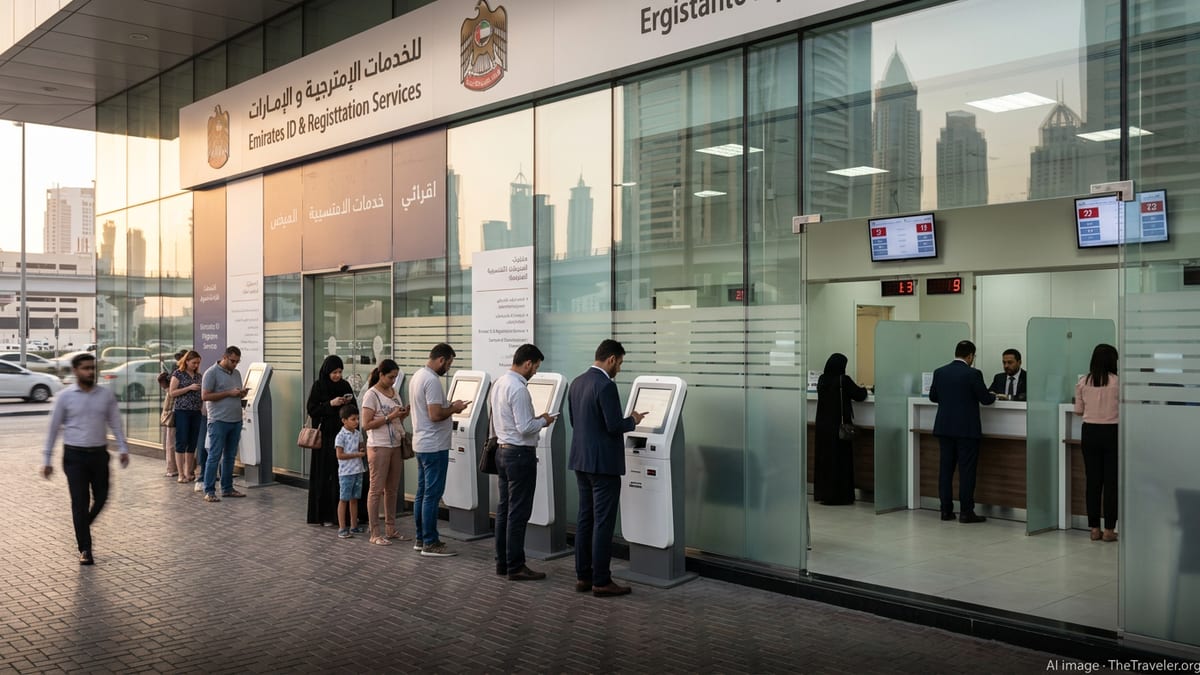
Emirates ID is arguably the single largest determinant of the UAE Relocation Complexity Score for foreign residents. It functions as a national identity card, a residency credential, and a gateway to both government and private services. Without a valid Emirates ID, foreign residents may be unable to access key services such as telecom subscriptions, utility connections, some banking services, and many public portals.
This centrality has two opposing effects on complexity. On the one hand, once a resident holds a valid card and its digital counterpart, many processes become dramatically simpler. Identity verification is quick and standardized, and integrated systems can auto-populate data from the national registry, reducing the need for multiple document submissions. On the other hand, during transition periods such as initial issuance, renewal, or replacement, any delay in producing the physical card or updating its status can significantly disrupt daily life, magnifying perceived complexity.
The replacement and renewal framework adds another layer. Foreign residents are expected to renew Emirates ID in line with the validity of their residence permit and to update details such as address or employer when they change. Late renewals can attract financial penalties that accumulate daily up to a capped amount, which materially increases the consequences of administrative oversight. For global mobility programs, this elevates the importance of systematic reminders and centralized monitoring of expiry dates for assignees and family members.
Because Emirates ID is also treated as a confidential document subject to strict data protection expectations, foreign residents must manage copies and sharing carefully. Many routine private-sector interactions now accept digital IDs, but some delivery services or intermediaries still request physical scans. Knowing when to comply and when to decline is not always intuitive for newcomers, which can add to perceived complexity during the first year of residence.
Penalty Environment and Compliance Burden
A critical input into the Relocation Complexity Score is the severity and structure of penalties for non-compliance with identification and registration rules. In the UAE, failure to renew Emirates ID on time or update certain details can result in daily fines up to a defined maximum. While the absolute amounts are modest for senior professionals, they are meaningful for lower-paid categories and can cause frustration, especially when the delay stems from oversight rather than intentional non-compliance.
In addition to financial penalties, lapses can have indirect consequences. An expired or invalid Emirates ID can temporarily prevent residents from completing transactions such as SIM card registration, some bank operations, or access changes for secure buildings that rely on ID data. This linkage between up-to-date identity status and everyday functionality means that even short interruptions can feel highly disruptive, particularly for assignees arriving with tight timelines for settling in.
The burden is not limited to individuals. Sponsors and employers carry their own compliance obligations, including ensuring that residents they sponsor maintain valid status, and that data reported to immigration and identity authorities remains accurate. Corporate non-compliance can lead to sanctions that affect the ability to sponsor future employees, which in turn influences how aggressively companies manage documentation deadlines and internal tracking. For relocated staff, this often translates into structured reminders and mandatory participation in periodic audits of personal data and document validity.
Overall, the UAE’s penalty environment is clear, predictable, and widely communicated, which supports transparency. However, its low tolerance for gaps and its linkage to key services mean that even residents who value administrative order may rate the day-to-day compliance burden as moderately high, reinforcing the country’s mid-range Relocation Complexity Score.
Benchmarking the UAE Against Other Destinations
When benchmarked globally, the UAE tends to rank favorably on ease-of-doing-business type indicators, reflecting streamlined company registration and relatively fast processing of permits. Historical data placed the UAE near the top of regional rankings, with high scores on starting a business and dealing with construction permits. Although the specific indices have evolved, the general pattern of administrative efficiency persists, especially for corporate-facing processes.
For individual foreign residents, however, the picture is more nuanced. Compared with some Western European Schengen states that operate residence registration largely through municipal offices and less centralized identity cards, the UAE’s model concentrates complexity in a smaller set of highly digitized but stricter systems. This results in fewer physical steps but more exacting data requirements. In contrast, compared with emerging-market destinations with fragmented or largely paper-based procedures, the UAE is substantially more predictable and faster, placing its Relocation Complexity Score in the lower-to-middle range globally.
Another differentiator is the pace of regulatory change. The UAE has introduced multiple waves of reform in visa categories, residence rules, and digital identity integration over recent years. While many of these changes ultimately reduce procedural complexity, they can temporarily increase information complexity as residents, employers, and service providers adjust. For global mobility planners, this dynamic environment calls for regular reassessment of lead times and process maps rather than relying on static assumptions from prior years.
In practical terms, the UAE is neither among the most administratively challenging nor the simplest relocation destinations. Its profile is characterized by strong state capacity, high digitalization, and clear rules, counterbalanced by strict enforcement, centralized identity dependence, and ongoing reform cycles.
The Takeaway
Viewed through a Relocation Complexity Score lens, the UAE presents a mixed but generally manageable profile for foreign residents. The country benefits from high levels of digitalization, integrated identity systems, and historically strong performance on administrative efficiency metrics. Many procedures that are time consuming elsewhere can be completed in comparatively short timeframes through online platforms and standardized workflows.
At the same time, the UAE’s reliance on Emirates ID as the core credential for residence and access to services, combined with strict renewal and update expectations, generates a notable compliance burden. Error sensitivity in name structures and data alignment adds to the need for careful preparation and ongoing monitoring, particularly during the first year of residence and at renewal milestones. The consequences of missed deadlines or data inconsistencies are real but predictable, usually taking the form of financial penalties and temporary access disruptions.
For individuals evaluating a move, and for organizations planning assignments, the key insight is that the UAE is not overwhelmingly complex, but it is unforgiving of administrative neglect. With structured support, realistic lead times, and disciplined tracking of Emirates ID and residence validity, foreign residents can navigate the system effectively. Without such support, the same environment can feel significantly more complicated than headline ease-of-doing-business rankings might suggest.
FAQ
Q1. What does the UAE Relocation Complexity Score measure for foreign residents?
The score measures how difficult it is for foreign residents to navigate identity, registration, and related administrative systems needed to live legally in the UAE.
Q2. Is the UAE considered a high- or low-complexity destination overall?
The UAE is generally considered a moderate-complexity destination, more efficient than many emerging markets but more exacting than some highly streamlined jurisdictions.
Q3. Why is Emirates ID so important to the complexity assessment?
Emirates ID is central because it acts as the primary identity and residency credential, and its validity affects access to many public and private services.
Q4. Do digital government services make relocation to the UAE easier?
Yes, extensive e-government platforms reduce physical visits and speed up many processes, although they require residents to be comfortable managing critical tasks online.
Q5. How do penalties for late Emirates ID renewal affect the complexity score?
Daily fines and the risk of service disruption for expired IDs increase the perceived burden, making timely renewals a key component of managing complexity.
Q6. Are process steps the main challenge, or is it data accuracy?
The main challenge is data accuracy and alignment across documents; the number of steps is moderate, but small discrepancies can cause delays or rework.
Q7. Does living in a free zone change the complexity level?
Free zones can add an extra administrative layer, as residents may need to comply with both free zone and federal processes, slightly increasing overall complexity.
Q8. How quickly can a typical foreign resident complete identity and residence formalities?
In standard cases, the full sequence from entry to Emirates ID issuance can often be completed within a few weeks, with renewals typically faster.
Q9. How does the UAE compare with European countries on relocation complexity?
Compared with many European destinations, the UAE has fewer in-person steps but stricter centralized identity rules, leading to a different but moderate complexity profile.
Q10. What can reduce the practical complexity for foreign residents in the UAE?
Thorough document preparation, early use of digital government platforms, systematic tracking of expiry dates, and employer or relocation support all significantly reduce complexity.