

More news on this day
Thousands of travellers across the United Arab Emirates remain stranded this weekend after Etihad Airways, IndiGo and Qatar Airways cancelled around 60 flights and reported 41 significant delays on routes serving Abu Dhabi, Dubai and Sharjah, as the wider Middle East airspace disruption enters a second week.
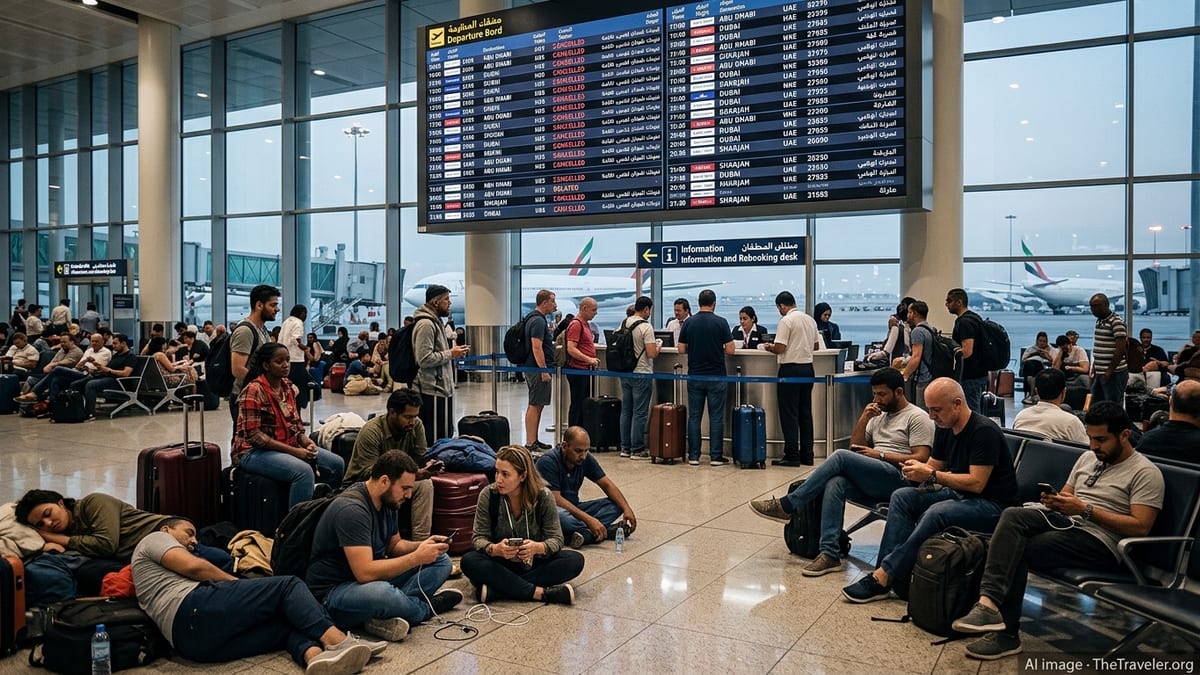
Limited Reopenings Offer Little Relief for Stranded Passengers
While the UAE has begun a cautious reopening of its skies, the patchy restoration of services is doing little to ease congestion at its busiest hubs. Aviation authorities confirmed that Dubai, Abu Dhabi and Sharjah are operating on sharply reduced schedules, prioritising repatriation flights, essential services and passengers with confirmed rebookings. Terminal halls that usually move transit passengers through in hours are now filled with travellers camping on seats and floors, waiting for new departure times that can change with little warning.
Etihad Airways, the national carrier based in Abu Dhabi, had earlier suspended all regular commercial services to and from Zayed International Airport until early Friday, March 6, allowing only limited cargo and special flights. A trimmed network has since resumed, but the airline is still cancelling and retiming departures as neighbouring airspace restrictions shift. Staff at Abu Dhabi describe a “rolling” operation, where schedules are adjusted day by day depending on which corridors are open.
In Dubai, where Emirates and flydubai are scaling up more quickly, the fallout from earlier cancellations continues to ripple through the system. Even as more aircraft take off, connecting passengers whose original Etihad, IndiGo or Qatar Airways flights were axed are often struggling to secure seats on alternative services. At Sharjah, low-cost carriers report full loads on the few flights that are operating, leaving limited capacity to absorb displaced travellers.
Travel agents in both the UAE and key source markets such as India and Europe say they are fielding nonstop calls from customers demanding clarity. Many passengers with multi-leg itineraries are discovering that a single cancelled segment to or from Abu Dhabi, Dubai or Sharjah can invalidate their entire trip, triggering complex and time-consuming rebooking negotiations.
Etihad, IndiGo and Qatar Airways Cut Deep Into Regional Networks
Operational data from airport and airline sources indicate that between them, Etihad Airways, India’s IndiGo and Qatar Airways have cancelled roughly 60 flights touching the UAE’s three main hubs over recent days, with at least 41 additional services operating with long delays. The figures cover a mix of point-to-point routes into Abu Dhabi, Dubai and Sharjah, as well as onward connections that rely on those airports as transfer points.
Etihad’s cancellations are concentrated on services linking Abu Dhabi to the wider Middle East and select European and Asian destinations, particularly where routings would normally cross the most heavily restricted airspace. The airline is instead focusing its limited flying program on routes where safe diversion options exist, while using spare capacity to run ad hoc repatriation flights for stranded travellers.
IndiGo, one of the largest foreign operators into the Gulf, has thinned out its busy schedule of services between Indian cities and the UAE. While it has mounted additional flights on some corridors to move backlog traffic, many passengers have seen their original journeys cancelled with short notice. The carrier is also operating select relief rotations, especially from Abu Dhabi, Dubai, Muscat, Ras Al Khaimah and Sharjah back to India, but seats are heavily over-subscribed.
Qatar Airways, which usually funnels large volumes of traffic between Asia, Europe, Africa and the Americas via Doha and onward to the UAE, continues to face its own severe constraints. The airline has parked much of its regional schedule, focusing instead on a narrow relief corridor linking Doha to a handful of long-haul destinations and special services aimed at repatriating travellers. As a result, many passengers who had planned to reach the UAE via Doha find themselves blocked before they even begin their journeys.
Human Impact: Missed Events, Mounting Costs and Frayed Nerves
For travellers on the ground, the operational statistics translate into very personal disruption. At Abu Dhabi’s terminals, families who had timed trips around school holidays and medical appointments describe days spent in limbo, repeatedly queuing at service desks only to be told that the next available flight is already full. Some have been rebooked several times, with each new option later cancelled as conditions evolve.
In Dubai and Sharjah, backpackers and business travellers alike are sharing hotel rooms to cut costs as their stays extend far beyond the original plans. While many airlines are providing accommodation and meal vouchers in line with their policies and local regulations, others are offering only partial support, citing the extraordinary nature of the regional airspace shutdown. Travellers without adequate travel insurance are finding that out-of-pocket expenses add up quickly.
The uncertainty is particularly acute for passengers on complex itineraries involving multiple airlines. A traveller who began their journey on IndiGo in India, connected to Etihad in Abu Dhabi and was due to continue on Qatar Airways via Doha, for example, may now be holding several partially used tickets, each governed by different rules. Resolving such cases often requires lengthy coordination between call centres and airport teams, with limited guarantee of a swift resolution.
Mental and emotional strain is also becoming evident. Airport volunteers and airline staff report an uptick in heated exchanges at gates and check-in counters, as exhausted passengers demand answers that frontline employees are often unable to provide. Authorities have increased security and customer-service teams around help desks in an effort to contain tensions and provide clearer, more consistent messaging.
Advice for Travellers: Check Status, Avoid Unnecessary Transit and Stay Flexible
With flight schedules changing by the hour, aviation authorities and airlines are urging passengers to check the live status of their flights before leaving for the airport and to avoid travelling without a confirmed booking. Walk-in passengers hoping to buy last-minute tickets or stand by for empty seats are being asked to stay away from terminals, as available capacity is being prioritised for those already holding disrupted reservations.
Travel experts recommend that anyone planning to fly into or out of Abu Dhabi, Dubai or Sharjah over the coming days build as much flexibility into their plans as possible. That includes allowing extra time for connections, being prepared to accept rerouting through alternative hubs, and keeping an open mind about date changes. Passengers are also advised to keep their contact details up to date with airlines so that automated notifications reach them quickly if schedules shift again.
Those who have not yet begun their journeys may want to consider postponing non-essential travel into the region until airlines have fully stabilised their operations. For essential trips, choosing itineraries with fewer connections and booking on a single ticket with one carrier or alliance can make it easier to secure assistance if things go wrong. Robust travel insurance that covers disruption caused by airspace closures or security incidents is also becoming an increasingly important safeguard.
As the airspace situation gradually improves and more corridors reopen, Etihad, IndiGo, Qatar Airways and their regional peers are expected to add back capacity in stages. However, industry observers caution that clearing the accumulated backlog of stranded passengers could take several more days, even in an optimistic scenario. For now, travellers are being told to expect continued uncertainty, even as the first signs of recovery appear in the departure boards of Abu Dhabi, Dubai and Sharjah.