

More news on this day
The United Arab Emirates has launched a new one-point travel system at Abu Dhabi’s Zayed International Airport, joining Bahrain and other Gulf partners in a regional push to streamline airport checks into a single, seamless experience for passengers.
A Pilot Linking Abu Dhabi and Manama Takes Off
The first phase of the one-point system went live this week on flights between Abu Dhabi and Manama, connecting Zayed International Airport with Bahrain International Airport under a shared clearance model. The project allows eligible travellers to complete key entry procedures for both countries at one location, sharply reducing the number of queues and formalities on arrival.
The launch follows a resolution adopted by Gulf interior ministers in late 2025, which endorsed a unified model to handle immigration, customs and security checks more efficiently for Gulf Cooperation Council nationals and, eventually, residents. In practice, the trial links systems in Abu Dhabi and Bahrain so that travellers transiting between the two capitals can pass through a single, fast-track channel instead of separate national checkpoints.
Officials say the streamlined approach is designed to mirror the ease of movement seen in Europe’s border-free travel area, though full passport-free circulation within the Gulf remains a longer-term ambition. For now, the corridor represents a significant technical and policy step towards that goal, placing Abu Dhabi’s main hub at the centre of the experiment.
How the New One-Point System Works at Zayed International
Under the pilot now operating between the UAE and Bahrain, eligible passengers clear most formalities before they depart. At the departure airport, security and immigration data is pre-checked and shared digitally with the destination state, allowing the arrival process to be compressed into a short, combined screening at a dedicated channel.
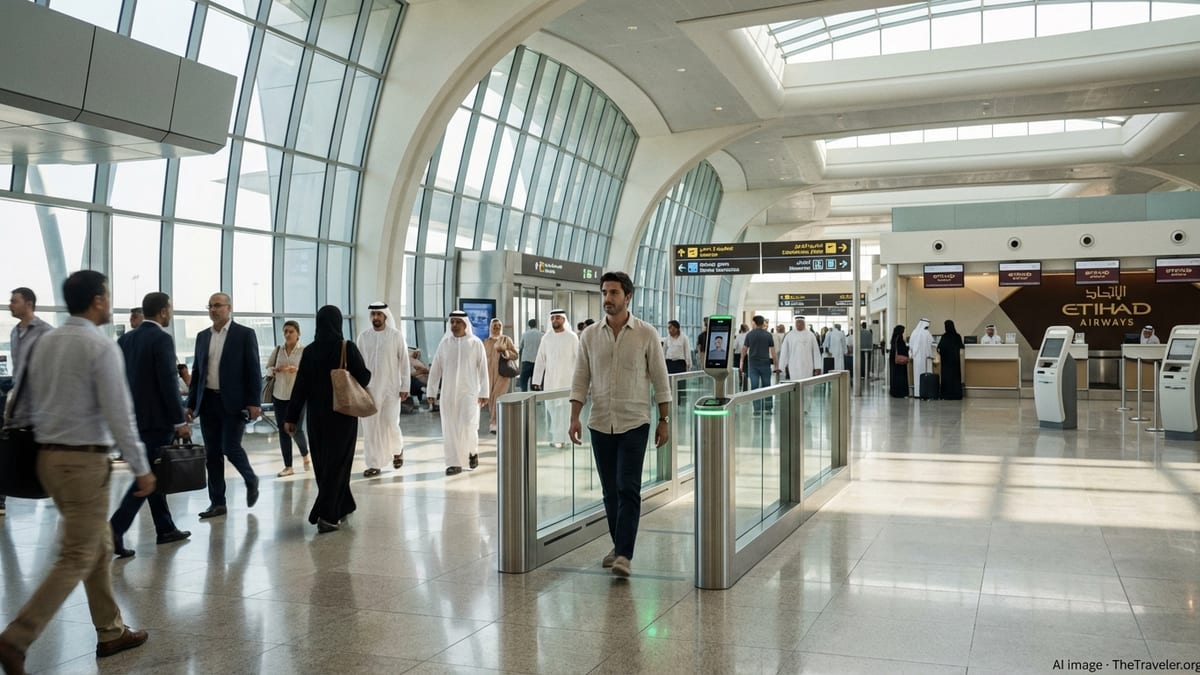
In Abu Dhabi, the system sits on top of a rapidly expanding biometric “smart travel” infrastructure at Zayed International Airport. The hub has been rolling out facial recognition across its passenger journey, from check-in and self-service bag drop to immigration e-gates and boarding gates. That biometric layer helps verify identity in seconds, enabling authorities to focus the new one-point channel on risk-based checks rather than repeated document inspections.
For travellers, the experience is designed to feel like one continuous flow. Boarding passes and passports are still required at this stage of the trial, but the number of times they are produced is shrinking. Airport executives say the aim is to bring total processing time from curb to gate, including border clearance, down to a fraction of traditional levels as the system matures.
From Biometric Corridor to Seamless Gulf Travel
Zayed International Airport has spent the past two years reshaping its passenger experience around biometrics, anticipating exactly the kind of cross-border integration now being tested. The airport’s new terminal has been configured for what operators describe as a “single-token journey,” in which a passenger’s face effectively becomes their boarding credential across multiple checkpoints.
Biometric e-gates and automated kiosks already handle large volumes of travellers, with facial templates captured once and used to authenticate identity as passengers move through immigration, duty-free areas, lounges and boarding bridges. Trials have demonstrated that process times can be cut from roughly 25 seconds to as little as seven seconds at each touchpoint, sharply reducing congestion during peak waves.
The new one-point system builds on that infrastructure by connecting Zayed International’s biometric corridor to systems in partner Gulf airports. As more airports across the region adopt compatible technologies, the vision is to create a network in which a single enrolment at the start of a journey unlocks a consistent, fast-tracked experience across several countries.
Gulf Cooperation Council Push for Integrated Travel
The UAE’s move at Zayed International comes as part of a wider Gulf Cooperation Council agenda to ease travel across the bloc’s six member states. At their meeting in Kuwait City in November 2025, GCC interior ministers formally backed a “single entry point for air travel” concept, to be rolled out in stages beginning with bilateral pilots.
That decision committed member states to upgrade the digital backbone of their border management systems, including shared platforms that can exchange watchlist information, travel histories and security alerts in close to real time. The one-point project launched between Abu Dhabi and Bahrain this month is the first tangible result of that political agreement, showcasing how regional integration can translate into shorter queues for everyday travellers.
Beyond aviation, Gulf officials have signalled that the single-point model could later be adapted to land borders and seaports. The long-term vision dovetails with discussions around a unified Gulf tourist visa and deeper economic integration, positioning seamless mobility as a pillar of the region’s competitiveness.
Who Benefits First: Eligible Passengers and Airlines
In the initial phase, the one-point system is available to citizens of the UAE and Bahrain travelling on select flights operated by their national carriers between Abu Dhabi and Manama. Those passengers can use the dedicated channel at participating terminals, where officers from both states coordinate checks through linked systems.
Airlines stand to gain from faster throughput at key choke points. Shorter processing times at immigration and security can help carriers tighten turnaround schedules, improve on-time performance and make better use of aircraft on high-frequency routes. For business travellers, the time savings can translate into more productive working days and greater flexibility for short-notice trips between regional capitals.
Airport operators also expect a knock-on benefit in the terminal itself. When bottlenecks at passport control ease, travellers have more time to spend in retail and dining areas, supporting non-aeronautical revenue streams that are increasingly important to hub economics.
Security, Data Protection and Public Confidence
Any move towards a single-point clearance model rests on strong security cooperation and public trust that personal data will be handled responsibly. Gulf officials stress that the new system is designed to strengthen, not relax, border safeguards by consolidating checks and giving authorities a more comprehensive view of passengers before they travel.
Behind the scenes, that means building shared electronic platforms capable of screening travellers against national and regional databases in seconds, while recording outcomes in a way that all participating states can access. Agreements on how long data is stored, who can see it and under what conditions it can be shared are central to the project’s viability, especially as more countries and airports join.
Public messaging has focused on the visible benefits of faster queues and contactless processing, but officials acknowledge that clear privacy standards will be essential as biometric use deepens. Regulators and airport operators are expected to refine consent mechanisms and transparency tools so that passengers understand what data is being captured and how it is used to facilitate their journey.
Positioning Zayed International as a Next-Generation Hub
The rollout of the one-point system reinforces Abu Dhabi’s strategy to position Zayed International Airport as a flagship next-generation hub in the Middle East. Since the opening of its new terminal, the airport has pursued a technology-led approach to growth, combining advanced security systems with an expanded retail and hospitality footprint.
Terminal A has been designed with nine biometric touchpoints in mind, giving Abu Dhabi Airports the flexibility to plug new services into an already dense digital infrastructure. Loyalty programmes, contactless payments and personalised retail offers are being layered onto the same foundation, turning the airport into a testbed for integrated travel and commerce experiences.
By aligning that in-house transformation with regional policy shifts on mobility, the UAE is seeking to ensure that Zayed International is not only efficient on its own terms but also deeply connected to the systems of neighbouring states. That connectivity is likely to become a key differentiator as Gulf hubs compete for transfer traffic, tourism flows and airline partnerships.
Next Steps: Towards a Wider GCC Travel Corridor
Authorities describe the Abu Dhabi–Manama link as a first phase that will be closely monitored before the model is extended to other Gulf routes. Technical performance, passenger feedback and security outcomes will all feed into decisions on how quickly to scale the system and which airports to prioritise next.
Interior ministries in Saudi Arabia, Qatar, Oman and Kuwait have already endorsed the principle of a shared one-point framework. As they ready their own systems, each country will adapt the concept to local regulations and infrastructure, leading to a patchwork of bilateral and multilateral corridors that could eventually knit together into a single, region-wide network.
For travellers, the incremental nature of that expansion means that, for some time, experiences will differ from route to route. Yet the direction of travel is clear: Gulf states are moving towards a future in which crossing borders within the region will feel progressively more like moving between domestic terminals than navigating traditional international frontiers.