

More news on this day
Flights in the United Kingdom have begun to be cancelled as the war in Iran reverberates through global aviation, pushing up fuel prices and disrupting key long-haul routes across the Middle East.
Get the latest news straight to your inbox!
First UK Cancellations Hit Regional Links
Travelers in southwest England were among the first in the UK to feel the impact, as regional carrier Skybus confirmed that services between Cornwall Airport Newquay and London Gatwick were being halted from 2 April. The airline attributed the abrupt move to circumstances beyond its control related to the Iran conflict and its knock-on effect on jet fuel availability and cost.
Reports indicate that the Skybus decision affects multiple daily connections that serve both business travelers and holidaymakers heading to and from Cornwall, a region that has worked in recent years to improve air links with London. The cancellations came with limited notice, prompting concern among local tourism and hospitality operators who rely on predictable air access as the summer season approaches.
Other UK airlines have not yet announced widespread domestic cancellations, but schedule adjustments and aircraft swaps are beginning to appear in booking systems. Industry analysts suggest that smaller regional routes with thinner profit margins are likely to be the first to come under pressure as carriers re-evaluate their networks in response to higher operating costs.
Passenger-rights advocates are already urging travelers to check their flight status frequently and to review compensation and rebooking rules under UK and EU regulations, which may apply differently depending on whether a cancellation is linked to technical, commercial, or security-related reasons.
Middle East Hubs Disrupted, Forcing Reroutes
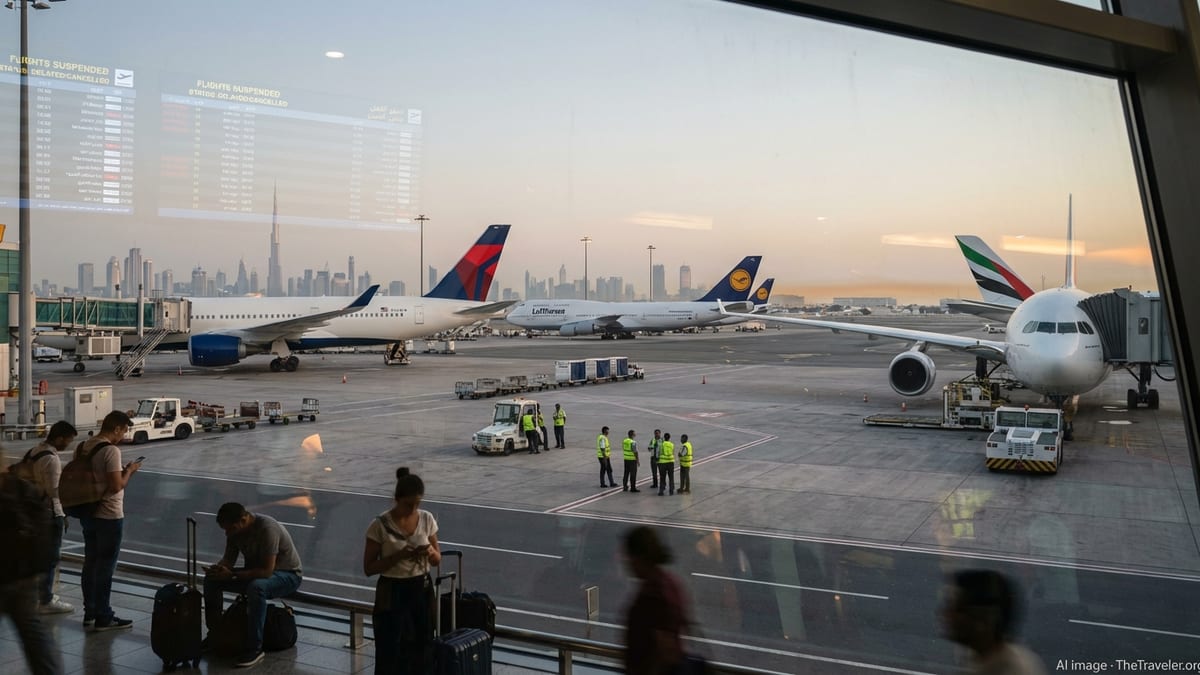
The developments in the UK come against a backdrop of severe disruption across the Middle East’s major aviation hubs since late February, when the Iran war escalated. Published coverage shows that airports in Dubai, Doha, Abu Dhabi and other Gulf cities have experienced waves of cancellations and delays as airspace closures and military activity forced airlines to suspend or curtail services.
Industry data cited in recent analyses indicates that more than twenty thousand flights were cancelled at key regional hubs in the first days of the conflict, affecting routes that connect Europe with Asia, Africa and Australasia. With Iran, Qatar, Israel and parts of surrounding airspace periodically restricted, many carriers have had to reroute aircraft along longer, more fuel-intensive paths.
This reconfiguration of global routes is feeding directly into the UK market. Flights that once connected British airports to destinations in Asia and Oceania via Gulf hubs are being cut back, consolidated or shifted to alternative routings through Europe, Central Asia or North America. Travelers departing from Heathrow, Gatwick and Manchester now face fewer one-stop options and, in some cases, significantly longer journey times.
Airline advisories reviewed in recent days highlight ongoing suspensions of services to several Middle Eastern cities, with extended validity for rebooking and refund waivers. For UK-based passengers, that translates into periods where certain destinations are effectively unreachable on their original itineraries, even if nominally still on route maps.
Fuel Prices Put Pressure on UK Airlines
The Iran war is also reshaping the economics of flying by driving oil and aviation fuel prices higher. Trade and financial press reports show benchmark crude prices climbing since the start of the conflict, as markets react to risks around the Strait of Hormuz and energy exports from the Gulf.
Rising fuel bills are particularly challenging for European and UK carriers that already face tight margins and heavy competition on long-haul routes. Some large airlines on the continent have warned they may ground part of their fleets if fuel costs remain elevated, a signal that network-wide capacity reductions are on the table if conditions deteriorate further.
In the UK, this environment increases the likelihood that airlines will trim less-profitable services, including thinner regional and off-peak routes, to preserve capacity on core transatlantic and high-demand leisure markets. For travelers, that could mean fewer daily frequencies, the withdrawal of marginal routes, and a shift of traffic toward larger hubs such as Heathrow at the expense of smaller regional airports.
Higher operating costs and constrained capacity also point toward sustained upward pressure on ticket prices. Analysts note that when airlines remove seats from the market, the remaining inventory often sells at higher fares, especially if demand for travel remains resilient despite geopolitical uncertainty.
Europe-Wide Impact Spreads Beyond the UK
The UK’s emerging disruption is part of a wider European pattern. Carriers across the continent have already cancelled or suspended services to multiple cities in Iran, Israel and the wider region, and some have announced sizeable schedule cuts in April as they adapt to new routing and fuel realities.
Published coverage of European schedules shows that airlines have halted flights to several Middle Eastern destinations and, in some cases, reduced overall flying to free up aircraft and crews. One Scandinavian carrier has flagged more than a thousand flights to be cancelled in a single month, highlighting the scale of the operational reset now under way.
As flights are diverted around closed or high-risk airspace, block times between Europe and Asia increase, tying up aircraft for longer and reducing the number of rotations each plane can perform in a day. This effect compounds fuel cost pressures and feeds through to network decisions that ultimately reach passengers at UK airports, even if their journeys are not directly routed via the Middle East.
Industry observers suggest that, unless the security situation in and around Iran stabilises and key air corridors reopen, European networks for the summer season will likely feature a patchwork of cuts, reroutes and capacity shifts rather than the broad expansions that airlines had planned before the conflict.
What UK Travelers Should Expect in the Coming Weeks
For UK travelers, the early wave of cancellations is a warning that disruption related to the Iran war could persist for some time. Travel insurers, government advisories and consumer groups are urging passengers to monitor airline updates closely and to consider flexible booking options when planning trips that might rely on affected regions or carriers.
Publicly available guidance from insurers notes that cover for war-related disruption varies widely between policies, and that travelers may need to rely on airline waivers and regulatory protections rather than insurance payouts in many scenarios. That makes it especially important to understand the terms attached to nonrefundable tickets, basic economy fares and promotional deals.
Experts in passenger rights point out that, within the UK and the wider European Union framework, travelers whose flights are cancelled are generally entitled to a choice between a refund and re-routing at the earliest opportunity, although entitlement to additional compensation can depend on whether the cause is considered extraordinary. The complex nature of war-related disruptions means outcomes may differ case by case.
As airlines, airports and regulators continue to respond to fast-changing conditions in the Middle East, passengers departing from or arriving in the UK are being advised to build more flexibility into their plans, allow extra time for connections, and keep abreast of shifting schedules. With the first cancellations now visible on domestic routes, the full extent of how the Iran war will reshape UK air travel is only beginning to emerge.