

More news on this day
Hundreds of travelers across the United Kingdom were left stranded or scrambling for alternative routes on Friday as at least 49 flights serving London and Manchester were cancelled and many more delayed, with services operated by Qatar Airways, Delta Air Lines, Qantas, Norse Atlantic, British Airways and other major carriers heavily affected by widening disruption linked to airspace closures in the Middle East.
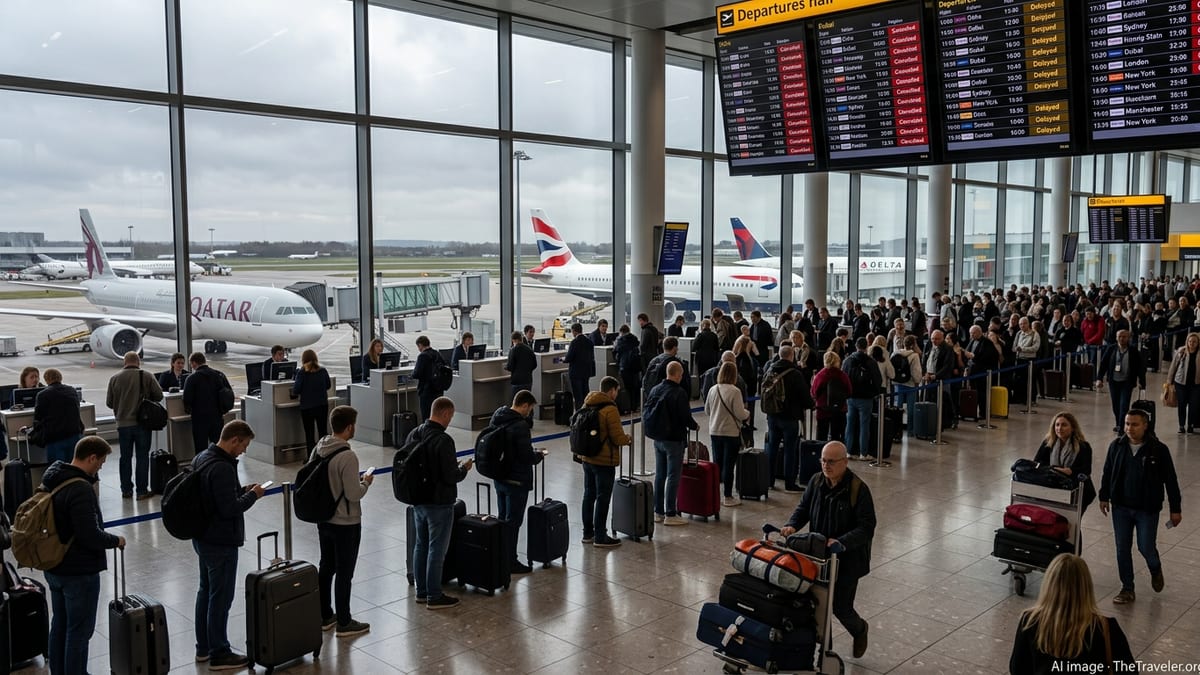
London and Manchester See Wave of Cancellations
By midafternoon, operational data from UK airports indicated a combined total of 49 cancellations on flights touching London and Manchester, alongside scores of late departures. London Heathrow and Gatwick bore the brunt of the disruption in the capital, while Manchester Airport, the country’s principal long haul gateway outside London, reported repeated schedule changes across its busiest intercontinental routes.
While the precise mix of affected services shifted throughout the day, passengers reported cancellations and lengthy delays on flights marketed or operated by Qatar Airways, Delta Air Lines, Qantas, Norse Atlantic and British Airways, among others. Several departures to key hubs including Doha, Dubai, Abu Dhabi and major North American cities were removed from departure boards or retimed at short notice as airlines recalibrated networks around closed or restricted airspace.
Airport operators urged passengers to check directly with their airline before setting off for the airport, warning that additional last minute changes remained possible as carriers continued to reassess routings, crew availability and turn times. Long queues formed at ticket desks and service counters as travelers sought rebooking options, refunds and overnight accommodation.
Although the disruption was concentrated on long haul operations, knock on effects filtered into European and domestic schedules as aircraft and crews were repositioned. Aviation analysts said the pattern of cancellations suggested a deliberate thinning of frequencies on longer routes to absorb extended flying times and diversions rather than a complete shutdown of services.
Qatar Airways and Gulf Connections Under Strain
Qatar Airways appeared among the most visible carriers affected for UK travelers, with multiple Doha bound departures from both London and Manchester scrubbed or rescheduled. The airline has already been operating a skeleton schedule on many routes while Qatari airspace remains closed, and the fresh wave of disruption further reduced connectivity between the UK and key destinations in Asia, Africa and Australasia that rely on Doha as a transit hub.
At Manchester, data compiled by airport and industry sources showed that services operated or marketed by Qatar Airways accounted for a significant share of the day’s long haul cancellations. Several rotations to Hamad International Airport were withdrawn outright, forcing passengers onto limited alternative departures in the days ahead or onto other Gulf carriers with spare capacity.
Travelers transiting through the Gulf reported receiving rebooking messages overnight and in the early hours of Friday, with some itineraries pushed back by 24 hours or more. Others were routed via different hubs, adding extra stops and longer journey times. Industry observers noted that with airlines such as Emirates, Etihad and Gulf Air also trimming schedules, options to and from the UK remained tight even for those prepared to travel at off peak hours.
In London, passengers booked on Qatar Airways services from Heathrow and Gatwick described departure boards flickering between delayed and cancelled statuses as the carrier attempted to consolidate lightly booked flights and prioritize essential sectors. Airline staff at check in counters were reported to be focusing first on passengers with immediate onward connections or urgent travel needs.
Transatlantic and Asia Pacific Links Hit by Delta, Qantas and Norse Atlantic Cuts
The disruption was not confined to Middle East services. Transatlantic operations also came under pressure, with Delta Air Lines among the carriers cancelling select departures between London and its US hubs as longer routings and crew duty limitations squeezed already tight schedules. While Delta has kept its core links to New York and Atlanta in operation, some frequencies were trimmed or retimed, leaving passengers facing rebookings across the alliance network.
Qantas, which operates high profile non stop services linking London with Australia alongside partner connections via the Middle East and Asia, also saw cancellations and extended delays ripple through its schedule. Travelers on London to Perth and London to Sydney routings reported reissued boarding passes and revised itineraries, with some journeys shifted onto partner carriers or broken with enforced overnight stops.
Norse Atlantic, the low cost long haul operator that focuses on leisure routes between the UK and North America, cancelled at least one rotation that was scheduled to operate from London, according to airport departure boards and passenger accounts. With a comparatively small fleet, each cancellation for Norse Atlantic represents a significant percentage of its daily schedule, leaving affected travelers with limited same day alternatives and little spare capacity for reaccommodation.
Industry analysts pointed out that while some of these cancellations can be traced directly to airspace restrictions and diversions, airlines are also making tactical decisions to protect operational resilience. By cancelling a subset of longer flights, carriers free up aircraft and crews to keep the remainder of their network functioning, even if that means abandoning some passengers to lengthy delays and complex rebookings.
British Airways and UK Carriers Battle Knock On Effects
British Airways, the UK flag carrier and the largest operator at Heathrow, spent the day juggling the consequences of the global disruption on its own schedule. The airline cut a number of departures serving the Middle East while introducing limited extra capacity on selected routes to help repatriate passengers affected by earlier cancellations and regional route suspensions.
Passengers with British Airways tickets reported both outright cancellations and rolling delays on flights from London and, to a lesser extent, from Manchester, particularly on services that usually traverse now restricted air corridors. The carrier has loosened its rebooking policies on several affected city pairs, allowing customers to move trips to later dates or change destinations within a defined geographic area without additional change fees.
Other UK based airlines, including leisure and low cost operators, also faced pressure as disrupted travelers looked for last minute alternatives. With many early March departures already heavily booked for school holidays and late winter sun breaks, spare seats at short notice were scarce and often significantly more expensive than original tickets.
Airport sources said that despite the scale of disruption, security and immigration queues remained manageable, suggesting that a substantial number of would be passengers took airlines’ advice to avoid heading to the airport without a confirmed alternative booking. Hotels near major hubs, however, reported brisk demand from stranded travelers seeking overnight stays while they waited for new flights.
What Stranded Travelers Are Being Told to Do
Across both London and Manchester, airline and airport messaging on Friday focused on encouraging affected passengers to manage their bookings digitally wherever possible. Most major carriers pushed updates through mobile apps, text messages and email, giving customers options to accept proposed new itineraries, request refunds or, in some cases, hold tickets open for future travel.
Consumer advocates reminded UK travelers that their rights depend on the operating carrier, the point of departure, and the underlying reason for the cancellation. Flights departing from UK airports are generally covered by UK passenger protection rules, but those arriving from abroad on non UK carriers may fall under different regimes, particularly where cancellations are linked to geopolitical events or government mandated airspace closures considered outside airlines’ control.
Passengers caught up in the disruption were advised to keep all receipts for accommodation, meals and ground transport, and to document communications with airlines. While some carriers offered hotel vouchers and meal coupons, others directed travelers to submit claims after their journey, creating uncertainty for those with tight budgets.
With airspace restrictions in the Middle East still evolving and global airlines already thinning schedules into the region, operational experts warned that UK travelers should brace for further short notice changes in the days ahead. For now, the immediate priority for carriers at London and Manchester is to clear the backlog of passengers from today’s 49 cancellations and to stabilize long haul operations as the situation develops.