

More news on this day
British holidaymakers planning Easter getaways to Germany and other popular European destinations are being urged to prepare for longer waits at passport control, as the UK government highlights Germany’s inclusion alongside Greece, Austria, Belgium, Denmark, Estonia, Finland and other states rolling out the European Union’s new Entry/Exit System at external Schengen borders.
Get the latest news straight to your inbox!
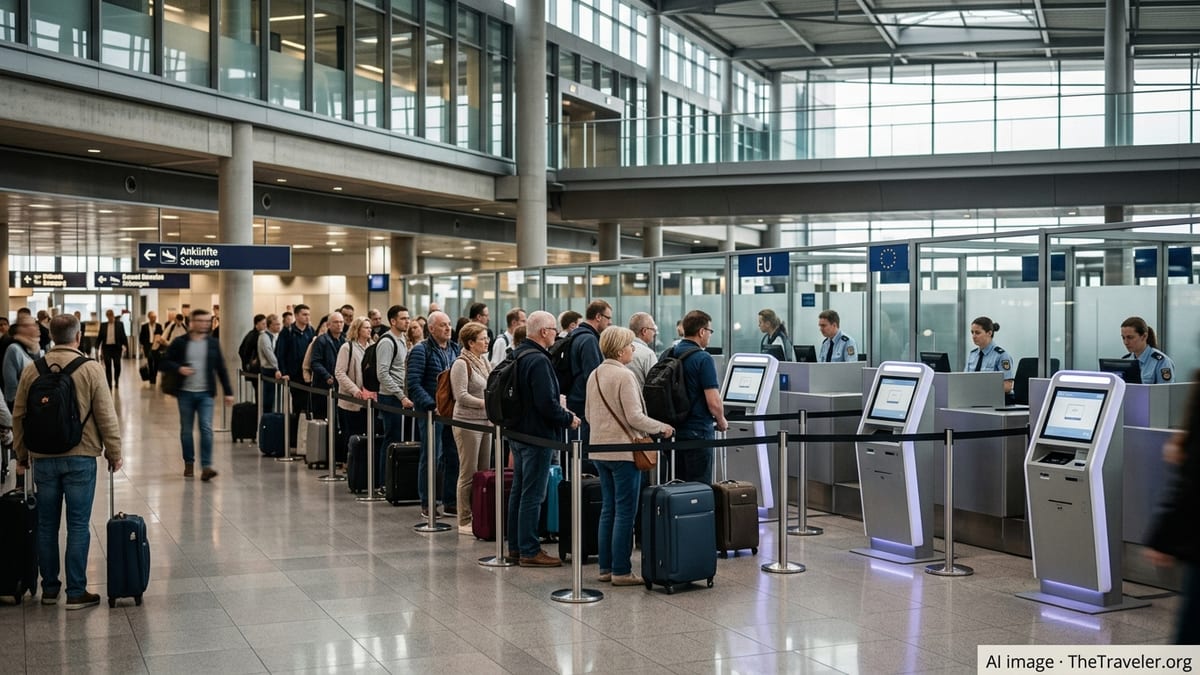
Germany Joins Growing List of EES Countries
Recent updates to UK government travel messaging underline that Germany is now among the Schengen countries actively phasing in the EU’s Entry/Exit System, or EES, for non-EU nationals such as British passport holders. Publicly available government guidance explains that the system began operating in October 2025 and is being introduced in stages across airports, ferry ports and land crossings, with variations between individual border points.
Germany’s participation comes on top of existing EES deployment in countries including Greece, Austria, Belgium, Denmark, Estonia and Finland, all of which are popular for city breaks and family holidays over the Easter period. Travel industry briefings and European media coverage indicate that the picture remains patchy: at some airports the system is already in regular use, while at others it may still be running in test mode or switched off at peak times to ease congestion.
The widening list matters because each additional country using EES increases the number of routes where British travelers face new digital checks on arrival and departure. Although the EU aims to streamline border controls in the long term, reports from several hubs since late 2025 suggest that first-time registration can be slow, particularly when large volumes of passengers arrive together.
For Easter travelers in 2026, this means that popular German gateways such as Munich, Frankfurt and Berlin, as well as Greek islands and Nordic capitals, may be operating under different rules and levels of readiness. UK government advice encourages passengers to check carrier communications and to allow extra time where EES is in force.
How the New Entry/Exit System Works for UK Visitors
The Entry/Exit System replaces the traditional practice of stamping passports for most non-EU visitors entering the Schengen area. According to official EU and UK guidance, travelers from the UK and other visa-exempt countries now have their details recorded in a central database the first time they cross an external Schengen border after EES goes live at that location.
This initial enrolment involves scanning the passport at a kiosk or desk and providing biometric data, typically fingerprints and a facial image, which are then linked to the passport number. The system also logs each subsequent entry and exit, helping border authorities monitor compliance with the 90-days-in-180 rule for short stays.
Once the first registration is complete, later crossings should, in principle, be faster because the traveler’s data is already stored. However, early experience from several European airports suggests that the registration step itself can take significantly longer than a simple stamp, especially if there are technical issues, language barriers or travelers are unfamiliar with using self-service machines.
For British travelers over Easter, the key practical change is that the very first arrival into an EES-enabled Schengen border may take noticeably longer, whether that is into Germany, Greece, Belgium or another participating state. Families traveling together should be prepared for each non-EU adult and child to be processed individually, which can further extend the time spent in queues.
What This Could Mean for Easter Queues and Connections
European and UK coverage of EES since late 2025 has highlighted instances of long lines and technical hiccups at some pilot locations, prompting concerns about how the system will cope with traditional holiday peaks. The EU has already allowed a phased roll-out, and recent reporting indicates that member states have the option to pause or slow use of the system temporarily if congestion becomes severe.
Even with this flexibility, travel and aviation groups continue to warn that busy weekends around Easter 2026 are likely to test the system. At major continental hubs, an influx of UK leisure travelers arriving within tight windows of time could meet staff still adjusting to new procedures, leading to sporadic bottlenecks at border control.
For those connecting onward to smaller regional airports or onward rail services, the risk is that an unexpectedly long wait at passport control could eat into minimum connection times. Passenger advice from airlines and train operators has increasingly urged travelers to allow additional buffer, particularly where an inbound flight from the UK connects to a separate ticket or a long-distance rail departure.
On the ground, the experience will vary by country and even by terminal. Some airports in Germany and the Nordic region have invested heavily in additional kiosks and staff training, while others are still scaling up. The mixed implementation means that one traveler may breeze through an EES border in minutes, while another, arriving around the same time at a different airport, faces an hour-long queue.
Key Differences Between EES and Future ETIAS
The current UK government messaging focuses on EES because it directly affects how British travelers are processed at the border this Easter. A separate system, the European Travel Information and Authorisation System, or ETIAS, is planned for a later stage and has itself been subject to multiple delays.
According to information published by the European Commission and summarized in recent travel industry bulletins, ETIAS is expected to start operations in the last quarter of 2026, following full implementation of EES. When it arrives, most visa-exempt travelers, including from the UK, will need to obtain an online travel authorisation before departure, similar to the United States ESTA model.
Crucially, ETIAS is not yet in force, so British holidaymakers heading to Germany, Greece or other Schengen destinations for Easter 2026 do not need to apply for it. The main change they will encounter at this stage is the EES registration at the border, not a pre-travel permit.
Nonetheless, the two systems are linked. EES provides the movement data that will underpin ETIAS checks in future, and both are part of a broader digital overhaul of EU external border management. Travelers who familiarise themselves with EES procedures now may find the transition to ETIAS smoother once that scheme finally launches.
Practical Tips for UK Travelers Planning an Easter Break
With Germany now added to the roster of EES-operating countries alongside Greece, Austria, Belgium, Denmark, Estonia and Finland, British travelers can take several simple steps to reduce the risk of disruption. Government guidance and travel industry advice both stress the importance of arriving early at departure points and allowing additional time at arrival airports for passport control.
Passengers are urged to ensure passports are valid and undamaged, keep travel documents to hand, and follow airline or ferry operator instructions on which lanes or kiosks to use. Families with children should be ready for younger travelers to be enrolled individually where required, and to keep groups together in queues to avoid further delays.
Choosing flight times outside the busiest weekend peaks, where possible, may also help. Some carriers report smoother processing during early morning or late evening arrivals, when border facilities are less crowded. For those booking tight connections, selecting through-tickets that protect onward journeys can offer an extra layer of reassurance if queues build unexpectedly.
Ultimately, reports from the first months of EES suggest that while delays are a genuine possibility, experiences differ widely between airports and days. Travelers heading for Easter breaks in Germany and across the Schengen area are being advised to plan for the worst but hope for the best: build in extra time, stay informed about local arrangements, and be prepared for new digital procedures at the border.