

More news on this day
Ukraine is moving to deploy its high-speed P1-SUN interceptor drones more widely across the country, seeking a scalable way to neutralize Russia’s relentless barrages of Shahed-style loitering munitions while preserving scarce missiles and artillery shells.
Get the latest news straight to your inbox!
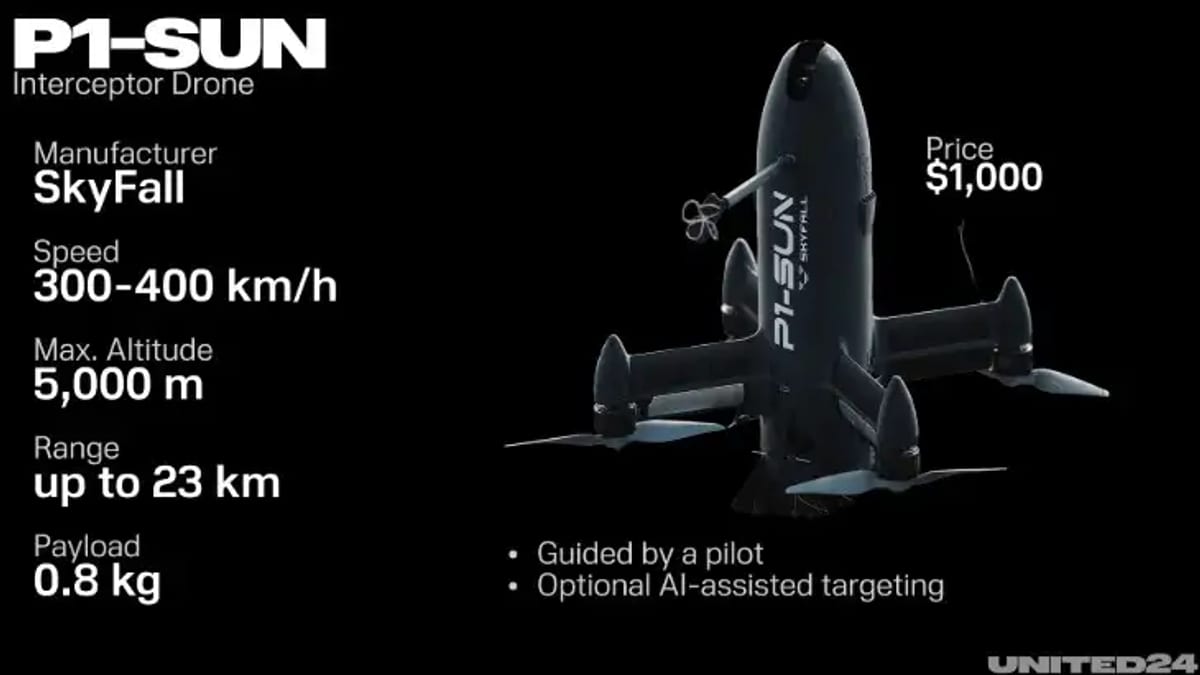
Image by Aviation News
A New Layer in Ukraine’s Air Defense Network
Publicly available information shows that the P1-SUN, developed by Ukrainian drone firm Skyfall, has shifted from prototype to mass-production status in recent months. Initially showcased at World Defense Show 2026 in Saudi Arabia as a short-range interceptor tailored to hunt Shahed and similar one-way attack drones, the platform is now being woven into Ukraine’s domestic air defense grid.
Reports indicate that Ukrainian planners view the interceptor as a missing layer between heavy surface-to-air missile systems and small arms fire. As Russia ramps up large-scale overnight strikes using Shahed and Geran variants, traditional missile defenses remain effective but costly, and can be saturated by sheer numbers. The P1-SSUN gives Ukrainian forces a reusable, rapidly deployable tool to engage slow and medium-speed loitering munitions at lower cost.
Analysts following the conflict note that the system slots into a broader “anti-drone dome” that Ukraine is trying to build. This evolving network combines radar and acoustic detection, lasers in development, and swarms of small interceptor drones that can be launched from dispersed positions across key regions.
Speed, Agility and a 3D-Printed Airframe
Technical details drawn from open-source defense coverage describe the P1-SUN as a compact, electrically powered interceptor that relies on high speed and agility rather than large warheads. The drone is built around a lightweight, 3D-printed airframe and a modular design that allows rapid replacement of damaged parts and quick turnaround between missions.
Performance data shared in specialist reports suggest that the P1-SUN can exceed 300 kilometers per hour in operational use, with some testing indicating peak speeds near 400 kilometers per hour. That velocity places it in the same envelope as many Shahed-type drones, giving operators a realistic chance to chase, overtake and physically ram or detonate near incoming targets before they reach urban or infrastructure areas.
Equally important is cost. Estimates from Ukrainian and international analyses put each P1-SUN at around 1,000 US dollars, far cheaper than high-end air defense missiles. In practice, this allows Ukrainian units to fire multiple interceptors at a single Russian loitering munition if needed without exhausting strategic stockpiles of more sophisticated weapons.
Combat Use Against Russian Loitering Munitions
Video evidence and frontline reporting emerging since late winter 2026 indicate that P1-SUN units are already in combat service against Russian loitering munitions. Footage verified by independent observers shows Ukrainian territorial defense brigades using the interceptor to chase and bring down Shahed and Geran drones over open countryside, visibly reducing the number that reach populated areas.
Drone-warfare monitors report that Ukrainian operators typically launch the P1-SUN from small, containerized racks once ground-based radar or acoustic arrays detect inbound swarms. Pilots then guide the interceptor via first-person-view links, maneuvering it to collide with or detonate near the target. Some publicly circulated clips show several interceptors engaging a single Shahed in sequence until it is destroyed mid-flight.
While exact success rates remain classified, Ukrainian and international assessments suggest that interceptor drones now account for a significant share of Shahed downings over major cities. The P1-SUN is frequently cited among the main platforms contributing to that trend, alongside other Ukrainian designs such as Sting and Octopus.
Scaling Production for Nationwide Deployment
Industry-focused coverage portrays Skyfall as one of Ukraine’s fastest-growing drone manufacturers, with assembly lines dedicated to churning out P1-SUN interceptors in large volumes. The use of 3D printing and off-the-shelf components appears to be central to this strategy, reducing bottlenecks and allowing new production facilities to be established closer to the front.
Ukrainian officials have publicly described ambitious plans to scale interceptor production across 2026, with a view to positioning launchers in every region regularly targeted by Russian strikes. Commentaries on Ukraine’s evolving defense sector highlight that domestic companies are increasingly able to supply thousands of interceptor-class drones per month, enabling a shift from improvised workshop projects to industrial-level output.
Travelers monitoring safety conditions in Ukraine are likely to see the effects of this shift first in major hubs such as Kyiv, Odesa and Kharkiv, where layered defenses are densest and intercept footage appears online most frequently. Over time, planners aim to extend comparable coverage to smaller cities, logistics corridors and energy infrastructure that have often been more vulnerable to Shahed raids.
Global Interest and the Broader Counter-Drone Race
As Ukraine fields the P1-SUN along its own front lines, the system is also attracting attention abroad. International media reports describe growing interest from the United States and Gulf states, which are confronting similar threats from Iranian-designed loitering munitions in the Middle East. Ukrainian counter-drone expertise, refined over four years of sustained combat against Shahed attacks, has become a sought-after asset.
Coverage from defense and technology outlets points out that countries facing large-scale drone salvos are looking for lower-cost ways to protect bases, ports and energy installations. Systems like the P1-SUN offer an appealing cost-per-shot compared with traditional missile shields, particularly when defending against relatively inexpensive one-way attack drones.
For Ukraine, wider deployment of the P1-SUN at home serves both immediate security needs and longer-term industrial goals. Each successful intercept over Ukrainian territory adds combat data that can be used to refine designs, train operators and demonstrate performance to potential partners, further strengthening Kyiv’s position in the fast-evolving global market for counter-drone solutions.