

Monastiraki is the Athens neighborhood where ancient stones, Ottoman echoes and today’s city rhythms collide. It is the place many travelers remember first when they think of the Greek capital: a square buzzing with street musicians, metro trains rumbling underneath, the Acropolis hovering above and a maze of flea markets and cafés running out in every direction.
This guide brings together the latest practical information with on-the-ground context so you can make the most of Monastiraki, whether you are here for one afternoon or several days.
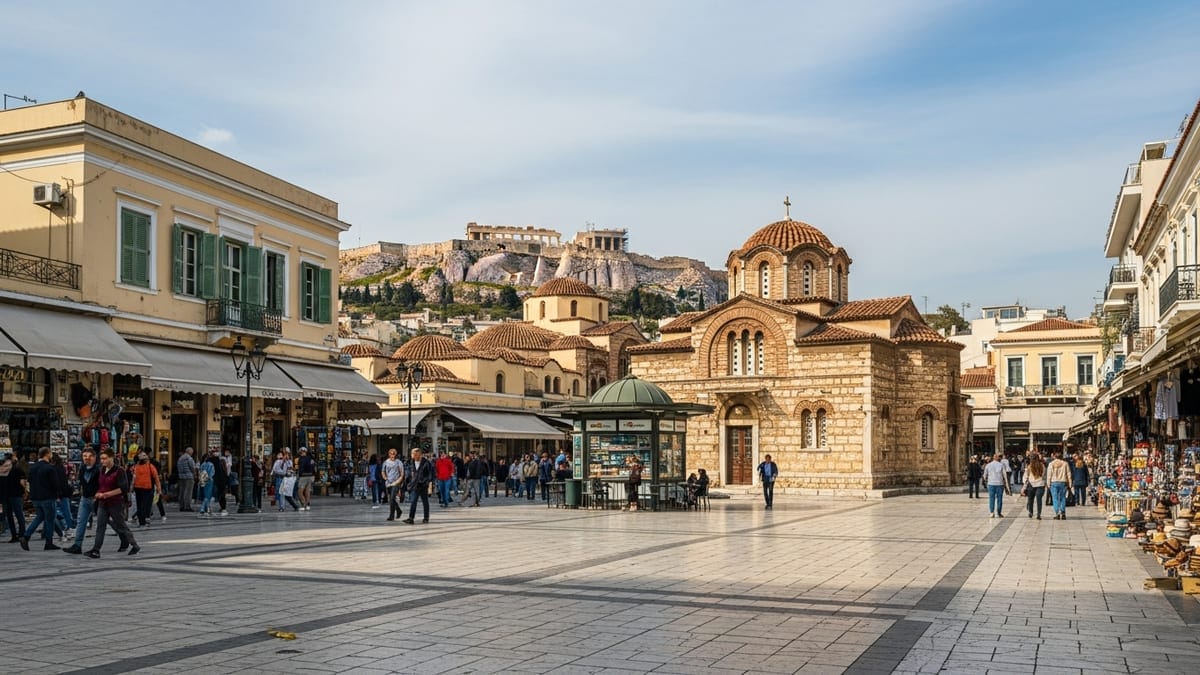
Getting Your Bearings in Monastiraki
Monastiraki sits in the historic heart of Athens, just below the northern slope of the Acropolis. It is officially a neighborhood of central Athens, but travelers usually experience it as a cluster of overlapping micro districts: the central square, the flea-market lanes radiating out toward Psyrri, and the older streets that climb gently toward Plaka and the Agora. Once you step out of the metro station, you are effectively in the middle of everything, with most sights within a 10 to 15 minute walk.
The neighborhood takes its name from the small church of Panagia Pantanassa, which still occupies one side of Monastiraki Square. Around it, layers of history unfold in every direction. To the north and west, the streets are dominated by market stalls and small shops selling everything from sandals to antiques. To the south and east, the streets lead toward major archaeological sites: Hadrian’s Library, the Roman Agora and, beyond them, the Ancient Agora and Acropolis.
Monastiraki Square itself works as your orientation point. Look up and you will see the Parthenon on its limestone pedestal, which makes it hard to get truly lost. On one side stands the former Tzisdarakis Mosque, a reminder of Ottoman Athens; on another, the neoclassical buildings that now house cafés and fast-food outlets. The square stays busy almost around the clock, so even late-night arrivals usually find it easy to get their bearings quickly.
Although Monastiraki is compact, it can be disorienting at first due to the density of stalls and narrow lanes. A mental map helps: picture the metro and square in the center, the main shopping streets of Ermou and Athinas as two axes running away from it, and smaller alleys such as Pandrossou and Adrianou threading between. Once you have walked one or two loops, you will begin to recognize landmarks and sightlines and the area becomes remarkably easy to navigate.
Getting To and Around Monastiraki
For most visitors, Monastiraki is the first real glimpse of Athens after leaving the airport or port. The neighborhood is one of the best-connected spots in the city, served by both Line 1 and Line 3 of the Athens Metro. From Athens International Airport, you can reach Monastiraki directly on Line 3 without changing trains. As of 2026, the journey takes about 40 minutes, trains run roughly every 30 minutes and a one-way airport ticket on the metro costs around 10 euros, with slightly discounted group fares for two or three people traveling together.
From Piraeus port, the main gateway for ferries, you can ride Line 1 directly to Monastiraki. The journey typically takes about 25 minutes, with frequent trains throughout the day. This direct connection is one reason many travelers choose to stay in or around Monastiraki, particularly when they have early-morning ferries or late-night arrivals. Taxis and ride-hailing services are widely available between the airport, port and central Athens, but traffic can be heavy at peak times and the metro is often faster and more predictable.
Once you arrive in Monastiraki, you are in a highly walkable area. Most major historic sites are within a 10 to 20 minute walk, and many corners of the neighborhood itself are pedestrianized or function as shared space with limited car access. Comfortable shoes are essential: historic paving, uneven stones and occasional steep sections toward the Acropolis can be hard on feet, particularly in summer heat. Short taxi or rideshare hops within the center are possible but often slower than walking due to one-way streets and traffic.
Public transport beyond the metro includes city buses and the tram that runs toward the coast, but for most visitors based in Monastiraki, walking and the metro cover nearly all needs. If you plan to use public transport several times over a few days, consider a tourist ticket that includes airport transfers and unlimited rides on metro, buses and tram for a limited period. These passes can represent good value if you expect to move around the city frequently, but light users may find that loading individual fares on the rechargeable Athens transport card is more economical.
What to See: History and Landmarks Around Monastiraki
Monastiraki is an access point to some of Athens’ most significant ancient and early modern sites. Just steps from the main square, Hadrian’s Library spreads out behind its colonnaded façade, a reminder of the Roman emperor’s building programs in Athens. Entrance requires a separate ticket, and since 2025 the former multi-site combo ticket issued by the Greek Ministry of Culture has been discontinued, so you now purchase entry separately for each archaeological site or through private combo products from tour operators.
A short walk south brings you to the Roman Agora, with its colonnades and the octagonal Tower of the Winds, which once functioned as a timekeeping and weather station. Slightly further along, the Ancient Agora opens up as a broad archaeological park. Here, the Temple of Hephaestus towers above well-preserved foundations and paths, and the reconstructed Stoa of Attalos houses a museum of finds from the site. Many visitors choose to explore the Ancient Agora in combination with a trip up to the Acropolis, using Monastiraki as the base between these key sites.
Inside Monastiraki Square, two historic buildings stand out. The small Pantanassa church, with its low, compact form, marks the plaza’s religious heritage. Opposite it, the former Tzisdarakis Mosque with its arched façade reflects the centuries of Ottoman rule. While the mosque itself is not currently used as a place of worship, it has housed museum collections and remains one of the square’s most distinctive silhouettes.
Beyond the strictly ancient, Monastiraki also opens onto Plaka and Anafiotika, older districts that climb the slopes toward the Acropolis. Exploring these streets from Monastiraki allows you to appreciate how ancient, Byzantine, Ottoman and modern layers fit together within a small area. For a different slice of cultural history, the Museum of Greek Folk Musical Instruments sits a short walk away in Plaka, showcasing traditional instruments and soundscapes from across Greece in a restored mansion.
Monastiraki Flea Market and Shopping Streets
Monastiraki is most famous among travelers for its flea market, a term that today covers a mix of permanent shops, street stalls and weekend antique sellers. The core of the commercial area runs along Pandrossou and Ifestou streets, narrow lanes packed with souvenir shops, leather sandal makers, T-shirt stands and jewelry counters. Prices and quality vary widely, so it pays to browse and compare before buying, especially for items such as handmade sandals and decorative pieces.
On weekends, especially Sundays, the character of the market shifts as antique dealers, collectors and secondhand sellers take over certain corners and side streets. You may find old coins, vinyl records, furniture, military memorabilia and an eclectic range of curiosities spread out on tables or blankets. Serious collectors should research in advance and inspect items carefully, but even casual browsers enjoy the atmosphere and opportunity to dig through unexpected finds.
Monastiraki is also one of Athens’ key districts for everyday shopping. Along Athinas Street, a short walk from the main square, you encounter spice shops, kitchenware stores, hardware merchants and grocers, illustrating the neighborhood’s role as a commercial hub for locals as much as for visitors. If you head toward Ermou Street, you move into a more mainstream shopping corridor with international and Greek clothing brands, shoe stores and accessory chains.
Bargaining is not as intense as in some other countries, but there is often some flexibility on prices for non-fixed items, especially in stalls selling antiques, art, rugs and souvenirs. Respectful negotiation is accepted: asking politely if there is “any little discount” or whether a better price is possible for multiple items is commonplace. For mass-produced goods with clearly marked prices, however, haggling is less common and often not effective.
Food, Drink and Nightlife in and Around Monastiraki
Monastiraki’s food scene mirrors its busy street life: casual, social and varied. Around the square and in nearby streets such as Mitropoleos and Aiolou, you will find numerous souvlaki and gyro counters. These are ideal for a quick, inexpensive meal while sightseeing. Portions are generally generous and you can eat on the go or at simple outdoor tables. Quality can vary between establishments, but turnover is high and meat and accompaniments tend to be fresh.
For more leisurely meals, look for traditional tavernas tucked into alleys off Adrianou Street, many offering views of the Acropolis illuminated at night. Menus often focus on classic Greek dishes: grilled meats, baked casseroles, salads, spreads and seasonal vegetables. In the evening, these areas fill with both locals and visitors, and it is common to linger over a carafe of house wine or ouzo with small plates. Reservations are recommended in high season if you want a specific terrace or rooftop view.
Cafés and dessert stops are equally abundant. Throughout the day, Athenians and travelers stop for strong Greek coffee, iced freddo espresso or cappuccino, and traditional sweets such as loukoumades, the honey-soaked doughnuts that are popular as a snack or dessert. Gelato and ice cream counters stay open late during the warmer months, providing a welcome way to cool down after walking the stone streets under the sun.
Nightlife in and near Monastiraki ranges from laid-back wine bars to lively rooftop cocktail lounges. Many rooftops around the neighborhood now host bars with direct Acropolis views, particularly appealing at sunset and into the evening. Nearby Psyrri, only a few minutes’ walk away, offers a more bohemian atmosphere with small bars, live music spaces and late-night cafés. Noise levels in the immediate vicinity of Monastiraki Square can be high at night, so travelers who prefer quiet evenings may wish to choose accommodation on side streets a little removed from the main thoroughfares.
When to Visit and How Long to Stay
Monastiraki’s atmosphere changes considerably with the seasons and even by hour of the day. Spring and autumn are often considered the best times to visit Athens overall, and Monastiraki is no exception. From late March to June and from September to early November, temperatures are generally more comfortable for walking, and the intense summer crowds are somewhat reduced, though weekends and holiday periods can still be busy.
July and August bring high heat and dense crowds, especially in the middle of the day. In peak season, the square and surrounding shopping streets can feel packed from late morning until well into the evening. If you visit in summer, early mornings and late evenings are the most pleasant times to wander the area. Shops typically open late in the morning and stay open into the evening, so you can adapt your schedule to avoid the hottest hours.
Winter transforms Monastiraki into a cooler, sometimes drizzly but often more relaxed environment. Many shops remain open, and there is still a steady flow of visitors, but the streets are less crowded, and you may find more space to browse and photograph. Around Christmas and New Year, festive lights and seasonal markets add a different character to the square and its surroundings.
In terms of timing, you can walk the core of Monastiraki in a couple of hours, but to really appreciate the area you should allow at least half a day. A full day gives you time to combine a leisurely market visit with one or two nearby archaeological sites, a sit-down meal and perhaps an evening drink with views of the Acropolis. Many visitors who base themselves in the neighborhood for several nights find themselves returning repeatedly to the same corners, watching how the light, crowds and street life change over time.
Practical Tips: Money, Tickets and Safety
Monastiraki is firmly on the tourist map, which brings conveniences and challenges. Prices for food and souvenirs in the immediate square and surrounding main lanes may be higher than in residential neighborhoods, though many options remain reasonable by wider European standards. Cash and cards are both widely accepted, but some smaller market stalls and antique sellers prefer or require cash. ATMs are plentiful around the square and along Athinas and Ermou streets.
For archaeological sites, a major recent change is the discontinuation, as of 2025, of the official combined ticket issued by the Greek Ministry of Culture that once covered the Acropolis and several central Athens sites. You now purchase individual tickets for each site through the official e-ticket system or at on-site ticket offices. Private companies sell their own “combo” passes bundling timed-entry tickets to multiple sites with audio guides or app access. These can be convenient but typically cost more than buying basic admissions separately, so read inclusions carefully and decide based on how many sites you realistically plan to visit.
Monastiraki is generally safe, including at night, thanks to constant foot traffic and a visible police presence. However, like many crowded urban areas, it is a hotspot for petty theft and pickpocketing, especially around the metro station, in packed lanes and at busy café terraces. Use standard precautions: carry bags in front of you, avoid keeping valuables in back pockets, and be cautious about distractions from strangers. At night, stick to well-lit streets, and if you are returning to accommodation outside the center, consider using the metro before its closing time or a reputable taxi service.
Heat is another important practical issue, particularly in summer. Surfaces in and around Monastiraki, from the square paving to the archaeological stonework, reflect and radiate heat, making it feel hotter than the official air temperature. Wear a hat, sunglasses and light, breathable clothing; carry water, which is easy to buy from kiosks; and take breaks in shaded squares or indoor cafés. Comfortable footwear with good grip will make navigating cobbles, steps and slopes safer and more pleasant.
Staying in Monastiraki: Pros and Cons
Many travelers choose to stay in or very near Monastiraki because of its central position and easy transport links. From a base here, you can walk to most must-see sights, including the Acropolis, Plaka, Syntagma Square, Psyrri and the central market on Athinas Street. The metro station’s connection to both the airport and Piraeus port is another major advantage, particularly for those catching early ferries or late arrivals from flights.
Accommodation options are wide-ranging. In recent years, historic buildings around Monastiraki have been converted into boutique hotels, hostels and serviced apartments. Rooftop terraces and balconies with Acropolis views are a common selling point, particularly in midrange and higher-end properties. Budget travelers find dormitories and simple guesthouses in nearby streets, especially toward Psyrri and Omonia. As with any popular center, it is worth reading recent guest feedback to confirm noise levels, cleanliness and the current state of any advertised amenities.
Noise is the main drawback of staying right on or immediately adjacent to Monastiraki Square. Street musicians, buskers, nightlife, traffic and late-night crowds can make the area lively until the early hours, particularly in high season and on weekends. If you are sensitive to noise, consider booking a room facing a courtyard or side street, check whether your chosen accommodation has effective soundproofing, or stay slightly further away while still within walking distance.
Another factor is cost: while there are still good deals to be found, prices in Monastiraki can be higher than in less central neighborhoods, particularly during major events or peak holiday periods. On the other hand, the money you might save by staying farther out could be offset by extra spending on transport and time. For many first-time visitors who want to maximize time on the streets and minimize commuting, Monastiraki remains one of the most efficient and atmospheric areas to base themselves.
The Takeaway
Monastiraki is where Athens’ layers of history and contemporary city life intersect in a tight, walkable grid. From the shadow of Hadrian’s Library and the Roman Agora to the spice-scented shops of Athinas Street and the rooftop bars with Acropolis views, it offers an immediate sense of place that many travelers look for in a city break. The neighborhood is busy and sometimes chaotic, but it is also rich with small moments: a musician playing on a corner, a vendor carefully arranging old books, a sunset glow catching worn stone façades.
With current knowledge about transport routes, ticketing changes and seasonal patterns, it is easier than ever to plan time in Monastiraki that fits your interests and pace. Whether you use it as a base for exploring the whole of Athens or as a concentrated window into the city’s character, approaching Monastiraki with a bit of preparation and an open schedule will reward you with memorable experiences. Allow yourself time to wander beyond the immediate square, look up at the Acropolis from different vantage points, and let the neighborhood’s sounds and textures tell you their own stories.
FAQ
Q1: How do I get from Athens International Airport to Monastiraki?
From the airport, take Metro Line 3 directly to Monastiraki station. Trains typically run about every 30 minutes, the journey takes around 40 minutes and you need a special airport ticket. Taxis and ride-hailing services are also available, but traffic can make them slower and more expensive than the metro.
Q2: Is Monastiraki a good area to stay in for first-time visitors?
Yes, Monastiraki is one of the most convenient bases for first-time visitors because it is central, walkable and well-connected by metro to the airport and port. You can reach major sights on foot and have many dining and shopping options nearby, though you should be prepared for noise and crowds, especially at night.
Q3: Is Monastiraki safe at night?
Monastiraki is generally safe, with plenty of people around until late and a visible police presence. The main issue is petty theft in crowded spots, so keep an eye on your belongings, avoid displaying valuables and stay aware of your surroundings, particularly around the metro and in tightly packed market lanes.
Q4: What happened to the old combined ticket for Athens archaeological sites?
The official combined ticket issued by the Greek Ministry of Culture, which once covered the Acropolis and several central Athens sites, was discontinued in 2025. You now buy separate tickets for each site or opt for private combo products sold by tour operators that bundle multiple admissions and services, often at a higher overall price.
Q5: When is the best time of day to visit the Monastiraki flea market?
Late morning and late afternoon are popular times, when most stalls are open and the light is good for photos. Early mornings can be quieter and better for browsing without crowds, while evenings have a lively, social atmosphere but can be more congested, especially in high season and on weekends.
Q6: Can I walk from Monastiraki to the Acropolis and other major sights?
Yes, the Acropolis, Ancient Agora, Roman Agora, Hadrian’s Library, Plaka and Syntagma Square are all within a roughly 10 to 20 minute walk from Monastiraki. The area is compact and largely pedestrian-friendly, making walking the most pleasant and efficient way to move between these sites.
Q7: Are prices in Monastiraki higher than elsewhere in Athens?
In the immediate square and main tourist lanes, prices for food, drinks and souvenirs can be higher than in more residential parts of the city. However, there are still reasonably priced tavernas, bakeries and cafés, especially if you step a few blocks away from the main square or explore nearby streets like Athinas and smaller alleys off Adrianou.
Q8: What should I wear and bring for a day in Monastiraki?
Wear comfortable walking shoes with good grip, as many streets are uneven or paved with smooth stone. In warmer months, bring a hat, sunglasses and sunscreen, and carry a refillable water bottle. Light, breathable clothing works best in the heat, and a small day bag that you can keep in front of you is practical for both comfort and security.
Q9: Do shops and markets in Monastiraki accept credit cards?
Most established shops, restaurants and cafés accept major credit and debit cards, but some smaller stalls and antique sellers still prefer cash. It is wise to carry some euros for small purchases and bargaining, while using cards for larger expenses. ATMs are easy to find around the square and along main streets.
Q10: How many days should I plan in Monastiraki and the surrounding area?
You can experience the core of Monastiraki in half a day, but one full day allows time for the flea market, a sit-down meal and at least one nearby archaeological site. Staying two or three nights in or near Monastiraki works well for many travelers, providing a central base to explore the wider city while returning to the neighborhood’s lively streets in the evenings.