

More news on this day
A Russian daytime drone attack on March 24 has damaged part of the UNESCO-listed historic center of Lviv, injuring residents and igniting fresh concern over the safety of Ukraine’s cultural heritage as the war’s front lines creep into cities once seen as relative havens.
Get the latest news straight to your inbox!
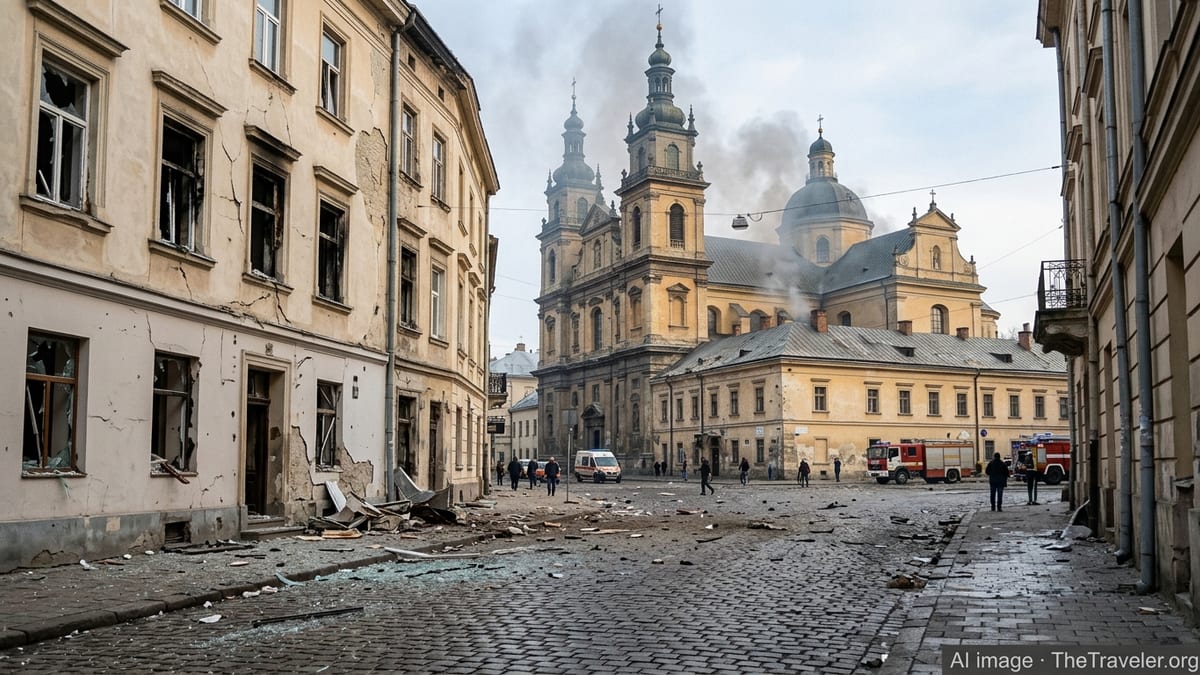
Historic Lviv landmark hit in rare daytime strike
According to published coverage from international news agencies, several drones struck central Lviv on March 24, hitting a residential building and parts of the Old Town, around 60 kilometers from the Polish border. The attack unfolded in the early afternoon, an unusual timing in a conflict where large-scale aerial barrages have more often taken place at night.
Reports indicate that at least 13 people were injured in the Lviv strike, some of them seriously, after one of the drones slammed directly into an apartment block in the dense historic quarter. Video published by local residents on social media shows a drone diving toward a multi-story building, followed by an explosion and flames engulfing the structure.
The impact and subsequent fire also affected the ensemble known as the Bernardine Monastery complex, including the 17th century St. Andrew’s Church, which forms part of the World Heritage property "Lviv: the Ensemble of the Historic Centre." The complex sits just south of the city’s main market square and is one of the most recognizable silhouettes in Lviv’s skyline.
Publicly available information from cultural heritage bodies describes the Bernardine complex as a fortified monastic ensemble dating from the early 1600s, with richly decorated facades and interiors that have undergone ongoing restoration in recent years. Initial images from the scene suggest scorch marks and broken windows in the vicinity, though detailed structural assessments are still pending.
UNESCO heritage status under renewed strain
Lviv’s historic center was inscribed on the UNESCO World Heritage List in 1998, recognized for its well-preserved medieval layout and a unique blend of Central and Eastern European architectural traditions. The March 24 strike marks one of the most direct hits on a component of this property since the full-scale invasion began.
UNESCO has previously described itself as deeply alarmed by attacks affecting World Heritage sites in Ukraine, including earlier strikes on Odesa and repeated incidents in and around Lviv’s protected area. In recent state of conservation reports, Ukrainian authorities and UNESCO experts have warned that repeated blast waves and shrapnel are gradually weakening historic masonry, stained glass, and wooden elements even when buildings are not directly hit.
Local conservation planners have worked over recent years to reinforce windows, install protective coverings on sculptures, and digitize archives housed in historic monasteries and civic buildings. The Bernardine complex itself has seen extensive restoration co-financed by international cultural heritage institutes, with work continuing into 2025 and 2026.
The latest damage underscores how fragile these protections can be in the face of modern weapons. Travel specialists following the situation note that even limited visible damage can conceal deeper structural harm, complicating future conservation efforts and potentially altering how visitors experience some of Lviv’s best-known landmarks.
City once seen as a refuge now on the front line of air war
Lviv, a major city in western Ukraine, was initially perceived by many residents and travelers as a safer hub far from the main battle lines in the east and south. Early in the conflict, it became a key transit point for displaced civilians and international organizations, and for a time it retained a semblance of normal urban life compared with heavily bombarded cities closer to the front.
Over the past two years, however, the city has been drawn more frequently into the air campaign. Previous barrages, including a large-scale missile strike in September 2024, damaged residential districts and infrastructure in the buffer zone surrounding the World Heritage property. More recent waves of drones and missiles have targeted energy and logistics sites across western Ukraine, with Lviv repeatedly included in the list of affected areas.
The March 24 drone attack came amid what open-source monitoring groups describe as one of the most intense reciprocal aerial campaigns of the war to date, with Russia launching hundreds of drones at Ukrainian cities and Ukraine striking military-linked targets across the border. Analysts quoted in international coverage suggest that such mass attacks increase the likelihood of debris or errant drones hitting densely populated historic districts.
For residents of Lviv’s Old Town, the latest strikes erode any lingering sense that cobbled streets and baroque facades might be shielded by distance from the front. Images shared on social platforms show shattered windows, charred balconies, and smoke drifting above the city’s cluster of spires and domes, a scene that contrasts starkly with the prewar reputation of Lviv as a romantic, café-lined city break destination.
Implications for cultural tourism and future visits
Before the full-scale invasion, Lviv was one of Ukraine’s most visited cities, drawing international travelers with its compact Old Town, coffeehouses, and layered Austro-Hungarian and Polish heritage. While foreign tourism has largely halted since 2022, domestic visitors, aid workers, journalists, and a small number of business travelers have continued to pass through the city.
Travel-industry observers note that damage to signature landmarks such as the Bernardine complex carries symbolic weight far beyond the immediate area affected. Heritage-led tourism has long been central to Lviv’s identity, and its skyline of churches, townhouses, and defensive walls features prominently in promotional imagery used to represent western Ukraine.
The current security situation means there is no conventional leisure tourism into Ukraine, and foreign ministries in Europe and North America continue to advise against travel. For future visitors, however, the latest strike will likely become part of the story of Lviv’s Old Town, just as wartime scars remain visible in historic centers across Europe.
Cultural organizations are expected to intensify documentation and stabilization efforts in the coming months, working to secure roof structures, glazing, and decorative elements where possible. Once conditions allow, heritage experts anticipate that careful restoration and sensitive interpretation will be essential in welcoming travelers back to a historic center that now bears visible marks of war.
Balancing preservation with daily life in a living city
Despite its World Heritage status, Lviv’s historic center remains a lived-in urban space, with apartments, offices, cafes, and archives sharing streets with churches and monuments. The March 24 attack, which struck both a residential building and a religious complex, illustrates how inseparable civilian life and cultural heritage have become in the city’s dense core.
Urban planners and conservationists working with Lviv’s historic environment department have long emphasized the need to integrate preservation with contemporary needs, from modern utilities to accessible public spaces. Wartime conditions add another layer of complexity, as sandbags, temporary bracing, and protective coverings must coexist with everyday pedestrian flows and essential services.
Reports from the ground after the latest strike describe firefighters, emergency crews, and local residents moving quickly to contain blazes and clear debris from narrow streets. At the same time, heritage advocates are calling for rapid assessments to document any new cracks, dislodged stones, or smoke damage inside the Bernardine complex and neighboring buildings.
For future travelers and cultural visitors, the evolving story of Lviv’s Old Town will likely include not only its centuries of architectural layering but also the resilience of residents who continue to live and work amid a landscape of both beauty and vulnerability.