

More news on this day
A United Airlines flight carrying more than 160 people narrowly avoided a collision with a U.S. Army Black Hawk helicopter near a Southern California airport this week, a close call that has intensified concern over interactions between military and commercial aircraft in crowded airspace.
Get the latest news straight to your inbox!
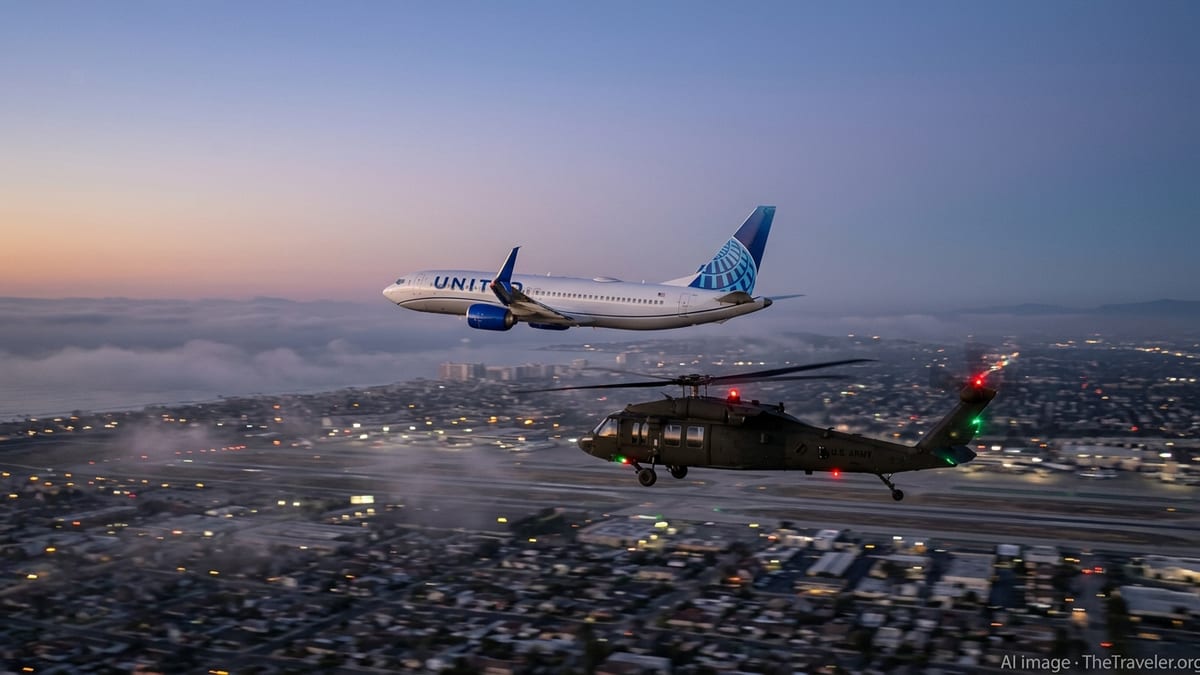
Incident Near John Wayne Airport Raises Alarms
Publicly available information indicates the incident occurred around 8:40 p.m. local time on Tuesday, March 24, when a San Francisco bound United Airlines jet was descending toward John Wayne Airport in Orange County. At the same time, a military Black Hawk helicopter returning from a training mission crossed into the passenger plane’s flight path.
Tracking data cited in multiple reports shows the aircraft came within roughly 525 feet vertically and about 1,400 feet laterally before the airliner halted its descent and leveled off after an onboard collision‑avoidance system issued an alert. The United flight was carrying 162 passengers and six crew members.
The jet subsequently continued to its destination without a collision, and there were no immediate reports of injuries on either aircraft. However, the proximity of the two machines in a busy terminal area has been described in aviation circles as a serious loss of separation that could have had catastrophic consequences.
According to published coverage, the Federal Aviation Administration has opened an investigation into how the Black Hawk’s return from training brought it into conflict with an arriving airline flight and whether existing procedures were followed by all parties involved.
Collision‑Avoidance Technology Credited With Averting Disaster
Preliminary accounts emphasize the role of the airliner’s safety systems and crew response in preventing a midair collision. Data derived from flight‑tracking platforms suggests the United jet was already on approach when its traffic alert and collision‑avoidance system detected the helicopter’s path and instructed pilots to stop descending.
Aviation analysts note that such systems are designed precisely for these scenarios, providing last‑second vertical separation when aircraft find themselves on converging trajectories. The sharp leveling maneuver ordered by the alert, while routine in training, can be jarring when executed in real‑world conditions with a full load of passengers.
Reports indicate that the helicopter was on a nighttime training return, a phase of flight that can be especially complex near civilian hubs, given differing performance characteristics, altitudes, and speeds between military rotorcraft and commercial jets. Investigators are expected to examine how air traffic control information, onboard instrumentation, and pilot decision‑making interacted in the final moments before the near miss.
Specialists following the case say the episode will likely add momentum to broader discussions about how collision‑avoidance technology, including future sensor and data‑sharing upgrades, can further reduce risk when different types of aircraft share constrained airspace.
Context: Recent Deadly Crash Involving Black Hawk and Airliner
The close call near John Wayne Airport comes just over a year after a devastating midair collision between an American Airlines regional jet and an Army Black Hawk helicopter over the Potomac River near Washington, D.C., which killed all 67 people aboard both aircraft. That January 2025 disaster over Ronald Reagan Washington National Airport remains under intense scrutiny.
According to publicly available hearing transcripts and investigative updates, that crash exposed a series of vulnerabilities, including questions about the helicopter’s altitude, the use and reliability of certain onboard instruments, and the adequacy of established routes and altitude restrictions meant to keep helicopters below fixed‑wing traffic near Reagan National.
In the wake of that tragedy, safety recommendations have included potential bans or strict curbs on some helicopter operations along existing corridors near the airport, as well as calls for more consistent use of systems that broadcast an aircraft’s position to controllers and nearby traffic. Aviation groups have also urged closer coordination between civilian regulators and the military on training flights conducted in high‑density terminal airspace.
Observers note that the recent United near miss, while nonfatal, is likely to be viewed through this lens of heightened sensitivity. The fact that another Black Hawk operating near a commercial jet in busy U.S. airspace came dangerously close, even without impact, is expected to sharpen calls for more systemic change.
Investigators Focus on Procedures, Training and Airspace Design
Initial accounts indicate that the current inquiry will examine whether established separation standards were maintained in the minutes leading up to the encounter near John Wayne Airport and how existing procedures govern the interaction of military helicopters and commercial jets in the area’s approach corridors.
Analysts following the case say investigators are likely to reconstruct detailed flight paths using radar and transponder data, assess air traffic control instructions, and compare them with the aircrafts’ recorded altitudes and headings. Particular attention is expected to fall on whether any miscommunication, incorrect assumption, or deviation from standard practice allowed the two flight paths to converge.
Training protocols for both military and airline crews may also come under renewed examination. While airline pilots practice collision‑avoidance responses in simulators, the effectiveness of those maneuvers depends on timely alerts, clear cockpit coordination, and predictable behavior by nearby traffic. For helicopter crews, especially those operating at night or returning from training missions, understanding the boundaries and expectations around busy civilian airports is considered a critical safety element.
Airspace design in Southern California, one of the most complex and congested regions in the United States, is another likely focus. The region’s overlapping arrival and departure routes for multiple airports, layered with military operations and general aviation, have long posed a challenge for regulators seeking to balance efficiency with safety margins.
Renewed Scrutiny of Near Misses in U.S. Skies
The United incident adds to a growing list of serious near‑miss events across the United States that have generated concern among travelers and aviation professionals. Industry experts note that while commercial aviation remains statistically very safe, a cluster of close calls in recent years has prompted fresh questions about the adequacy of safeguards in an era of high traffic volumes and constrained infrastructure.
Publicly available safety analyses have highlighted factors such as staffing levels in air traffic control facilities, the complexity of mixed‑use airspace around major hubs, and increased reliance on automation. Episodes involving helicopters near commercial jets, particularly in the Washington, D.C., area after the 2025 Black Hawk collision, have underscored how quickly routine operations can turn hazardous when any link in the safety chain weakens.
For passengers, episodes like the near collision near John Wayne Airport can be unsettling reminders of risks that are typically managed invisibly. Aviation advocates argue that transparent reporting, rigorous investigation, and visible implementation of recommendations are essential to maintaining public confidence.
As investigators reconstruct the seconds leading up to the United jet’s evasive maneuver, the near miss is likely to inform ongoing national debates about airspace modernization, better integration of military and civilian operations, and investment in technologies and training designed to prevent a close call from ever becoming the next fatal headline.