

More news on this day
Passengers traveling on United Airlines from the United States, Peru, Japan, Taiwan and the Philippines faced a day of disruption on Friday, after an overnight technology upgrade rippled through the carrier’s global network, triggering nearly a dozen flight cancellations and hundreds of delays across hubs including Chicago, Lima, Tokyo, Kaohsiung and Cebu.
Planned System Outage Leaves Early-Morning Flyers Stuck on the Ground
United had warned for weeks that it would temporarily take much of its reservations and operational technology offline during the small hours of Wednesday and Thursday to complete a major system upgrade. The carrier said the work was designed to improve reliability after a string of recent technology failures across the industry and to modernize aging back-end platforms that handle everything from check in to crew scheduling.
In practice, the outage left early-morning travelers in several time zones effectively frozen in place. With key systems down or rebooting, some airport agents were unable to complete check in, reissue boarding passes or process same-day rebookings. Aircraft and crew assignments updated more slowly than usual, making it harder for operations teams to release flights on time once the ground stop lifted.
United said the outage window was tightly scheduled during historically quieter hours and that most services were restored on time. However, the knock-on effects crept well into the main departure banks later in the morning as delayed aircraft and displaced crews cascaded through the network, especially at major hubs and outstations that depend on tight connections.
By midday, tracking services showed United facing hundreds of delayed departures worldwide and nearly a dozen cancellations tied directly or indirectly to the system work, from short hops within the United States to long-haul departures in South America and Asia.
Chicago O’Hare at the Center of US Disruptions
Chicago O’Hare, one of United’s primary hubs, saw some of the heaviest fallout. The airline had already pre-canceled several early departures from O’Hare in anticipation of the outage, including select regional services and the first waves of flights to other domestic hubs. On Friday morning, additional services were held at the gate as operations teams worked through a backlog of aircraft routing changes and crew reassignments.
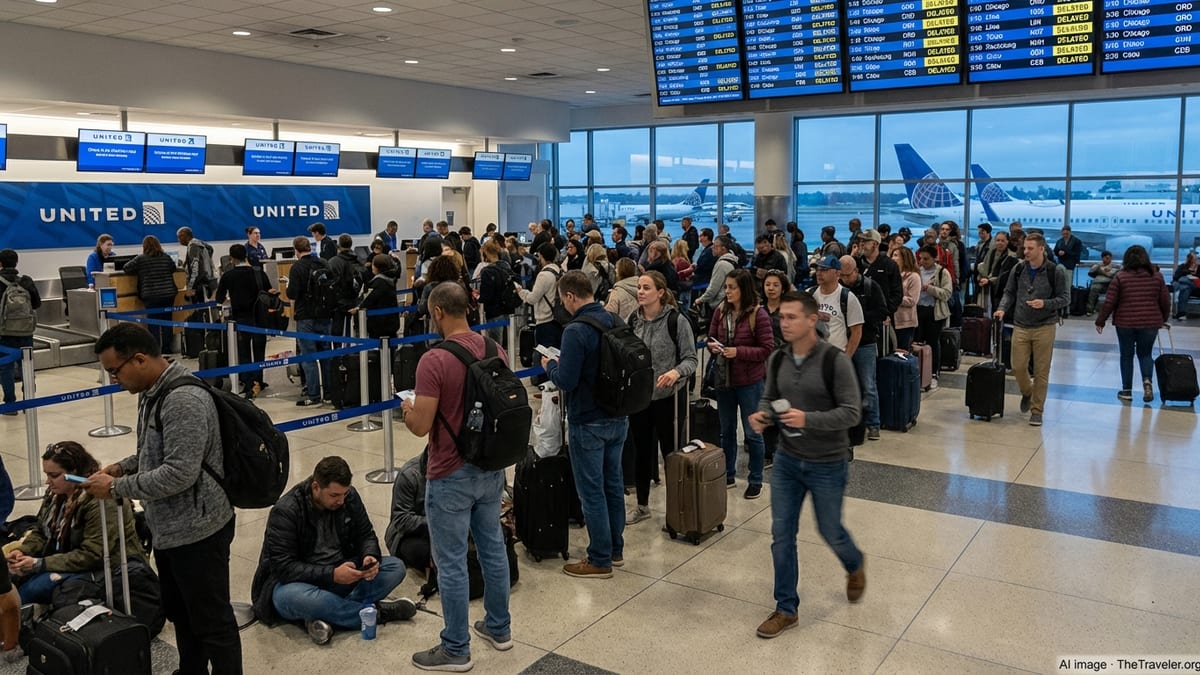
Passengers arriving at O’Hare before dawn encountered long but relatively orderly queues at United’s check-in counters and self-service kiosks. Some kiosk screens briefly displayed outage notices or failed to retrieve reservation details, pushing more people toward staffed counters. Inside the terminal, departure boards filled with yellow delay markers beside the blue and white United logo, even as ground staff emphasized over the public-address system that most flights would eventually depart.
Travelers connecting through Chicago bore the brunt of the schedule turbulence. Missed inbound connections forced many to be rebooked onto later services, with some passengers bound for smaller Midwestern cities told to expect same-day stand-by or overnight stays. Agents handed out meal vouchers and hotel referrals on a case-by-case basis, but some customers reported via social media that they were instructed to manage their own accommodations and seek reimbursement later through United’s customer-care channels.
Despite the delays, security checkpoints at O’Hare remained open and functional, and there were no reports of safety concerns. Federal officials stressed that air traffic control operations and aviation safety systems were not affected by the airline’s internal technology work.
Lima and South America See Schedule Knocks as Aircraft Run Late
South American operations, anchored for United by services to and from Lima, also felt the impact. Overnight and early-morning departures from the United States to Peru left behind schedule as aircraft originating in Chicago, Houston and other hubs faced tech-related hiccups. The delayed arrivals compressed turn times in Lima, where ground crews had less margin to refuel, clean and reboard aircraft for their return legs north.
By Friday afternoon local time, Lima’s Jorge Chávez International Airport recorded multiple United flights departing significantly behind schedule, with some pushed back by more than two hours. That created headaches for onward travelers connecting in the United States from Peru, including passengers heading to secondary US cities and beyond to Canada or Europe on partners.
Peruvian travelers interviewed in the terminal described confusion over changing gate assignments and a lack of clear information in Spanish during the height of the disruption. While airport monitors reflected new departure times, many said they relied on word of mouth and updates delivered in English over the public-address system before staff began making more frequent bilingual announcements.
United deployed additional customer-service personnel to assist at the check-in hall and boarding gates in Lima as the scale of the delays became evident. The airline reiterated that tickets on significantly delayed flights could be changed without fees, subject to availability, for customers willing to travel on different days or routings.
Tokyo Passengers Feel the Ripple Effects of US Tech Work
In Japan, where United operates key trans-Pacific routes to and from Tokyo, the fallout from the US-based outage surfaced as a series of secondary disruptions. Flights scheduled to depart from US hubs to Tokyo during or immediately after the system work encountered rolling delays, leaving aircraft and crew arriving in Japan later than planned. That, in turn, affected return services for passengers heading back to the United States.
At Tokyo’s international terminals, travelers reported a patchwork of experiences. Some United departures left with only minor delays as the airline was able to reposition aircraft in time. Others endured extended waits at the gate as flight crews completed mandatory rest periods or as maintenance teams cleared paperwork backlogged during the outage window.
Japanese passengers and US-bound business travelers described scenes of crowded boarding areas and frequent announcements revising boarding times. However, check-in and security processes themselves remained smooth, with local airport systems operating normally and ground staff able to fall back on manual procedures when United’s internal tools were slow to refresh.
Travel agents in Tokyo said they fielded an uptick in calls from corporate clients concerned about missed meetings and tight connection windows in the United States. Some companies instructed employees to proactively shift to later same-day flights or to route through alternative carriers where possible, adding to the churn on already busy trans-Pacific routes.
Kaohsiung and Cebu Highlight Vulnerabilities at Smaller Gateways
Beyond major hubs, the disruptions were acutely felt at smaller but strategically important gateways in East and Southeast Asia, including Kaohsiung in southern Taiwan and Cebu in the central Philippines. At these airports, United and its partners operate a more limited number of daily services, which means any delay or cancellation can leave passengers with fewer immediate alternatives.
Travelers at Kaohsiung International Airport described arrivals and departures boards peppered with delayed-status indicators for United-operated or codeshare flights during the local morning rush. With fewer ground staff and less redundancy in schedules, gate agents had to juggle rebookings onto the next available services while coordinating with operations centers thousands of miles away in the United States that were still stabilizing after the overnight work.
In Cebu, where tourism traffic has rebounded strongly, passengers bound for North America via United connections faced long waits in the departures hall as inbound aircraft missed their scheduled slots. Some passengers were provided hotel stays or transfers to alternative routings through Manila when same-day options evaporated. Others opted to delay travel altogether, wary of further knock-on delays at their US entry points.
Local airport officials in both Taiwan and the Philippines said they worked closely with United’s regional teams to manage crowding at gates and maintain orderly boarding once flights were cleared to depart. They underscored that basic airport operations remained stable throughout, even as airline-specific technology challenges constrained scheduling flexibility.
Passengers Describe Frustration, But Also Moments of Flexibility
Across the affected countries, passenger stories captured both anger and moments of improvisation. In social-media posts and interviews, some travelers from the United States, Peru, Japan, Taiwan and the Philippines criticized what they saw as limited communication from United during the earliest phases of the disruption, especially overnight when call centers and airport desks were not fully staffed.
Several passengers traveling from Chicago to Lima and onward to regional Peruvian cities said they received initial delay notices through the airline app only minutes before arriving at the airport, even though pre-cancellations had been built into the schedule. Others in Kaohsiung and Cebu reported difficulty accessing updated itineraries when mobile check-in tools briefly timed out during or after the system restart.
At the same time, some customers praised individual United agents and local airport staff who went out of their way to find solutions, including rerouting travelers through alternative hubs, securing last-minute hotel rooms or arranging ground transportation when overnight stays became unavoidable. In Tokyo, one family heading back to the US Midwest after a vacation said a gate agent personally walked them to a nearby lounge and arranged meal vouchers after their connecting flight from Chicago slipped by several hours.
Consumer advocates noted that while planned outages can be less chaotic than sudden meltdowns, they still test airlines’ ability to keep passengers informed and protected. They urged travelers affected by the disruptions to keep detailed records of expenses and to familiarize themselves with both United’s customer-service commitments and any applicable local compensation rules in the countries where they were stranded.
United Cites Modernization Push Amid Wider Scrutiny
United has pitched its technology upgrade program as a necessary step to avoid the kind of catastrophic outages that have plagued airlines in recent years. A previous failure of a core system triggered massive flight disruptions across its US network and drew sharp criticism from regulators and passengers. The carrier has also faced heightened oversight of its maintenance and safety practices, putting additional pressure on management to demonstrate stronger operational resilience.
Company executives had framed the latest outage as a tightly controlled reboot of core systems that would ultimately yield faster, more reliable tools for employees and customers alike. In public guidance ahead of the work, United encouraged passengers to check in early, download mobile boarding passes in advance and allow extra time at the airport if traveling during the affected window.
Industry analysts said the new wave of delays and cancellations, even if limited compared with a full-scale meltdown, underscores the fragility of complex airline IT systems and the difficulty of upgrading them without affecting customers. Carriers walk a fine line between investing in modernization and maintaining day-to-day operations, particularly when global schedules rely on precise aircraft rotations and legally mandated crew rest periods.
Regulators have signaled their intention to probe how airlines plan and communicate planned outages, especially when they intersect with other systemic risks such as staffing gaps at oversight agencies or broader infrastructure strains. Any perception that airlines are shifting the burden of modernization entirely onto passengers’ shoulders is likely to fuel further political and public pressure.
What Travelers Can Do If Their Flight Is Affected
For passengers still facing residual disruptions in the wake of United’s outage, travel experts recommend a pragmatic approach. The first step is to confirm flight status through multiple channels, including the airline’s website, mobile app and airport departure boards. When technology is slow to refresh, speaking directly with an agent at the check-in counter or a customer-service desk can sometimes reveal options that are not visible online.
When delays stretch into several hours, passengers may be eligible for meal vouchers or hotel accommodations, depending on local regulations and the airline’s internal policies. Travelers are advised to keep receipts for any out-of-pocket spending on food, lodging or ground transport tied to the disruption and to submit claims promptly through United’s customer-care portal. In some jurisdictions, including parts of Asia and Latin America, additional consumer-protection rules may apply to long delays and cancellations.
Those with urgent commitments at their destination might consider asking about rerouting through alternative hubs, including on partner airlines, if same-day arrival is still possible. Flexible travelers, meanwhile, may find it less stressful to request a voluntary change of date or time and avoid days when the network is clearly strained. For itineraries involving multiple carriers, coordination with travel agents or corporate travel departments can help ensure that changes to one segment do not inadvertently strand passengers on another.
As United works to stabilize operations following the planned outage, observers say the coming days will be a key test of whether its technology investments deliver the promised gains in reliability. For now, passengers from Chicago to Lima, Tokyo, Kaohsiung and Cebu are left juggling revised itineraries and hoping that the airline’s next reset happens behind the scenes, without another visible shock to their travel plans.