

More news on this day
As the U.S.-Israeli war with Iran sends shockwaves through the Middle East, U.S. nationals in the United Arab Emirates are confronting shrinking commercial flight options, intermittent airport closures and mounting uncertainty over how and when they can leave the country.
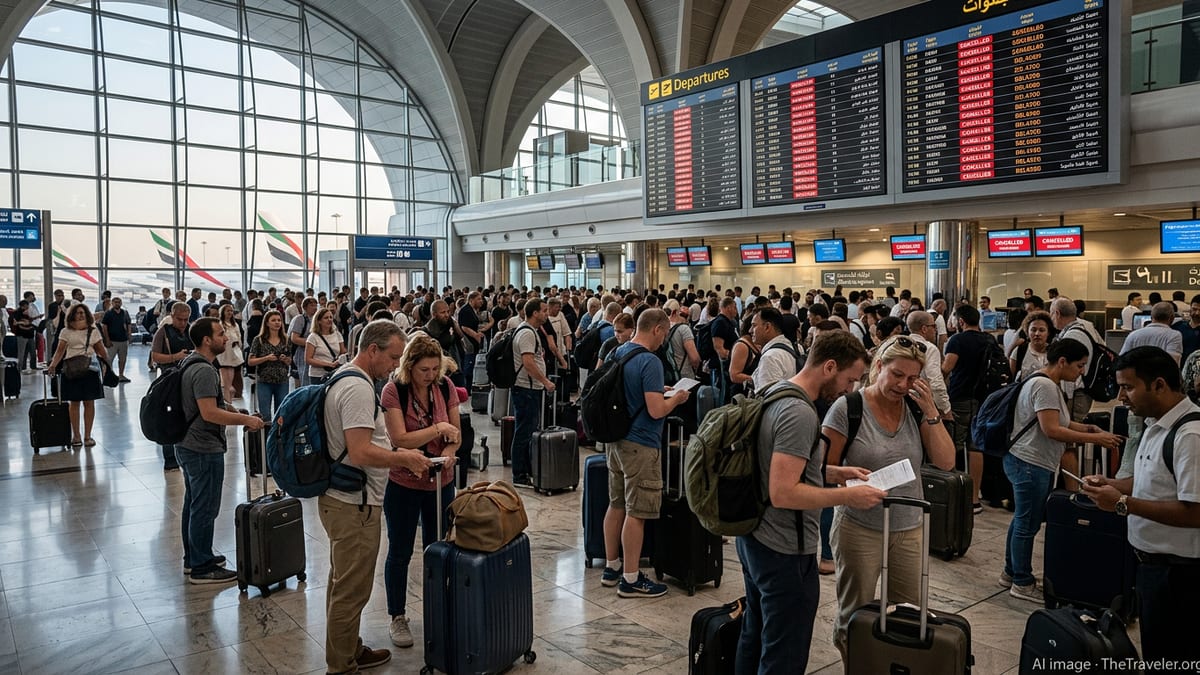
Conflict Escalation Leaves UAE Air Travel Severely Disrupted
The latest phase of the regional conflict, triggered by coordinated U.S. and Israeli strikes on Iran beginning February 28, 2026, has rapidly reshaped the aviation map of the Gulf. Iranian retaliatory missile and drone attacks on targets across the region, including the UAE, have led to sweeping airspace restrictions and damage at key hubs that normally serve as vital bridges between Europe, Asia and North America.
For days, commercial air traffic over much of the Gulf was effectively frozen as authorities closed or sharply curtailed operations at Dubai International and Abu Dhabi’s Zayed International Airport. Flight tracking data showed near-empty skies over the Emirates while airlines rushed to reroute or cancel thousands of services. Aviation analysts estimate that tens of thousands of passengers have been stranded at Gulf hubs since the war began.
Limited schedules are now beginning to re-emerge, but only on a heavily reduced basis. Emirates and Etihad have both announced very small, tightly controlled programs of outbound flights to select long-haul destinations, with aircraft often operating at reduced capacity and subject to last-minute operational changes. Seats on these services are being snapped up within minutes, driving steep fare increases and leaving many travelers without viable options.
Regional and foreign carriers have layered additional disruption on top of this. Several major European and Asian airlines have suspended or rerouted services that would ordinarily connect through Dubai or Abu Dhabi, forcing U.S.-bound travelers to piece together complex itineraries via secondary hubs, if they can find availability at all.
U.S. Government Issues Stark Advisories as Consular Access Tightens
Washington’s messaging to its citizens in the UAE has grown more urgent in recent days. An updated security alert from U.S. missions in the country underscores that American diplomats and staff have been instructed to shelter in place, and that in-person consular services, including routine passport and notarial appointments, have been suspended for security reasons.
The State Department has separately issued regional guidance urging U.S. nationals across a swath of Middle Eastern states, including the UAE, to depart via commercial means while limited options remain. At the same time, officials have cautioned that any government-assisted evacuation flights will be constrained, cannot be guaranteed for all, and may operate with minimal notice from airfields outside normal civilian terminals.
For now, U.S. authorities are emphasizing personal responsibility and early action. Americans are being advised to monitor embassy security alerts closely, maintain a charged phone and important documents within easy reach, and be prepared to move quickly if an opportunity to leave arises, whether on a commercial ticket, a charter arranged by an employer, or a potential government-coordinated flight.
Consular assistance has shifted largely to remote channels, with missions fielding heavy call and email volumes from citizens seeking guidance on expiring visas, cancelled flights and the safety of overland alternatives. Travelers report long waits for responses, reflecting the strain on diplomatic resources as the conflict widens.
Commercial Flights Scarce as Demand Soars and Routes Lengthen
The Emirates’ role as a global aviation crossroads has magnified the shock. Before the crisis, Dubai and Abu Dhabi together handled massive daily flows of connecting traffic between Europe, Asia and the Americas. With regional airspace now constrained or periodically closed, that model has been severely disrupted, creating a chokepoint for anyone trying to depart.
Airlines operating from the UAE are contending with a patchwork of closed corridors and high-risk zones that force them onto longer, more circuitous routings. Flights that do operate are typically detouring to avoid Iranian and Iraqi airspace, adding hours to journey times, raising fuel burn and pushing up operational costs. Those pressures are feeding through into higher fares, especially on last-minute bookings sought by anxious travelers.
Capacity is further limited by safety and logistical constraints on the ground. Some services are restricted to narrow-body aircraft with sharply capped passenger loads, while others are operated only during daylight windows, when security assessments deem missile and drone risks marginally lower. Airlines are warning passengers that departure boards can change without notice as security conditions shift.
For U.S. nationals, this means that finding a seat on an outbound flight, particularly one connecting all the way to North America, has become both challenging and expensive. Industry watchers say that in the short term, the most realistic strategy is to secure any seat out of the UAE to a stable third country, then rebook from there once away from the immediate conflict zone.
Overland Routes Offer Alternatives but Face Heavy Congestion
With flights scarce, some travelers are eyeing overland exits to neighboring states such as Oman or Saudi Arabia. Reports from border crossings, however, describe mounting congestion, long queues and sporadic closures that reflect both heightened security and sheer volume of outbound traffic.
Transport links between the UAE and Oman, including highways leading toward Muscat and Salalah, have seen an uptick in private vehicles, chartered buses and corporate convoys carrying expatriate staff. Similar patterns are emerging on routes west into Saudi Arabia, where travelers hope to access less-disrupted airports or overland corridors continuing on toward Jordan or beyond.
Border authorities on all sides are balancing security screenings with humanitarian and commercial pressures to keep trade moving. Travelers describe multi-hour waits in high temperatures, inconsistent information about documentation requirements and occasional turning back of non-residents without clear onward plans. Conditions can change rapidly, and there is no guarantee that an open crossing at departure will remain so upon arrival.
Security analysts caution that overland travel also carries its own risks, from potential spillover of hostilities into new areas to the strain placed on fuel supplies and roadside services. They recommend that any U.S. nationals contemplating a land exit check current advisories, ensure they have sufficient supplies and contingency plans, and avoid traveling at night where possible.
Practical Guidance for U.S. Nationals Currently in the UAE
For Americans still in the Emirates, experts say the fundamental priorities are situational awareness, flexible planning and realistic expectations. Conditions at airports and borders are fluid, and both commercial and government-organized solutions are likely to be limited in number and unevenly distributed across the country’s expatriate communities.
Travelers are advised to register their presence with the U.S. State Department’s traveler enrollment program if they have not already done so, as this remains a key channel through which embassies share urgent alerts and potential departure options. Those with existing commercial tickets should stay in close contact with their airlines, using official apps or customer service channels to monitor rebooking possibilities and schedule changes.
Employers with significant American workforces in the UAE are increasingly stepping in to coordinate contingency arrangements, including charter buses to alternative departure points and, in some cases, block-booked seats on rare outbound flights. Individual travelers without institutional support are being urged to network with hotels, tour operators and community groups that may have access to real-time information.
Above all, security specialists stress that U.S. nationals should avoid unnecessary movement, steer clear of demonstrations or military facilities and keep personal risk tolerance under constant review. With the trajectory of the conflict uncertain and both air and land corridors under strain, decisions taken in the coming days about when and how to move could prove critical to personal safety.