

More news on this day
Transatlantic and intra-European travel faced renewed disruption this week as United Airlines, Delta Air Lines, KLM and Brussels Airlines scrapped more than a dozen services touching Germany, knocking out links to Newark, Amsterdam, Brussels, London, Copenhagen and several other key hubs after severe winter weather and mounting operational pressures.
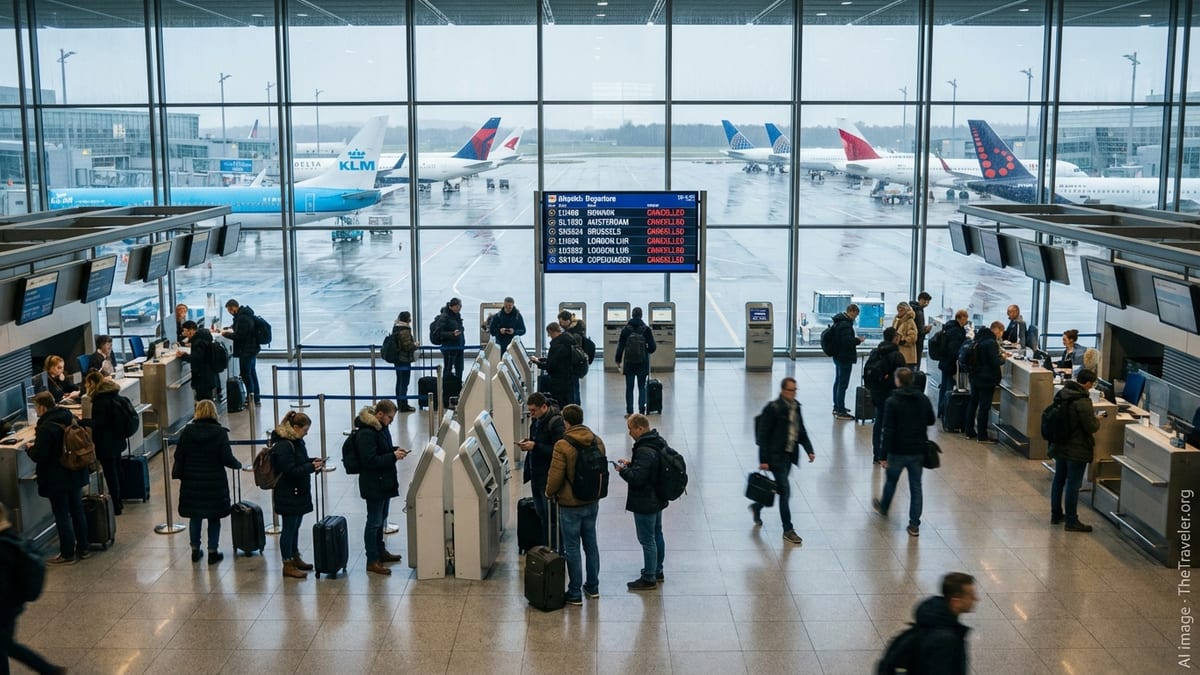
Weather Systems and Operational Strain Converge on German Gateways
The latest round of cancellations comes on the heels of a powerful winter storm that swept across northern and western Europe around February 19, triggering at least 210 cancellations and thousands of delays at major airports including Amsterdam Schiphol, Frankfurt and Munich. German hubs, already operating near capacity, have seen lingering knock-on effects as airlines attempt to reset their networks.
Industry data providers tracking real-time movements show that, within that broader disruption, at least 15 flights operated by United, Delta, KLM and Brussels Airlines and either departing from, arriving in, or routing over Germany were cancelled in recent days. While that number is modest compared with the continent-wide tally, the affected services include high-demand corridors linking Germany to Newark, Amsterdam, Brussels, London, Copenhagen and other connecting points, amplifying the impact for long-haul travelers.
Airline schedulers say the difficulty is not just the storm itself but the recovery window. Aircraft and crews displaced by earlier weather cancellations in New York and across the European network have left gaps in rotations, forcing carriers to consolidate frequencies and occasionally scrap individual flights where rebooking options are strongest.
For Germany, that has meant isolated cancellations out of Frankfurt, Munich, Berlin and Düsseldorf on routes that typically feed transatlantic banks or major European hubs, rather than a wholesale shutdown. The targeted cuts, however, are enough to ripple across multi-leg itineraries built around tight connections.
Transatlantic Links to Newark and Other US East Coast Cities Hit
United and Delta have both trimmed select services linking Germany to the US East Coast, especially flights tied to Newark and New York that were already under pressure from a severe snowstorm in the New York area on February 23. That storm prompted local authorities to warn of up to 30 to 45 centimeters of snow and contributed to cancellations at Newark Liberty and other New York airports.
United, which relies heavily on Newark as its primary European gateway, has cancelled a small number of Germany-bound and Germany-originating services as part of its broader reduction between New York and Europe. Frankfurt and Munich services are among those affected, with some passengers rerouted via alternate hubs or shifted by a day.
Delta’s adjustments have primarily focused on services where it shares capacity with European partners. Flights touching New York and Boston that would ordinarily connect via German or nearby European gateways have been thinned, resulting in the cancellation of a subset of departures that intersect with Germany-bound itineraries.
Although the total number of cancelled flights for each US carrier in Germany is in the single digits, the loss of specific departures can eliminate favored overnight or daylight options, leaving travelers with less convenient connection times or extended layovers on remaining services.
KLM and Brussels Airlines Trim Short-Haul Europe Links via Germany
KLM, whose primary hub at Amsterdam Schiphol was among the hardest hit by last week’s storm, has been forced to pare back parts of its short-haul schedule, including feeders that cross German airspace or stop in German cities before continuing to Amsterdam. Data from recent travel alerts and disruption logs shows that KLM has already recorded dozens of cancellations and a much higher number of delays across its network since the storm, with a portion of those affecting German routes.
Feeder flights between secondary German airports and Amsterdam are particularly vulnerable, as the airline prioritises maintaining its core long-haul departures. When aircraft and crews are in short supply, point-to-point links that can be replaced by rail or connections through other hubs are among the first to be cut.
Brussels Airlines is facing similar pressure as it navigates both weather-related disruptions and labour-related uncertainty at its home hub. In the near term, the carrier has cancelled a handful of Germany services tied to its Brussels hub, forcing passengers to rebook on later departures or reroute via Star Alliance partners. Future schedules may see additional volatility as Belgium prepares for a nationwide strike on March 12 that Brussels Airport has warned could reduce departures to near zero.
For travellers counting on smooth same-day connections from German cities into Amsterdam or Brussels for onward flights to London, Copenhagen or transatlantic destinations, even a small number of cancellations can mean missed meetings, lost hotel nights or hastily rearranged itineraries.
London, Copenhagen and Other Hubs Feel the Knock-On Effects
London Heathrow and Copenhagen have both reported elevated levels of disruption as the weather systems and operational challenges reverberate through Europe’s tightly interlinked hub network. Recent performance figures from Heathrow show more than 200 delays and dozens of cancellations across multiple airlines, including United, Delta, KLM and Brussels Airlines, as ground staff shortages and crew scheduling issues compound the impact of the weather.
Some affected flights involve direct Germany links, while others are part of more complex routings that rely on German airports as alternates or diversion points. With aircraft and crews arriving late from storm-affected hubs, delays cascade into later departures, increasing the risk that carriers will proactively cancel select services to prevent further knock-on disruption.
Copenhagen, an important transfer point for northern Europe, has also seen schedule changes as airlines reposition aircraft and absorb the backlog from earlier days. While Scandinavian carriers account for much of the activity, allied airlines such as KLM and Brussels Airlines rely on Copenhagen to funnel passengers onward to German cities when direct options are constrained, so cancellations in one part of the system quickly affect the others.
As of February 24, most German airports remain open and operating, but with pockets of disruption scattered across peak periods. Aviation analysts say that until the weather pattern stabilises and airlines can restore aircraft and crew rotations to their normal cycles, travellers should expect an elevated risk of last-minute changes on routes linking Germany with the wider European and North American networks.
Rebooking Options and What Affected Passengers Should Do
Carriers involved in the latest wave of cancellations are offering a range of rebooking and refund options, particularly for passengers whose itineraries were disrupted by the February 19 European storm or the February 23 New York snowstorm. KLM has issued travel alerts detailing flexible change policies for impacted East Coast flights, including the option to move travel dates within a specified window or request vouchers in lieu of immediate rebooking.
United and Delta have similarly leaned on established waiver policies that allow customers to switch to alternate departures without change fees in many cases, especially when disruptions are directly linked to severe weather. In practice, however, rebooking can be challenging on popular transatlantic routes where remaining seats fill quickly once cancellations are announced.
Brussels Airlines is steering affected customers toward online tools and alliance partners for reaccommodation, a strategy that becomes increasingly important as the March 12 industrial action at Brussels Airport draws closer. Travellers connecting from Germany through Brussels around that date are being urged to monitor airline communications closely and consider advancing or postponing their journeys to avoid the strike window.
Across all four airlines, passenger advocates recommend that travellers flying between Germany and hubs such as Newark, Amsterdam, Brussels, London or Copenhagen in the coming days build extra buffer time into their plans, keep airline apps and notifications enabled and confirm the status of every flight segment before heading to the airport. With Europe still in the grip of winter and networks stretched thin, even a handful of targeted cancellations can create outsized headaches for those caught in the middle.