

More news on this day
The United States has firmly overtaken other major international markets in driving Mexico’s tourism surge for 2025, as new data shows American travelers accounting for the clear majority of foreign air arrivals while Los Cabos posts a record 440 US dollar average daily hotel rate, the highest in the country and a powerful signal of its ascent as a top global luxury destination.
Get the latest news straight to your inbox!
US Tourists Cement Lead in Mexico’s Visitor Rankings
Fresh figures from Mexico’s tourism authorities confirm that US travelers now dominate the country’s inbound market to an unprecedented degree, outpacing not only nearby Canada but also key long-haul source countries such as France, Brazil, Spain, Germany and Chile. In the first months of 2025, visitors from the United States accounted for around 58 percent of all international tourists arriving by air, far ahead of Canada’s roughly 20 percent share and the low single digits contributed by European and South American markets including France, Spain, Germany, Brazil and Chile.
That dominance is not simply a matter of volume. Analysts note that the US market has recovered faster than almost any other since the pandemic, both in absolute visitor numbers and in spending power. Recent sector reports indicate that the United States has supplied well over 18 million visitors annually to Mexico, making it the single largest driver of the country’s post-pandemic tourism rebound and placing it firmly ahead of regional competitors like Canada and Brazil as well as traditional European tourism powerhouses.
By contrast, while France, Spain, Germany, Chile and Brazil remain strategically important markets for Mexico, their combined share of inbound tourists remains a fraction of US demand. Some of these countries have even registered declines in recent months amid visa changes, economic headwinds or shifting airline capacity, further underlining the extent to which Mexico’s tourism fortunes are now tied to the US traveler.
Los Cabos Tops Mexico With 440 Dollar Average Daily Rate
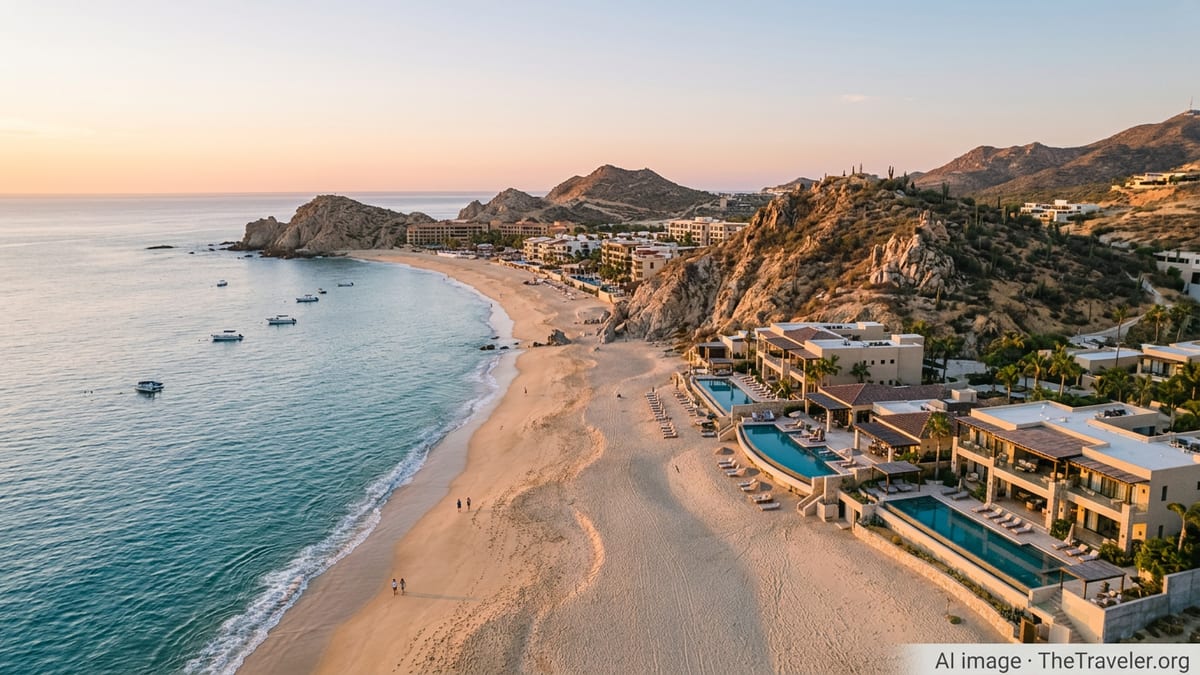
Nowhere is the impact of this US-led surge more visible than in Los Cabos, the twin-resort destination at the tip of Baja California Sur. A new performance report from the Los Cabos Tourism Board for the 2025 season highlights a milestone: the destination’s average daily rate, or ADR, has hit 440 US dollars, the highest in Mexico and nearly double what it was in 2017. Tourism officials describe this as the clearest proof yet that a decade-long pivot toward the high-end market is paying off.
Over the last ten years, visitor arrivals to Los Cabos have climbed by nearly 130 percent to about 3.8 million annually. Yet local authorities stress that the real story is not volume, but value. Revenue per available room has jumped to more than 300 US dollars while occupancy has held near 70 percent, a combination that places Los Cabos in the upper tier of global leisure destinations by profitability. That performance is particularly striking given that the market remains heavily leisure-focused and seasonally exposed.
Much of the demand behind these numbers is coming from the United States, where nonstop connectivity from major hubs such as Los Angeles, Dallas, Houston and Phoenix has positioned Los Cabos as a quick, aspirational getaway for affluent travelers. Hotel groups report that premium beachfront suites, all-inclusive luxury offerings and private-villa style products consistently achieve some of the highest nightly rates anywhere in Mexico, even as new inventory comes online.
Luxury Strategy Pays Off Amid Global Competition
The transformation of Los Cabos into a luxury stronghold has been deliberate. Local tourism leaders frequently refer to a “quality over quantity” strategy that has favored high-end resort developments, branded residences and boutique properties over mass-market hotel construction. Over the past decade, this has attracted a wave of luxury brands positioning the region alongside Caribbean and Mediterranean competitors for top-spending guests.
Industry observers point out that this strategy differentiates Los Cabos from other Mexican sun-and-sand destinations that still depend more heavily on volume and discounted packages. While places like Cancún and Riviera Maya remain giants in absolute visitor counts, their average room rates trail the 440 dollar benchmark now set in Baja California Sur. In practical terms, this means that fewer tourists can generate equal or greater tourism revenue when they spend more per night and more per stay.
In a global context, the shift is significant. As European markets such as France, Spain and Germany work to push visitors into shoulder seasons and disperse tourism away from saturated hotspots, Los Cabos has quietly positioned itself as a year-round luxury alternative for North American travelers. Analysts say the destination is increasingly appearing in the same consideration set as high-end Caribbean islands, with its pricing now reflecting that competition.
Economic Impact and Sustainability Pressures
The economic benefits of Mexico’s current tourism boom are sizable. Tourism is estimated to contribute close to 9 percent of national GDP, and the strong recovery in international arrivals since 2023 has helped reinforce Mexico’s place among the world’s most visited countries. Inflows of foreign currency have been rising steadily, with government figures for the first half of 2025 pointing to billions of dollars in tourism receipts and a notable increase in average per-capita spending compared with the previous year.
In Los Cabos, tourism is the backbone of the local economy, generating billions of dollars annually and supporting the vast majority of jobs either directly or indirectly. The luxury pivot, bolstered by high-spending US tourists, has fostered growth in sectors ranging from upscale dining and golf to private yachting and wellness retreats. Local business leaders argue that this higher-value model gives the region more fiscal room to invest in infrastructure, services and community projects.
At the same time, there are mounting concerns about sustainability and livability. Rapid growth in visitor numbers, combined with intensive resort development, has increased pressure on limited water resources, fragile coastal ecosystems and local housing markets. Authorities in Baja California Sur have begun to highlight environmental stewardship and community impact as core pillars of tourism planning, promising to reinvest part of the gains from premium pricing into conservation and social infrastructure.
Air Connectivity and 2025 Outlook
Strong air connectivity is helping to sustain and deepen the US role in Mexico’s tourism landscape. Airlines on both sides of the border have expanded capacity on key leisure routes into 2025, with additional frequencies and larger aircraft into Mexican beach and urban gateways. Los Cabos in particular has benefited from an upgraded international airport capable of handling increased traffic from major US cities, reinforcing its status as a convenient luxury escape.
Mexico’s national tourism projections for 2025 point to continued growth in both arrivals and spending, even if the pace moderates after the sharp rebounds of 2023 and 2024. Officials expect the United States to remain by far the leading source market, with Canada solidly in second place and a cluster of European and South American nations, including France, Spain, Germany, Brazil and Chile, competing for the remaining share of international arrivals.
For Los Cabos, the challenge will be to defend its 440 dollar average daily rate in the face of new hotel openings and macroeconomic uncertainties, while also demonstrating that luxury growth can coexist with environmental responsibility. Early indicators for 2025 bookings suggest that high-end demand from the US remains resilient, particularly in the premium all-inclusive and villa segments. If that trend holds, the Baja California Sur destination appears poised to consolidate its reputation as one of the Western Hemisphere’s most exclusive beach resorts.