

More news on this day
As regional tensions linked to the Iran war tighten commercial flight options across the Gulf, the U.S. Embassy in Kuwait has shifted its focus toward urgent overland exit strategies, advising American citizens to be ready with visas, ground transport and travel-agent support should conditions deteriorate further.
Get the latest news straight to your inbox!
Regional Crisis Forces Rethink of Traditional Exit Routes
Publicly available information on the 2026 Iran war indicates that Kuwait has been drawn sharply into the regional crisis, with reports that the U.S. Embassy compound in Kuwait City was struck by Iranian missile fire in early March and that consular operations have since been heavily curtailed. In the wider Gulf, airlines have scaled back schedules or suspended routes amid security concerns and changing risk assessments, leaving many travelers dependent on a reduced network of commercial flights.
Coverage of recent State Department alerts shows that American citizens across the Middle East are being urged to closely monitor security messages and to keep travel plans flexible as airspace restrictions, short-notice flight cancellations and temporary airport closures become more common. With Kuwait located at the northern end of the Gulf and sharing a long land frontier with Saudi Arabia, attention has increasingly turned to roads and border crossings as viable alternatives to limited air links.
Security analyses of the crisis note that overland corridors through Saudi Arabia have already become essential for travelers leaving neighboring conflict-affected states when direct flights proved unreliable or unavailable. The emerging guidance for Kuwait appears to follow the same pattern: move early if possible, use commercial options while they exist and be prepared to shift quickly from air to land routes if the situation worsens.
Overland Corridors Through Saudi Arabia Take Center Stage
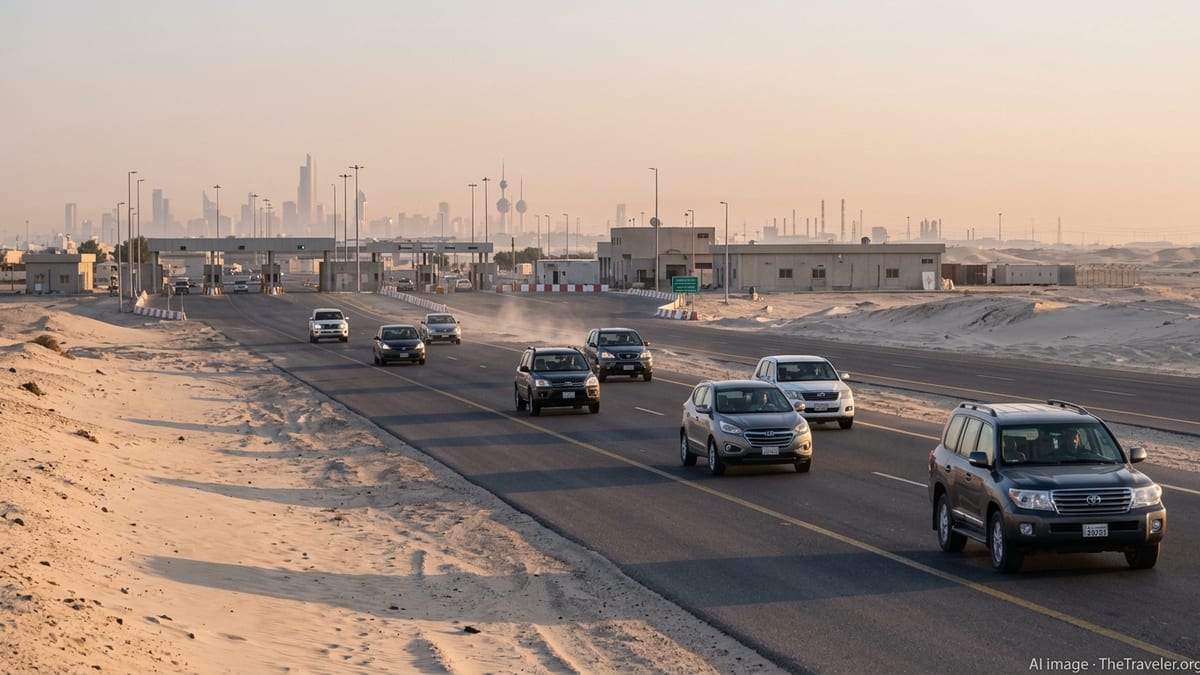
Available guidance on regional mobility during the current conflict highlights the importance of Kuwait’s southern highway network, which links the capital with Saudi border posts and onward routes deeper into the kingdom. Reports from regional observers indicate that, as in previous crises, many foreign nationals are already mapping potential drives to Saudi cities where airports remain operational and where a wider range of long-haul departures may still be found.
Practical travel commentary emphasizes that the main Kuwait–Saudi crossings are accustomed to handling commercial and expatriate traffic, but that wait times, security checks and documentation requirements can increase sharply during periods of heightened alert. Travelers are being encouraged to anticipate delays, carry food and water, and ensure that vehicles are in good working condition before attempting a cross-border journey in an unpredictable security environment.
Analysts also point out that overland routes do not necessarily end at the first major Saudi airport. Depending on the pattern of flight disruptions, Americans may need to continue onwards by road to other Gulf hubs judged to be safer or better connected on a given day. That calculus, observers say, is changing quickly, requiring constant review of airline schedules and local advisories to determine which gateway offers the most reliable path out of the region.
Visa Rules and Transit Costs Add New Layer of Complexity
While using Saudi Arabia and other neighboring states as overland transit corridors appears increasingly attractive, visa requirements and related costs are emerging as a critical consideration for Americans in Kuwait. Publicly available visa guidance shows that Saudi authorities have developed a mix of tourist, transit and pilgrimage visas in recent years, each with distinct eligibility criteria, application platforms and fees denominated in local currency or equivalent U.S. dollars.
Travel-industry commentary notes that, in normal times, Americans can often secure Saudi tourist or transit e-visas online, but warns that processing timelines, accepted purposes of travel and payment channels may shift during a regional security crisis. Some travelers may face higher costs if they are forced to rely on last-minute applications, premium processing or third-party assistance to meet tight departure windows.
Observers stress that travelers should avoid assuming visa-on-arrival access at land borders, particularly when security conditions are fluid. Instead, Americans in Kuwait are being urged by travel advisers to verify, in advance, whether they require a pre-approved visa for transit through Saudi territory, how long they are allowed to remain, whether multiple entries are permitted and which airports or checkpoints are valid under the terms of their documents.
Similar issues may arise for onward travel beyond Saudi Arabia, including potential stops in other Gulf countries or connections through Europe or Asia. Each jurisdiction applies its own mix of entry, transit and health regulations, and any miscalculation can result in denied boarding or forced rerouting at additional expense.
Travel Agents and Fixers Become Essential Intermediaries
As conditions across the Gulf grow more volatile, experienced travel agents and regional logistics companies are emerging as key intermediaries for Americans seeking to leave Kuwait. Industry reporting from previous evacuation scenarios in the Middle East shows that established agencies often maintain up-to-date knowledge of which airlines are still operating, which road routes are open, and how to sequence cross-border movements so that visas, tickets and ground transport align.
Analysts describe a growing reliance on trusted local agents who can react quickly when airlines cancel flights or when governments introduce new entry conditions with little notice. These intermediaries can assist with securing scarce seats on outbound flights, arranging private vehicles or shared buses to border points, and coordinating hotel stays near airports if travelers are forced to wait for a new departure.
Specialist firms with experience in high-risk travel are also being cited in regional coverage for their role in advising corporate security teams and non-governmental organizations with staff in Kuwait. Such companies typically provide route assessments, GPS-based tracking tools and on-call support for drivers, helping to reduce but not eliminate the risks associated with long overland journeys undertaken during an active regional conflict.
However, experts caution that private-sector help comes at a price, which can be significant for individuals and families. Fees for last-minute ticketing, emergency ground transport, and bespoke security routing can escalate quickly, particularly if demand surges and availability tightens.
Americans Urged to Prepare Early and Stay Mobile
Across the region, publicly accessible advisories emphasize a consistent message for U.S. citizens: prepare before options narrow. For Americans in Kuwait, that translates into practical steps such as ensuring passports are valid for the required period, maintaining digital and printed copies of key documents, and registering contact details with relevant notification systems that disseminate security updates.
Travel risk specialists quoted in open analyses recommend that individuals map several potential exit plans rather than relying on a single route. One plan might prioritize direct flights from Kuwait City if operations stabilize, another might use a drive to a Saudi airport with stronger international links, and a third could involve routing via a different Gulf state should diplomatic or security dynamics shift.
Public commentary also underlines the importance of budgeting for a protracted and potentially expensive journey out of the region. Beyond visa fees and higher airfares, travelers may face costs for additional nights of accommodation, overland transport to distant airports, and the need to rebook itineraries multiple times if airlines continue to adjust schedules in response to security events.
While many details of the evolving situation in Kuwait remain uncertain, the broad direction of official and industry messaging is clear: Americans who can safely depart are encouraged to do so while commercial and overland pathways remain open, and those who stay are advised to keep their documents, plans and support networks in constant readiness.