

More news on this day
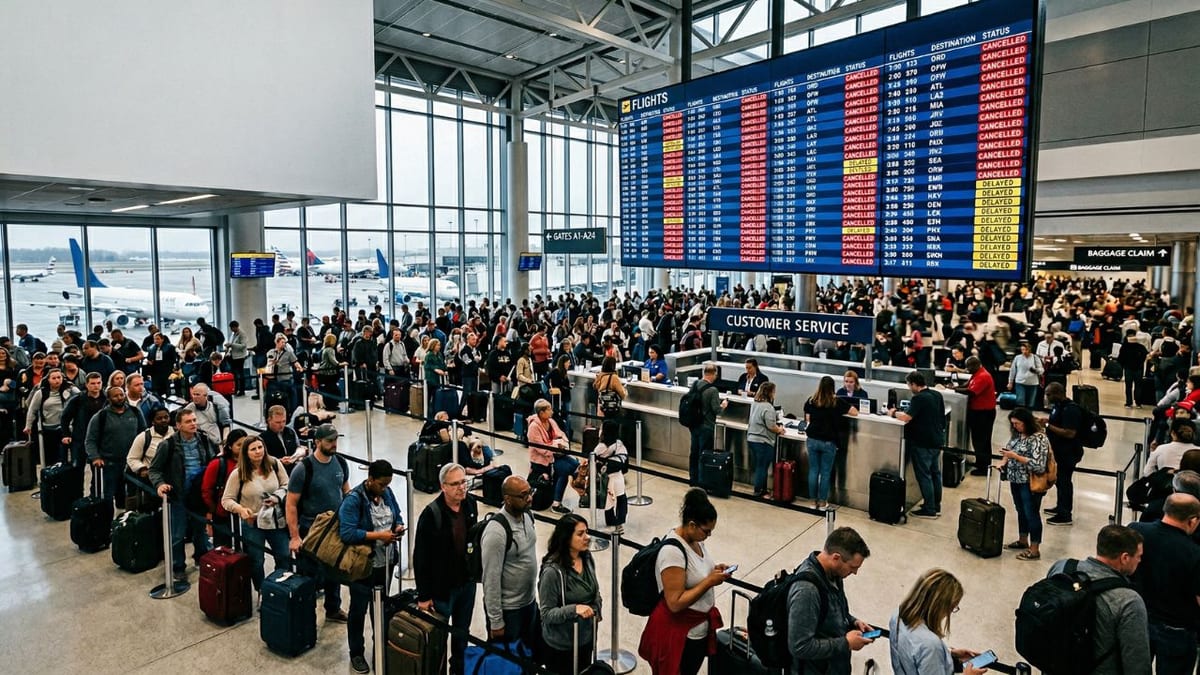
Passengers across the United States faced a fresh wave of aviation turmoil today as flight-tracking data showed 114 cancellations and 3,440 delays disrupting operations at 27 major airports, snarling schedules at key hubs from New York and Los Angeles to Miami, Atlanta, Orlando and Seattle and straining networks for major carriers including Delta Air Lines, American Airlines and Southwest Airlines.
Get the latest news straight to your inbox!
Nationwide Crunch Builds on Days of Elevated Disruptions
Publicly available flight-monitoring statistics for early April indicate that the latest round of 114 cancellations and 3,440 delays comes on top of several days of heightened disruption, rather than as an isolated event. Recent reports describe how U.S. airports collectively recorded more than 200 cancellations and several thousand delays on April 7 alone, with major hubs from Los Angeles to New York already struggling to keep up with the spring surge in passenger traffic.
Coverage from travel industry outlets notes that airports including Chicago O’Hare, Denver, Miami, New York, Newark and Los Angeles have all experienced recurring disruption patterns in recent days, with delay totals regularly entering the high hundreds and cancellations creeping into triple digits. These rolling problems have increased the likelihood that even relatively modest schedule upsets can snowball into wider network instability.
Live national statistics continue to show several hundred cancellations and thousands of delays on a typical day, underscoring how fragile the system has become during peak periods. Within this context, today’s 114 cancellations and 3,440 delays represent another acute stress point in an already stretched aviation network, rather than an outlier event.
Operational data and travel media analysis suggest that while the bulk of the disruptions remain concentrated at the biggest hubs, knock-on effects can quickly reach secondary airports that depend on tight connection windows and shared aircraft rotations. The result is that a disruption that begins in a few cities can rapidly touch dozens more within hours.
Major Hubs from New York to Los Angeles Under Pressure
The latest figures indicate that 27 major airports have been affected, with some of the harshest impacts reported at hubs in New York, Los Angeles, Miami, Atlanta, Orlando and Seattle. New York’s congested airspace, which has long been identified as a key source of delay propagation across the United States, appears once again to be playing an outsized role as delays at John F. Kennedy, LaGuardia and Newark ripple through domestic and international networks.
On the West Coast, reports highlight how disruption at Los Angeles International Airport has recently triggered dozens of delays and a cluster of cancellations on routes up and down the coast. Analysts note that tight turnarounds and densely scheduled shuttles between Los Angeles and other western cities such as San Francisco and Seattle can quickly magnify operational pressures, especially when gates, crews or aircraft are not where they are scheduled to be.
In Florida and the Southeast, Miami and Orlando continue to surface in flight-status summaries as hotspots for delays and select cancellations, particularly on routes feeding the Caribbean, Latin America and domestic leisure destinations. Recent coverage has shown Miami logging hundreds of delayed flights and several dozen cancellations over short periods, with those strains spreading to connecting hubs in New York, Chicago and Los Angeles as aircraft and crews fall out of position.
Atlanta, the nation’s busiest airport by passenger volume, and Seattle, a key transcontinental and transpacific gateway, also feature prominently in disruption tallies. Data-driven reviews of U.S. aviation performance point out that these hubs handle such high traffic volumes that even small slowdowns driven by weather, ground congestion or staffing challenges can push delay statistics sharply higher in a matter of hours.
Delta, American and Southwest Grapple with Cascading Network Strain
Among the airlines bearing the brunt of today’s disruption are Delta Air Lines, American Airlines and Southwest Airlines, alongside other large U.S. carriers. Flight-tracking and industry reports from recent days show these three airlines consistently appearing near the top of delay and cancellation rankings, reflecting their large market share and concentration at the most heavily affected hubs.
Delta’s extensive presence in Atlanta, New York and Seattle means that any operational turbulence at those airports can quickly echo throughout its network. Earlier analyses have shown Delta repeatedly recording dozens of cancellations and hundreds of delays on challenging days, particularly when weather and air-traffic-control constraints overlap with busy banked departure waves.
American Airlines, with major hubs in Miami, Dallas Fort Worth, Charlotte, Philadelphia and key New York airports, has also faced significant recent disruption, with published figures citing hundreds of delayed flights in a single day and select cancellations mounting when storms or ground stops interfere with its tightly timed schedules. These strains tend to be especially visible on transcontinental and international services where aircraft and crew utilization are finely tuned.
Southwest, which relies heavily on quick-turn, high-frequency operations at airports such as Denver, Chicago Midway, Dallas and select Florida cities, has repeatedly appeared in daily disruption summaries with sizable delay counts and occasional pockets of cancellations. Because Southwest uses a point-to-point model rather than a classic hub-and-spoke structure, operational setbacks affecting a few airports can scatter consequences across its route map, reaching cities that may not themselves be experiencing bad weather or congestion.
Structural Pressures: Staffing, Weather and System Capacity
Aviation analysts and policy documents have for months warned that persistent structural pressures are likely to keep disruption risks elevated. Federal aviation reports describe an ongoing shortfall of air traffic controllers relative to targeted staffing levels, with many controllers working extended schedules to manage peak demand. In parallel, updated guidance from the Federal Aviation Administration has extended slot and capacity limits at certain congested airports, a recognition that runway and airspace constraints continue to weigh on punctuality.
Weather remains a central driver of irregular operations. As recently as March, large storm systems and blizzards across the eastern United States and Midwest triggered thousands of delays and cancellations in a single multi-day stretch, with ground stops implemented at key hubs to manage safety and gate availability. Industry coverage notes that even when storms are localized, their impact can be magnified when they strike hubs that function as critical switching points for aircraft and crew flows.
Government data on the causes of delays highlight the significant share attributed to what is termed the national aviation system, a broad category encompassing weather that is not officially extreme, airport operations, and traffic volume constraints. This category often outpaces airline-controlled factors such as maintenance or crew readiness, illustrating how much of the disruption picture stems from system-level limitations rather than isolated company decisions.
Historical performance analyses from aviation agencies and independent consultancies also underscore the role of a small number of large airports as “delay amplifiers.” Facilities in New York, Atlanta, Los Angeles, Miami, Orlando and Seattle consistently rank among the country’s highest contributors to total passenger delay hours, meaning that disturbances at these hubs can have disproportionate consequences for travelers nationwide.
Passengers Confront Long Lines, Missed Connections and Limited Options
For travelers on the ground, the latest figures translate into long lines at check-in counters, security lanes and rebooking desks, along with crowded gate areas and aircraft waiting on taxiways for departure slots. Recent travel media coverage from Atlanta, Orlando and Miami has described extended queues at customer service points as passengers seek seat assignments on later flights or alternative routings to their destinations.
Missed connections remain one of the most disruptive outcomes for passengers, particularly at hubs with dense bank structures where many flights arrive and depart within short windows. When an inbound flight is delayed beyond its connection threshold, rebooking options can quickly become scarce, especially on popular leisure and business routes that are already close to full during peak travel periods.
Consumer advice published in the wake of earlier disruption waves continues to emphasize the importance of monitoring flight status frequently, building additional time into connections at historically delay-prone airports and understanding airline policies on rebooking and refunds. Regulatory guidance notes that refunds are required in certain cancellation scenarios when passengers choose not to travel, but availability of alternative flights and compensation for delays can vary widely depending on the circumstances and carrier-specific commitments.
With today’s 114 cancellations and 3,440 delays adding yet another layer of complexity to an already active spring travel season, aviation observers suggest that passengers planning upcoming trips should brace for continued volatility and treat on-time performance as a welcome outcome rather than a guaranteed norm across the U.S. air travel system.