

More news on this day
A fast‑deepening nor’easter blasting the northeastern United States has forced major Gulf carriers including Emirates, Etihad Airways and Qatar Airways to cancel or significantly retime flights into New York and other East Coast gateways, leaving thousands of long‑haul passengers scrambling to rebook as the blizzard grinds the transatlantic air corridor to a near standstill.
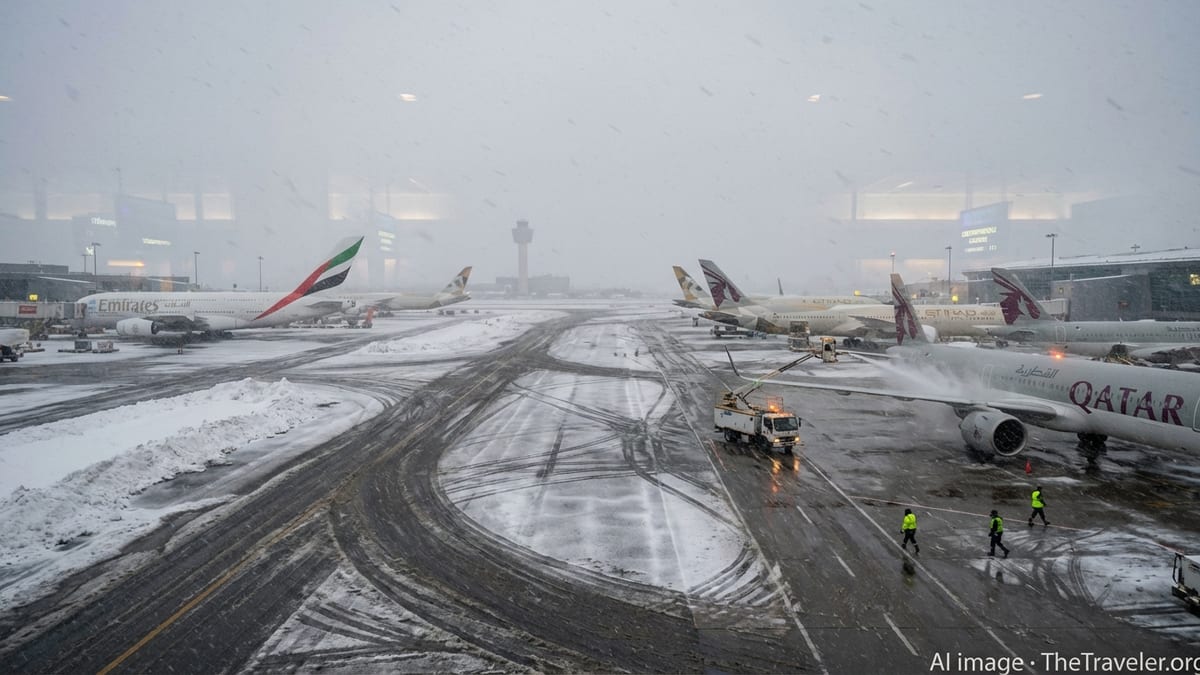
Nor’easter Hernando Turns Northeast Corridor Into No‑Fly Zone
The storm system, informally dubbed Winter Storm Hernando by forecasters, began organizing over the southeastern United States on February 20 before racing up the Atlantic seaboard and intensifying off the Mid‑Atlantic coast. By Sunday, February 22, heavy snow, fierce crosswinds and rapidly deteriorating visibility were sweeping across a stretch of the country from Washington to Boston, prompting the National Weather Service to issue blizzard warnings for densely populated coastal areas.
New York’s three main airports, John F. Kennedy, LaGuardia and Newark Liberty, quickly emerged as the epicenter of the disruption. Airlines preemptively cancelled thousands of flights rather than risk gridlock on snowy taxiways and overwhelmed de‑icing pads, with forecasters warning of snowfall rates of up to three inches an hour and wind gusts above 60 miles per hour at the height of the storm. Conditions were expected to remain challenging into Monday, with whiteouts, blowing snow and runway contamination complicating efforts to restart operations.
The domino effect rippled well beyond the Northeast. Airports in Boston and Philadelphia reported significant cancellations and long delays, while Caribbean and Canadian gateways that depend on East Coast connections also saw schedules unravel. For global carriers that rely on New York and Boston as their primary US entry points, Hernando effectively slammed shut the most important door into the American market at the peak of the winter travel season.
Emirates Scraps Key New York, Newark, Washington and Boston Rotations
Dubai‑based Emirates, which operates some of the highest profile long‑haul services into the United States, began paring back its East Coast program as forecasts for Hernando grew more ominous heading into the weekend. The airline confirmed the cancellation of several flagship flights between Dubai and New York, including select EK203 and EK204 rotations into John F. Kennedy, as well as disruptions to its Milan and Athens tag flights that operate onward to Newark.
Operational planners at the carrier also moved to retime multiple services outside the expected peak of the blizzard. Some New York‑bound flights were shifted earlier to arrive before the heaviest snow, while others were pushed back into Monday evening, a window when runway conditions and visibility are forecast to improve. Similar schedule surgery affected Washington Dulles and Boston Logan, where at least one round‑trip rotation on each route was cancelled and others consolidated to carry rebooked passengers on higher capacity aircraft.
Emirates has urged customers traveling to or from the United States over the February 22 to 24 window to check their flight status frequently and to allow extra time for connections. The carrier’s advisory noted that further rolling delays remain possible as airport crews contend with long de‑icing queues and rapidly changing wind conditions. While safety remains the primary driver of the cancellations, the airline is also working to avoid leaving aircraft and crews stranded for extended periods at storm‑hit airports, a lesson reinforced by earlier winter disruptions in North America and Europe.
Etihad’s New York Schedule Hit Hard as Abu Dhabi Links Fray
Abu Dhabi‑based Etihad Airways has also found itself among the most heavily exposed international carriers as Hernando disrupts the Northeast air corridor. The airline has cancelled multiple frequencies on its key Abu Dhabi to New York John F. Kennedy route, including the suspension of at least one daily EY1 and EY2 round trip through the height of the storm. Additional flights have been retimed to operate outside the worst conditions or rerouted to alternative US gateways where feasible.
Etihad has warned that even flights that remain scheduled may face extended ground holds and last‑minute delays in New York if de‑icing operations fall behind or crosswinds exceed safe landing thresholds. Passengers connecting in Abu Dhabi to onward services across the Middle East, India and Southeast Asia have been advised to monitor itineraries closely and to consider voluntary rebooking options where available. The airline has temporarily relaxed change fees for affected sectors, reflecting the scope of the disruption.
The timing of the storm is particularly challenging for Etihad, which has been steadily rebuilding its North American network and positioning Abu Dhabi as a major transfer hub for traffic between the Indian subcontinent, the Gulf and the United States. New York is the linchpin of that strategy, feeding high‑value flows to and from business centers such as Mumbai, Delhi and Karachi. With multiple rotations off the board and aircraft repositioned out of the storm zone, the carrier faces a complex recovery operation to restore normal connectivity once conditions improve.
Qatar Airways Joins List of Most Affected Foreign Carriers
Qatar Airways, the Doha‑based carrier that has built a large global network around its Hamad International mega‑hub, has joined Emirates and Etihad among the foreign airlines hardest hit by Hernando’s punch. The airline has cancelled or rerouted several New York flights over the weekend, including select Doha to JFK services that would have arrived during the expected peak of the blizzard. Additional schedule adjustments are affecting flights to Boston and Philadelphia, two other East Coast cities now squarely in the storm’s path.
The disruptions are especially acute for passengers relying on Qatar Airways for onward connections across Africa and South Asia. With New York functioning as both a destination and a critical connecting point for northbound and southbound itineraries, the closure of key arrival and departure windows has broken long‑planned journeys midstream. Travelers originating in markets such as Johannesburg, Nairobi, Colombo and Dhaka face involuntary stopovers in Doha as the airline works to rebuild its US schedules route by route.
Qatar Airways has issued a travel advisory encouraging customers booked to or from the northeastern United States between February 22 and 24 to take advantage of flexible rebooking and refund policies. The carrier is prioritizing passengers with urgent travel needs for the first restored flights, but warns that limited seat availability and ongoing air traffic control restrictions in the New York area may constrain options for several days after the snow stops falling.
US Carriers Slash Schedules as International Networks Feel the Shock
While attention has focused on the impact to Gulf airlines, Hernando’s most dramatic numerical effects are being felt by US carriers. According to flight tracking data, more than 6,000 flights into, out of or within the United States have been cancelled over a roughly 48‑hour window centered on February 22 and 23, with the largest cuts concentrated at New York‑area airports, Boston Logan and Philadelphia International. American Airlines, Delta Air Lines, United Airlines and JetBlue Airways are among those that have preemptively slashed schedules.
The strategy of pulling capacity ahead of the worst conditions is intended to prevent the kind of cascading meltdown that can paralyze airport operations for days. By cancelling flights early, airlines hope to keep aircraft and crews parked in less affected cities, ready to be deployed quickly once runway conditions stabilize. However, the decision has immediate knock‑on effects for international partners that codeshare on domestic feeder routes or rely on US carriers to deliver passengers to long‑haul departures.
For Emirates, Etihad and Qatar Airways, the scale‑back by US airlines means that even passengers whose long‑haul flights still operate may struggle to reach their departure airports in time. Feeder flights from the Midwest, Southeast and West Coast into New York and Boston have been sharply reduced, eliminating vital connections onto evening transatlantic and transpacific services. This secondary wave of missed connections is compounding the initial cancellations, expanding the pool of disrupted travelers well beyond those directly booked on storm‑hit flights.
Global Ripple Effects Reach Europe, Asia and the Caribbean
The closure of crucial East Coast gateways is reverberating across the wider aviation network. European and Asian airlines have announced their own cancellations or diversions as Hernando tightens its grip, including suspended services from carriers such as Singapore Airlines, Turkish Airlines, Korean Air and Asiana on routes to New York and Boston. For many of these airlines, the decision to cancel is driven both by conditions at destination airports and by concerns about aircraft and crew becoming stranded far from their home bases.
In the Caribbean, airports that rely heavily on US tourists and outbound travelers have reported a sharp uptick in cancellations and no‑shows on flights bound for northeastern cities. Princess Juliana International Airport on the island of St. Maarten, for example, has seen multiple flights to New York and Philadelphia scrubbed as airlines react to the deteriorating weather picture. Similar patterns are emerging at gateways in the Bahamas, Dominican Republic and Puerto Rico, where departures to the Northeast represent a lifeline for local tourism economies.
These ripple effects underscore the degree to which New York and Boston function as connective tissue in the global air transport system. When winter weather shuts down those nodes, it does not simply disrupt travel within the United States; it fractures a lattice of connections linking cities across Europe, the Middle East, Africa, Asia and Latin America. For travelers, that reality is playing out in the form of unexpected stopovers, sudden rerouting through secondary hubs, and itineraries that stretch from hours into days.
Stranded Passengers Face Long Lines, Limited Options
At New York John F. Kennedy, where long‑haul international traffic is concentrated, scenes on Sunday and early Monday were dominated by departure boards filled with red cancellations and departure lounges crowded with stranded passengers. Emirates, Etihad and Qatar Airways check‑in desks drew long lines of travelers seeking rebooking assistance, many of them connecting from or to destinations with only a handful of weekly services.
Airlines have deployed additional customer service staff on the ground and urged passengers who do not need to travel immediately to opt for full refunds or travel vouchers in order to free up seats for those with urgent journeys. However, the capacity crunch is acute. With multiple widebody flights wiped from the schedule on back‑to‑back days, there are simply not enough replacement seats available in the short term to accommodate everyone whose plans have been derailed.
Hotels near the airports are reported to be nearing full occupancy as airlines hand out meal and accommodation vouchers where required by local regulations or company policy. For some long‑haul passengers, particularly those without visas to enter the United States, remaining in the transit area of the airport has become the only option while they wait for news of new departure times. Airport authorities, working with airlines and ground handlers, have bolstered staffing in security and immigration halls in anticipation of crowding as operations resume.
Airlines Activate Flex Policies and Recovery Playbooks
In response to the widespread fallout, Emirates, Etihad and Qatar Airways have all activated flexible rebooking policies for passengers holding tickets to or from affected US cities over the storm window. Customers are being offered the option to change travel dates without additional change fees, reroute via alternative gateways where space permits, or receive refunds on unused portions of their tickets. The airlines have emphasized that passengers should make changes through original booking channels, whether travel agents, online platforms or direct airline contact centers.
Behind the scenes, network planners and crew scheduling teams are working through well‑practiced winter disruption playbooks. Once conditions at New York, Newark, Boston and Washington begin to improve, aircraft currently parked in Dubai, Abu Dhabi and Doha will be repositioned to fill the most critical gaps in the schedule. In some cases, airlines are expected to upgauge aircraft on the first wave of restored flights, swapping in larger widebodies to carry as many rebooked passengers as possible on a single rotation.
Industry analysts note that the experience of last winter’s transatlantic disruptions has prompted airlines to be more aggressive about preemptive cancellations this time around, prioritizing operational resilience over attempting to operate through marginal conditions. While that approach front‑loads inconvenience for some travelers, it can shorten the overall recovery period and reduce the risk of widespread crew misalignment and aircraft displacement that can linger long after the snow has stopped falling.
Tourism and Business Travel Brace for Short‑Term Shock
For the broader travel and tourism sector, Hernando’s impact arrives at a sensitive moment. Gulf carriers have played a pivotal role in restoring international capacity into the United States following the pandemic downturn, reconnecting American gateways to a vast network of destinations across Asia, Africa and the Indian Ocean. The sudden loss or reduction of key Emirates, Etihad and Qatar Airways flights over several days threatens to dent what had been a steadily strengthening winter high season for inbound and outbound travel.
Hotels, tour operators and destination marketing bodies in the United States and abroad are bracing for a wave of cancellations and postponements tied directly to the flight disruption. Popular winter sun destinations that rely on Gulf carrier feed, such as the Maldives, Zanzibar and Sri Lanka, may see softer occupancy in the coming weeks as guests unable to reach their initial departures in New York or Boston opt to rebook for later in the year. On the corporate side, business travelers heading to financial and tech centers along the US East Coast face rescheduled meetings and compressed itineraries once the skies clear.
Yet for all the near‑term turbulence, industry observers point out that the underlying demand for US–Gulf and US–Asia travel remains strong. Provided that airports can swiftly restore normal operations after the storm and airlines can execute their recovery plans without additional weather setbacks, the expectation is that Emirates, Etihad and Qatar Airways will quickly reinstate full schedules and, in some cases, add extra recovery flights to soak up displaced demand. Until then, Hernando stands as another reminder of how a single snowstorm can send shockwaves through one of the world’s most interconnected travel corridors.