

More news on this day
A sprawling March storm system combined with ongoing airline operational challenges is triggering fresh travel disruptions across the United States, with passengers facing significant delays and cancellations from Seattle and Boston to Detroit, Nashville, Philadelphia, and Raleigh–Durham International Airport.
Get the latest news straight to your inbox!
Storm Complex Drives New Wave of Flight Disruptions
Publicly available weather and aviation data indicate that a mid-March storm complex sweeping across large parts of the country is heavily impacting air travel, particularly in the Pacific Northwest and the Northeast. Snow, ice, low visibility, and gusty winds around Seattle and New England are reducing runway capacity and slowing the overall flow of aircraft through the national airspace system.
Seattle–Tacoma International Airport has seen hundreds of flights delayed or canceled as crews work to de-ice aircraft and keep runways clear, creating bottlenecks that ripple through airline networks. Boston and Philadelphia have also faced repeated weather-related interruptions this winter, and the latest system is once again constraining operations at these already delay-prone hubs.
Detroit and Nashville are being pulled into the disruption pattern as connecting flights, repositioning aircraft, and crew schedules are affected by problems originating elsewhere. Even when local conditions improve, airlines can struggle to restore normal operations quickly because planes and personnel are out of position, leading to rolling delays that persist long after a storm has passed.
Raleigh–Durham Sees Dozens of New Delays and Cancellations
At Raleigh–Durham International Airport, tracking data for the current disruption window show 104 new flights delayed and 80 canceled, underscoring how a regional hub can be hit hard even when it is not at the epicenter of a storm. These figures reflect departures and arrivals affected over a compact period as the storm and associated operational issues move through the national system.
The delays span a broad range of routes, from short-haul connections to major southeastern hubs to longer services linking RDU with the Northeast, Midwest, and West. Cancellations appear concentrated on flights whose aircraft and crews were scheduled to rotate through already stressed airports such as Seattle, Boston, Detroit, and Philadelphia, or through weather-sensitive hubs that have been managing repeated storms this season.
Publicly accessible airport boards and flight-tracking platforms indicate that many of the affected services at RDU involve large network carriers and their regional partners. Once enough rotations are disturbed, airlines generally consolidate passengers onto fewer flights and cancel others, creating the kind of sudden spike in delays and cancellations now visible at Raleigh–Durham.
How Disruptions Spread Across the National Air Network
Recent studies of the US National Airspace System describe how a relatively small number of highly disrupted days can account for a disproportionate share of total passenger delays each year. On such days, closely interconnected hubs experience sharp reductions in on-time performance as weather, congestion, and resource constraints intersect.
Seattle, Boston, Detroit, Nashville, and Philadelphia all play significant roles in airline route networks, handling both origin-and-destination traffic and large volumes of connections. When a storm forces holding patterns, runway closures, or ground stops at any one of these airports, airlines must adjust departure times and sequences elsewhere to prevent aircraft from arriving faster than they can be processed.
Operational challenges compound the effect. When previous flights arrive late, aircraft and crews may not be available for their next scheduled segments, triggering what airlines often describe as rotation or operational delays. Once cancellations pass a certain threshold, the system can take days to fully recover, particularly if additional weather events or staffing constraints emerge before schedules are normalized.
Passenger Impact From Coast to Coast
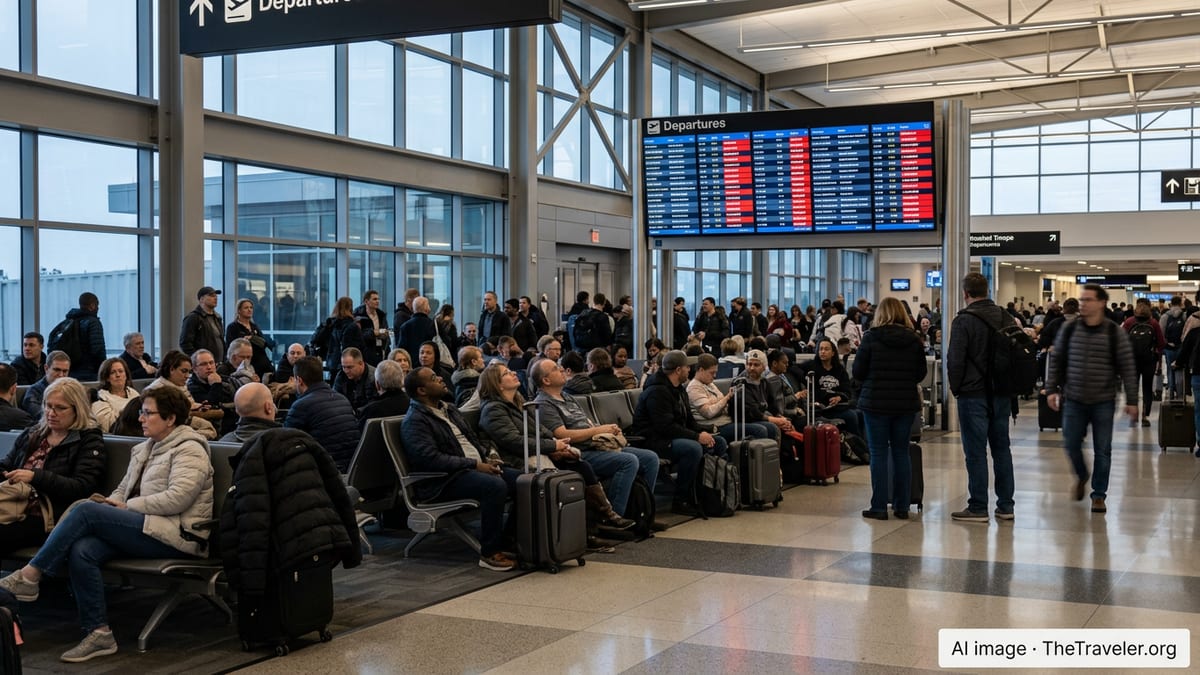
For travelers, the practical impact of this latest disruption is most visible in crowded departure halls, long customer service lines, and constantly changing departure boards. Passengers flying through Seattle, Boston, Detroit, Nashville, Philadelphia, and Raleigh–Durham report a mix of extended tarmac waits, last-minute gate changes, and same-day cancellations that require rebooking or overnight stays.
Travelers connecting through multiple hubs are particularly vulnerable, as a delay on the first leg can quickly make a planned connection impossible. With a large number of RDU flights now delayed or canceled, some passengers are being rerouted through alternative cities, sometimes adding several hours and additional takeoffs and landings to their journeys.
The concentration of delays and cancellations at mid-sized but fast-growing airports such as Raleigh–Durham also affects surrounding road and ground transportation networks. Shuttle buses, rideshare services, and nearby hotels can become strained during peak disruption periods, adding another layer of complexity for stranded passengers trying to adjust their plans on short notice.
What Travelers Can Expect in the Coming Days
Based on recent patterns during major weather and operational events, residual disruptions are likely to linger even after the current storm system moves away from key hubs. Airlines typically prioritize restoring long-haul and high-demand trunk routes first, while lower-frequency regional services may continue to see scattered cancellations or prolonged delays.
Publicly available industry guidance suggests that passengers scheduled to travel through Seattle, Boston, Detroit, Nashville, Philadelphia, or Raleigh–Durham in the near term should be prepared for schedule changes and allow additional time for connections. Same-day rebooking options may be limited on certain routes when cancellation numbers are high and load factors remain elevated at the height of the spring travel period.
Airline and airport data also indicate that recovery can vary widely from carrier to carrier, depending on fleet size, staffing levels, and how aggressively each operator preemptively trims its schedule during severe weather forecasts. For travelers, that means disruption risk may not be uniform across all flights from a given airport, even on the same day and in similar conditions.