

More news on this day
A U.S. Navy F/A-18 Super Hornet narrowly escaped an Iranian surface-to-air missile during a low-altitude mission over Iran, according to recent open-source reporting that has intensified scrutiny of the risks facing carrier-based aviators in the expanding regional conflict.
Get the latest news straight to your inbox!
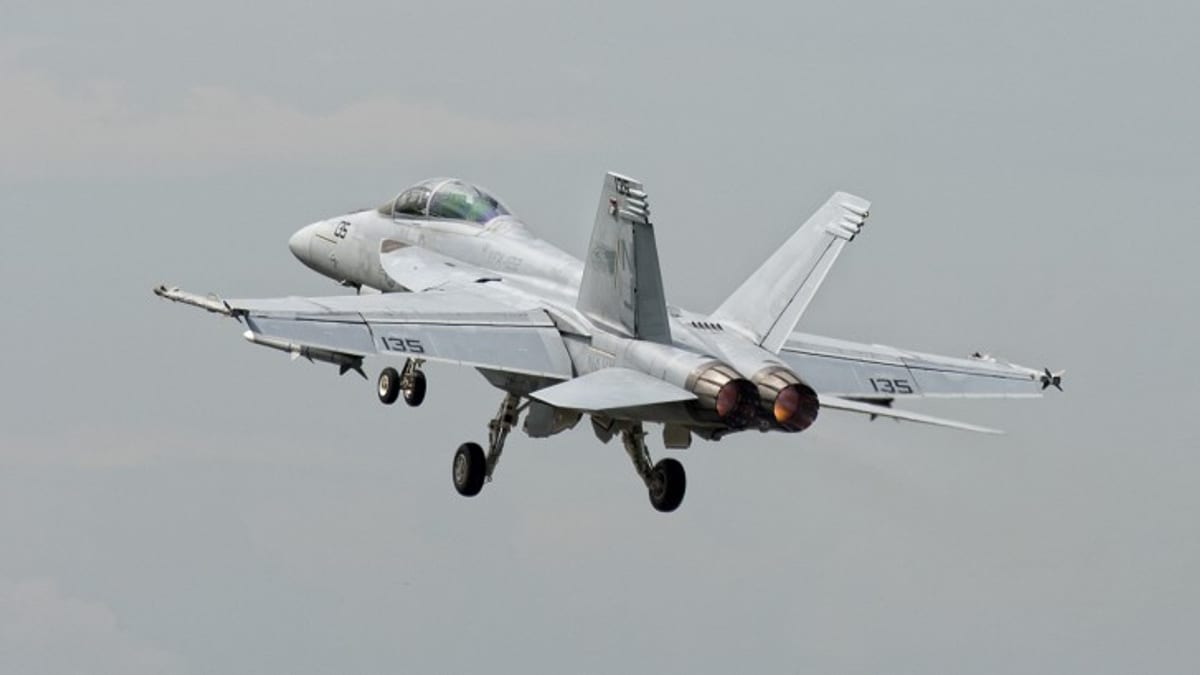
Image by Aviation News
Near Miss in Iranian Airspace Captured on Video
Publicly available imagery and battlefield footage circulating on social media in recent days appear to show a U.S. Navy F/A-18 Super Hornet conducting a low-level pass over Iranian territory before an infrared-guided missile streaks past the jet, missing by a small margin. Open-source defense analysts describe the weapon as an Iranian man-portable air-defense system launched from the ground, with the missile closing rapidly on the aircraft before losing track at the last moment.
The incident reportedly occurred in the context of ongoing U.S. operations connected to the wider confrontation involving Iran and its regional proxies. Coverage by defense-focused outlets indicates the Super Hornet had just engaged a target with its onboard cannon when the missile launch occurred, forcing the pilot to maintain a hard turn at treetop height as the weapon passed behind the aircraft.
Although the U.S. government has publicly denied Iranian claims of successfully downing an American fighter over Iran, the available footage and subsequent analysis suggest at least one Super Hornet experienced a very close call. Commentators following the conflict note that even a near miss at such short range can shower an aircraft with fragments, raising the likelihood of minor damage that may not be immediately visible on grainy video.
The episode has quickly become a focal point in online military communities and open-source intelligence circles, where the video is being replayed frame by frame to assess the missile’s behavior, the aircraft’s flight profile, and what the encounter reveals about Iranian air-defense tactics.
Low-Altitude Tactics and the Super Hornet’s Role
The F/A-18E/F Super Hornet has been a central workhorse of U.S. carrier aviation for years, tasked with missions ranging from air superiority to close air support and precision strike. In the current campaign environment around Iran, reports suggest many sorties involve prolonged low-altitude flight profiles intended to reduce exposure to longer-range radar-guided surface-to-air missiles.
Flying at low level can complicate enemy tracking and engagement, but it also brings aircraft into the envelope of shorter-range systems, including shoulder-fired infrared missiles and anti-aircraft artillery. Analysts observing the recent near miss argue that the video underscores this trade-off: the Super Hornet appears to be exploiting terrain masking while simultaneously operating within reach of man-portable systems hidden among civilian or rugged landscapes.
Publicly available information on U.S. naval air operations shows that Super Hornet squadrons embarked on carrier strike groups in the region have been heavily involved in missions over contested airspace, including suppression of enemy air defenses, strikes on missile and drone infrastructure, and protective patrols in support of wider coalition activity. The aircraft’s combination of advanced sensors, electronic-warfare pods, and precision weapons makes it a key platform for these tasks, but the latest incident illustrates how even a sophisticated jet can be vulnerable in the tight confines of low-altitude maneuvering.
Defense commentators note that crews in such environments must constantly balance mission effectiveness with survivability, adjusting altitude, speed, and routing as threats evolve from both Iranian forces and affiliated militias equipped with modern short-range systems.
What the Missile Encounter Reveals About Iranian Air Defenses
The missile seen racing toward the Super Hornet has drawn particular attention because it appears to be a relatively small, shoulder-launched weapon rather than a large radar-guided interceptor fired from a long-range battery. Open-source assessments describe it as part of a class of man-portable air-defense systems that rely on heat-seeking guidance, widely proliferated across the region and increasingly integrated into Iranian and proxy arsenals.
While such systems are typically less capable than high-altitude strategic surface-to-air missiles, they pose a serious threat to aircraft conducting the kind of close-in, low-level missions now common over Iran. The footage suggests that the Iranian team launching the missile had sufficient advance warning or visual contact to position themselves for a shot as the jet completed its attack run, highlighting the challenges of fully suppressing dispersed, mobile air-defense teams.
The incident also arrives amid broader reporting on Iranian missile and drone activity across the region, including strikes on bases used by U.S. and partner forces. Military analysts point out that each successful launch, even if it results only in a near miss, provides Iranian tacticians with valuable data on engagement ranges, likely flight paths, and Western countermeasures, potentially informing future attempts.
For their part, U.S. and allied planners are expected to factor this engagement into ongoing assessments of air-defense coverage, threat layering, and the extent to which low-level tactics remain viable over heavily surveilled and increasingly contested terrain.
Rising Risks for Carrier Aviation in the Region
The Super Hornet’s brush with an Iranian missile adds to a growing list of aviation incidents associated with the expanding conflict, including earlier friendly-fire losses and accidents involving carrier-based jets. Together, these events highlight the continuous risk to crews operating from U.S. carriers positioned in or near contested waters while supporting missions over Iran and neighboring states.
Carrier air wings in the region are reported to be flying at a sustained operational tempo, juggling defensive patrols, strike sorties, and surveillance missions in an airspace saturated with drones, cruise missiles, and a patchwork of regional air-defense assets. Every low-level mission over hostile territory requires meticulous planning around known and suspected threats, yet the latest near miss demonstrates how unpredictable and dynamic those threats can be once a jet crosses the coastline.
Naval aviation experts following the conflict through public sources suggest that the incident may influence future decisions about risk thresholds, route selection, and reliance on low-altitude tactics versus standoff weapons. While the Super Hornet escaped this encounter, the margin of error appeared uncomfortably slim, a fact that is likely to resonate throughout carrier air wings currently deployed to the theater.
For travelers and observers tracking regional security, the episode underscores how quickly the airspace picture can shift, with each missile launch or interception altering the perceived safety of key corridors, coastal approaches, and population centers under the flight paths of combat aircraft.
Implications for Regional Stability and Airspace Safety
Beyond the immediate drama of a missile arcing past a low-flying jet, the Super Hornet’s escape feeds into broader concerns about escalation and airspace safety in and around Iran. Each close call raises the possibility of debris, weapons fragments, or misdirected fire affecting civilian areas, commercial routes, or neighboring countries’ airspace at a time when air traffic managers and airlines are already routing around multiple conflict zones.
Publicly accessible airspace advisories and route adjustments in recent months reflect a cautious approach by civil aviation authorities and carriers, many of which have restricted or entirely avoided Iranian overflight in response to missile tests, drone activity, and ongoing military operations. The latest footage of a near miss may reinforce that caution, even if no civilian aircraft were directly threatened in this specific encounter.
Regional analysts also highlight the symbolic dimension of such incidents. Iran’s ability to engage U.S. aircraft, even unsuccessfully, is often framed domestically as proof of resilience and deterrent strength, while the continued operation of U.S. carrier-based fighters over or near Iranian territory is presented in Western coverage as evidence of freedom of action and alliance commitment. Each high-profile engagement therefore carries both military and political weight, potentially complicating diplomatic efforts to limit escalation.
As the conflict environment evolves, the Super Hornet’s narrow escape is likely to be studied as a case study in the intersection of modern airpower, dense ground-based defenses, and congested regional airspace. For now, it stands as a vivid reminder of the hazards facing aircrews flying at low level over one of the world’s most volatile theaters.