

Spain is one of Europe’s most card friendly destinations, yet travelers are often surprised by unexpected fees after they return home. The charges rarely come from Spanish merchants themselves. Instead they result from how your bank, card network, and payment terminals handle foreign currency. With a bit of preparation and a sharper eye at the checkout screen, you can enjoy tapas, train tickets, and museum entries in Spain while keeping extra card fees to an absolute minimum.
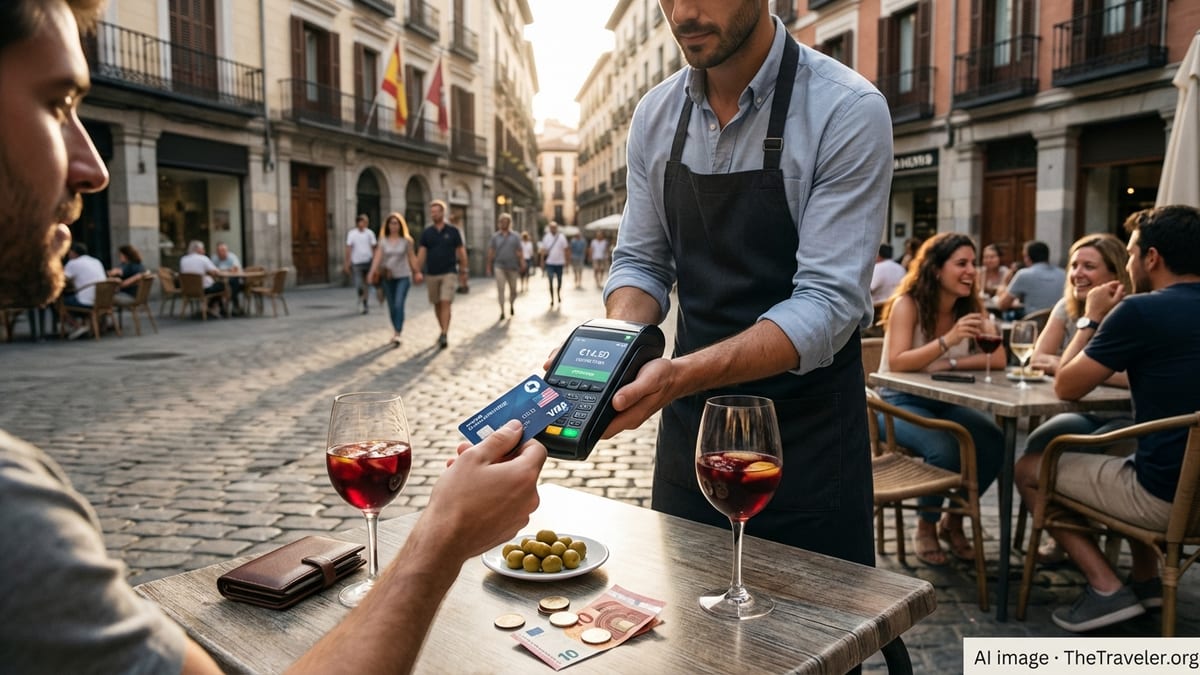
How Card Payments Work in Spain
Spain has adopted card and contactless payments at a rapid pace, particularly in cities and tourist hubs. Most hotels, restaurants, supermarkets, museums, and transport operators accept major credit and debit cards. Smaller village bars or local markets may still prefer cash, but in everyday travel you can expect to pay by card almost everywhere. Point of sale terminals are modern, support chip and PIN, and often present screens in multilingual formats when a foreign card is detected.
When you tap or insert a foreign card in Spain, three main actors get involved. The merchant’s bank, known as the acquirer, processes the euro transaction. Your bank or card issuer back home authorizes the charge in your home currency. In between, networks like Visa or Mastercard handle messaging and currency conversion rules. The fees you ultimately pay depend on how these parties interact and what options you choose at the moment of payment.
The standard process is simple. The Spanish terminal submits the amount in euros to your card network, which converts it at a wholesale exchange rate close to the market rate. Your issuing bank then adds any foreign transaction fees specified in your card’s terms. When everything follows this default path and you hold a low fee card, paying by card in Spain can be nearly as cheap as using cash from a perfect exchange booth.
Problems start when extra services such as dynamic currency conversion or hidden international surcharges are layered on top. These services are framed as conveniences, offering to show you a familiar currency on screen. In practice they tend to inflate the exchange rate or add markups that quietly increase your bill. Understanding where these costs appear makes it easier to refuse them and protect your travel budget.
The Biggest Hidden Cost: Dynamic Currency Conversion
The most common extra fee foreign visitors meet in Spain is dynamic currency conversion, often shortened to DCC. When a terminal detects that your card is issued outside the euro area, it may offer to charge you in your home currency instead of euros. The screen might say something like "Pay in EUR" or "Pay in USD" and emphasize that choosing your home currency lets you "know exactly what you pay." This framing is persuasive, especially after a long travel day.
What the screen rarely explains clearly is that the exchange rate for the foreign currency option is usually set by the payment processor or the merchant’s bank, not by the card network. That gives them room to add a sizable margin on top of the interbank rate. While the additional cost varies, it is often noticeably higher than what you would pay if you let your card network handle conversion in the background. In effect, DCC trades transparency on the screen for a quietly worse rate.
To avoid this, consistently choose to pay in euros whenever you are offered a currency choice in Spain. If a waiter or cashier asks on your behalf, you can politely say that you prefer to pay in euros. If the machine defaults to your home currency, ask them to cancel and rerun the transaction in euros. It may feel awkward the first time, but it quickly becomes routine and can save meaningful money over the course of a trip.
ATMs can use the same technique. When withdrawing cash in Spain with a foreign card, some machines offer to lock in a conversion to your home currency at a "guaranteed" rate. The same principle applies: select the option that keeps the transaction in euros and declines conversion, then let your own bank or card network do the exchange. This single habit is one of the most effective ways to reduce unnecessary costs.
Choosing the Right Card Before You Travel
The easiest way to limit fees in Spain is to start with a card that does not penalize foreign transactions. Many issuers in popular outbound markets such as the United States and the United Kingdom now offer cards with zero foreign transaction fees. These cards skip the extra percentage that some banks still add to every non domestic purchase. Over the course of a Spanish holiday, that difference can be equivalent to losing one meal for every several you buy.
Even if your card advertises no foreign transaction fee, it is worth checking whether it sits on a network that uses competitive exchange rates. Visa and Mastercard typically use rates close to wholesale market levels. Some regional networks or co branded cards may apply additional spreads. Reading your card’s detailed pricing disclosure before departure can reveal whether there are any separate international service charges or conversion markups that might apply in Spain.
Carrying more than one card with different networks can provide backup and extra savings. Acceptance in Spain for Visa and Mastercard is extremely broad. American Express and some domestic brands are less widely accepted, especially outside major cities and upscale hotels. Bringing at least one widely accepted Visa or Mastercard with low or zero foreign transaction fees gives you flexibility to decline offers like dynamic currency conversion without worrying that your payment will fail.
Debit cards tied to low fee online banks or multi currency accounts can also be powerful tools. Many such providers issue cards that automatically convert at interbank or near interbank rates and charge little or no margin on euro purchases. While it is still important to decline terminal conversion, combining a competitive card with smart in person choices can get you very close to the real market rate for everything from train tickets to restaurant bills.
Understanding Bank and Network Fees on Euro Purchases
Even when you avoid dynamic currency conversion, your bank may still add its own fees to purchases in Spain. The most visible is the foreign transaction fee. This is usually expressed as a percentage of each purchase amount and can apply even though Spain uses the euro, which is a major global currency. Some banks distinguish between in person and online foreign transactions, or between purchases within and outside certain regions.
In addition to stated foreign transaction fees, a small number of issuers apply their own currency conversion spread on top of the network rate. This is less transparent because it appears in the rate itself rather than as a separate line item. You can sometimes spot it by comparing the rate your bank used on a particular day with the approximate market rate for euros, keeping in mind that minor differences over a single day are normal.
Network level fees are less common for individual consumers but they can appear on certain co branded or corporate cards. In such cases, the network might levy an international service assessment that the issuer passes through to you. These charges are usually modest per transaction but can accumulate over a long stay or a high spending trip. Carefully reviewing the terms of each card you bring is the most reliable way to understand what might appear on your statement later.
Despite these possibilities, travelers should remember that not all cards are equal. It is entirely possible to structure your wallet so that most everyday expenses in Spain incur no additional percentage based fees beyond the exchange rate itself. For many travelers, that means deliberately reserving fee heavy cards for domestic use and taking only the most travel friendly products abroad.
Best Practices at Shops, Restaurants, and Hotels
Once you are on the ground in Spain, most of your savings will come from habits at the payment terminal. The core rule is to keep every transaction in euros. Whenever the screen offers a choice between your home currency and euros, choose euros. When staff present a portable terminal at your table, glance at the currency before entering your PIN or tapping. If it is not in euros, you can ask them to change it or cancel and retry.
Spanish merchants are accustomed to visitors, especially in major destinations like Barcelona, Madrid, and Seville. Politely requesting to pay in euros is routine. You do not need to explain the technicalities of exchange rates. A simple request such as "in euros, please" is generally enough. If informed staff mention that paying in your home currency shows the final amount, you can acknowledge that and mention you prefer your own bank’s rate.
At hotels, you may encounter a similar choice when settling your bill. Some properties or booking systems may default to charging international guests in their home currency through dynamic currency conversion. If you see a pre check in form or an email asking your billing currency preference, select euros. Upon checkout, confirm the currency on the invoice before the charge is processed. Correcting it at that stage is far easier than disputing a conversion after you return home.
Restaurants in touristy areas sometimes print an additional slip that shows what you would pay in your home currency. Treat this as informational only. As long as the actual card charge is in euros, your card network will handle conversion at its standard rate. Slip copies that mention "customer currency choice" often list the DCC option separately, so a quick review before signing or entering your PIN helps ensure you are not opting in unintentionally.
Using ATMs in Spain Without Excessive Fees
Card payments are widely accepted in Spain, yet having some cash can still be useful for small purchases, tipping in certain contexts, and public facilities that only accept coins. Withdrawing euros from ATMs is usually better than exchanging large amounts of cash at currency booths. Still, to keep costs low, you need to navigate both ATM operator fees and your own bank’s international charges.
Some ATM operators in Spain charge a direct usage fee when you withdraw with a foreign card. The machine must display this fee before you confirm the withdrawal. It is typically a fixed amount per transaction rather than a percentage. If you encounter a machine showing a particularly high fee, you can cancel and try a different bank’s ATM nearby. Large Spanish banks often have competitive terms, and some international friendly institutions have policies that reduce or rebate ATM fees for their customers.
In addition, many Spanish ATMs attempt dynamic currency conversion. Similar to card terminals, they will ask whether you want to be charged in your home currency at a "guaranteed" rate. To minimize fees, decline this service and opt to be charged in euros. Your home bank or your card’s network will then handle the conversion, often at a better rate. This is one of the most important choices you can make, because the ATM’s conversion margin can quietly be larger than the visible usage fee.
Your own bank’s policies play a major role as well. Some banks charge a flat fee per foreign withdrawal, some charge a percentage of the cash amount, and some do both. Others, including some online focused banks, reimburse these charges or let you use a certain number of foreign ATMs for free each month. Before traveling to Spain, review the terms for each card you might use at an ATM and favor those with the most traveler friendly structure.
Managing Prepaid, Travel, and Mobile Wallet Cards
Prepaid and travel cards have become popular tools for overseas spending, and Spain is no exception. These cards are often marketed as fee free and convenient, but their actual cost depends on how they handle exchange rates and top up methods. Some allow you to load euros in advance at a fixed rate, which can be beneficial if you want certainty. Others hold your balance in your home currency and apply a conversion each time you spend.
To avoid surprises, pay attention to any loading fees, inactivity charges, and currency conversion spreads embedded in the rates. Even if card marketing claims zero foreign transaction fees, the provider may earn revenue from a slightly less favorable exchange rate. Carefully reading the pricing section and trying a small test top up and purchase before departure can clarify how much you are really paying.
Mobile wallets such as Apple Pay and Google Pay are widely accepted in Spain wherever contactless card payments work. When you use a mobile wallet, the underlying card’s fees and exchange rate rules still apply. The wallet simply passes the transaction through in a tokenized form. That means your primary task is to choose a low fee card to connect to your wallet and then continue to decline dynamic currency conversion at terminals.
Some multi currency digital accounts pair well with mobile wallets by letting you hold euros alongside your home currency. If you pre convert a portion of your travel budget into euros inside such an account, you can then pay in Spain as if you were using a local euro card. In that scenario, ensure that you are comfortable with the rate the provider uses when you first buy euros, since that is when most of the cost is determined.
Safety, Disputes, and Record Keeping
While focusing on fees, it is also worth considering safety and dispute protection when using foreign cards in Spain. Credit cards often provide stronger consumer protections against fraud and billing errors than debit cards. If a transaction is mischarged or duplicated, it is usually simpler to contest it with a credit card issuer, and your everyday bank balance is not directly impacted while the dispute is investigated.
To make disputes easier, keep digital or paper copies of major receipts, particularly in hotels, car rental agencies, and any high value purchases. When you sign a slip that mentions dynamic currency conversion or a chosen billing currency, ensure it matches what you requested verbally. If the slip states that you selected your home currency but you remember asking for euros, correct it on the spot. Addressing the issue immediately with staff is almost always simpler than arguing about it from another country.
Fraud prevention practices in Spain are similar to those in other parts of the euro area. Chip and PIN, contactless limits, and occasional requests for signature are all normal. Always shield your PIN, avoid letting cards out of sight in crowded venues, and use ATMs attached to bank branches or reputable locations where possible. If your card is lost or compromised, contact your issuer right away to block it and arrange a replacement or a backup card.
Many banks provide real time alerts for international transactions. Enabling these notifications before you travel offers two benefits. First, you can quickly spot any unauthorized use. Second, you can see the euro amount and the approximate converted charge soon after each transaction, which helps you identify whether dynamic currency conversion was applied unintentionally.
The Takeaway
Using foreign credit cards in Spain without extra fees is less about mastering complex financial rules and more about forming a few consistent habits. Start by choosing cards that minimize or eliminate foreign transaction charges. Then, once in Spain, always choose to pay in euros, both at card terminals and ATMs, declining any currency conversion offers that appear on screen. Those two decisions alone eliminate many of the most common hidden costs.
Layering on a bit of preparation, such as checking your bank’s ATM policies and connecting the right cards to your mobile wallet, can make your spending in Spain almost as efficient as that of a local resident. Combined with sensible safety practices and basic record keeping, your cards become secure and low cost tools instead of sources of anxiety. With these steps in place, you can focus on the experiences that brought you to Spain in the first place rather than on deciphering your card statement when you return home.
FAQ
Q1. Should I choose euros or my home currency when paying by card in Spain?
In almost all cases you will pay less overall if you choose to pay in euros and let your card network and bank handle the currency conversion.
Q2. What is dynamic currency conversion and why is it expensive?
Dynamic currency conversion is when a terminal or ATM offers to charge you in your home currency at a set rate. The provider often adds a significant margin to that rate.
Q3. How can I tell if dynamic currency conversion is being used?
If the payment screen in Spain shows an amount in your home currency and highlights words like "rate" or "guaranteed," you are likely being offered dynamic currency conversion.
Q4. Are credit cards or debit cards better to use in Spain?
Credit cards with no foreign transaction fees often provide stronger protections and competitive rates, while low fee debit cards can be useful for ATM withdrawals and everyday spending.
Q5. Do all Spanish ATMs charge extra fees to foreign cards?
No, fees vary by operator. Some Spanish ATMs apply a usage fee while others do not, and you will see any such fee on screen before confirming your withdrawal.
Q6. Will contactless and mobile wallet payments work in Spain?
Yes, contactless cards and mobile wallets are widely accepted wherever modern card terminals are used, especially in cities, transport systems, and larger retailers.
Q7. How many cards should I bring to Spain?
Bringing at least two cards from different issuers or networks is wise so you have a backup if one is lost, blocked, or unexpectedly declined at a particular merchant.
Q8. Can I rely only on cards or do I still need cash in Spain?
You can rely mostly on cards in urban areas, but carrying a modest amount of cash is useful for small purchases, some rural locations, and occasional coin operated services.
Q9. How do I check if my card charges foreign transaction fees?
Review your card’s pricing and terms section or contact your bank directly to ask whether a percentage fee applies to purchases made in foreign currencies or outside your home country.
Q10. What should I do if I am charged in my home currency by mistake?
First discuss the issue with the merchant as soon as you notice it. If it cannot be corrected on the spot, document the receipt and contact your card issuer to request a review.