

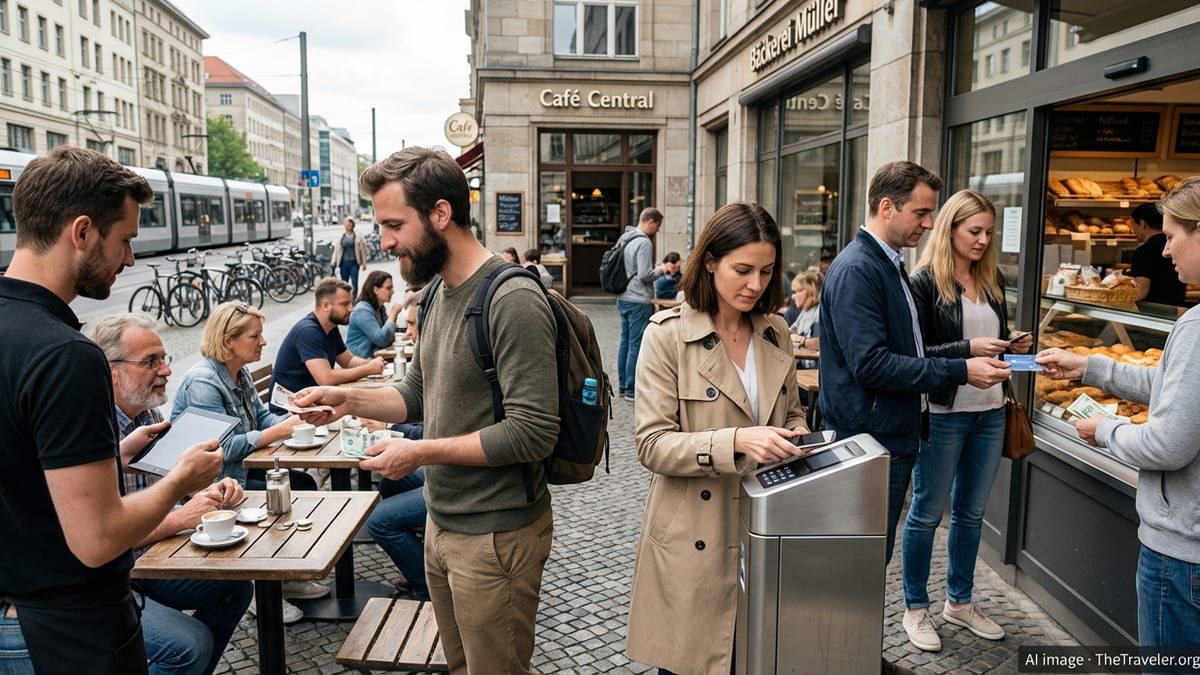
Germany has a reputation for loving cash, yet contactless cards and mobile wallets are now part of everyday life. For visitors, this mix can be confusing. You may read that Germany is a "cash only" country, then walk into a café where the sign says "Card payments only". The reality sits somewhere in between. Understanding when cash is expected, when cards are welcomed, and how foreign cards fit into a system built around domestic Girocards will make paying your way in Germany far less stressful.
The Big Picture: How Germans Pay Today
Germany is in the middle of a slow but clear shift away from cash. Official surveys from the Deutsche Bundesbank indicate that cash still accounts for just over half of day to day transactions at the point of sale, but that share has been declining steadily in recent years. At the same time, card use has grown quickly and record numbers of card payments are now processed each year. For practical purposes, this means that both cash and cards are widely used side by side.
The dominant plastic in German wallets is not the classic credit card but the domestic debit system known as Girocard, issued directly by banks and savings banks. These cards are routinely used in supermarkets, pharmacies, bakeries, train stations and larger shops, often via contactless tap. International credit and debit cards from Visa and Mastercard are gaining ground, especially in cities and chain businesses, but do not yet enjoy truly universal acceptance in smaller, independent venues.
For visitors this creates a mixed landscape. In big cities you can expect to pay by card in most supermarkets, fashion stores, museums and restaurants. In small towns, traditional inns, family run cafés, open air markets and some service providers may still prefer or insist on cash. Many businesses now accept both and leave the choice to the customer, but it is still common to see a minimum amount for card payments or to find that only certain card types are accepted.
Despite the rise of plastic and phones at the checkout, cash remains deeply embedded in German financial culture. Many people view it as the most tangible, private and secure way to manage everyday spending. As a result, access to cash is still good, automated teller machines are common in populated areas, and there is no legal or political push to eliminate cash. Visitors who arrive with the expectation of a fully cashless experience are often surprised by how often they still reach for paper money and coins.
Cash Culture: When You Still Need Banknotes and Coins
For all the growth in card payments, having some cash on hand in Germany is still essential. Small purchases are the most obvious example. In many bakeries, kiosks, newsstands and village shops, people pay for a coffee, bread roll or newspaper with coins from their pocket rather than tapping a card. Some of these businesses now accept cards, but they might set a minimum charge, such as 5 or 10 euros, below which they refuse or discourage card use.
Cash is also common in more traditional parts of the hospitality sector. Rustic inns, family run guesthouses, beer gardens and smaller restaurants, especially outside major cities, sometimes advertise that they take only cash. Even where cards are technically accepted, owners may prefer cash for smaller bills to avoid fees. It is therefore sensible to assume that you will need cash for at least some meals, and to verify payment options before ordering if you plan to rely on a card.
Open air markets, local festivals and seasonal events are other cash heavy environments. Weekly farmers markets, Christmas markets and street fairs do feature more card readers each year, often using simple smartphone based terminals, but many vendors still work on a cash basis. Likewise, small service providers such as hairdressers, independent tradespeople and rural taxis may not take cards at all, or may accept only domestic debit cards.
Even in larger cities that feel very modern, pockets of cash culture remain strong. Older residents and people who are wary of digital payments often choose to withdraw cash once a week and use it for nearly everything. That habit keeps cash firmly in circulation. As a visitor, you do not need to copy the local pattern, but you should assume that practical situations will arise where cash is the easiest or only way to pay.
Card Payments: Where and How Plastic Works Best
Card acceptance in Germany has expanded dramatically, especially in urban areas and national chains. Supermarkets, discount grocers, department stores, pharmacies, electronics shops and most larger clothing retailers routinely accept both domestic Girocards and international Visa and Mastercard products. In these settings, contactless transactions are now the norm, and many customers no longer insert a card or sign a receipt for everyday amounts.
Hotels, major attractions and intercity transport providers are also generally card friendly. International credit cards are widely accepted for booking and paying for hotels, train tickets purchased through main machines or apps, and entry fees to popular museums and cultural sites. Larger restaurant groups and fashionable city cafés often accept a broad range of cards, and some city centre venues have flipped the traditional pattern by going fully cashless for security and convenience.
Nevertheless, card acceptance is not uniform. Some smaller merchants contract only with providers that specialize in German debit systems and may not accept foreign cards at all. Others accept Visa and Mastercard but refuse foreign prepaid cards or certain corporate cards. In some cases a shop will accept cards but will indicate a minimum transaction amount, especially if processing fees are a concern. When in doubt, look for signage near the entrance or till, or simply ask which cards are accepted before you order.
It is also worth noting that card use patterns differ by transaction size. Data from the Bundesbank and industry providers show that Germans still prefer cash for very small amounts, while cards dominate for larger purchases such as electronics, clothing and fuel. As a visitor, you may be able to rely on your card for most mid range and high value transactions, but you should be prepared to switch to cash for small, everyday items and anywhere that appears strongly traditional or family run.
Understanding Girocard, Credit Cards and Foreign Plastic
The key to understanding payments in Germany is the central role of Girocard, the domestic debit system run by German banks. A Girocard is linked directly to a current account and is issued as standard by most banks and savings banks. It is widely accepted in shops, restaurants, self service fuel pumps, ticket machines and for cash withdrawals. Fees for merchants are relatively low, which encourages broad acceptance in retail. For German residents this makes the Girocard a convenient daily payment tool.
By contrast, classic credit cards play a more limited role in German daily life than in some other countries. Surveys suggest that a significant share of Germans own a credit card, but they are used most frequently for online purchases, travel bookings and larger transactions rather than for small everyday items. In recent years, debit cards branded with international schemes such as Visa and Mastercard have started to bridge the gap, allowing banks to issue cards that function as a debit product for the customer while being processed through global networks at the checkout.
Visitors usually arrive with international debit or credit cards rather than Girocards. These work best at larger merchants, hotels, chain restaurants, railway counters, major ticket machines and in most city taxis. However, not every terminal that accepts Girocard will process a foreign card. Situations where foreign cards may fail include small independent shops and machines configured only for the domestic system. When a card is refused, it is rarely personal. The terminal simply has not been set up to handle that network.
Because the domestic system is so dominant, a small number of businesses still describe non German cards as "credit cards" and claim not to accept them, even if your card is technically a debit card. What matters in practice is not what the card is called, but whether the terminal and the merchant’s contract with their payment provider include your card network. Carrying at least two cards from major global providers and a back up of cash greatly reduces the risk of being left without a way to pay.
Contactless, Mobile Wallets and the Move Toward Cashless
While Germany was slower than some neighbours to adopt contactless payments, the situation has changed in recent years. The vast majority of new Girocards, as well as international debit and credit cards, now include contactless capability, and almost all modern terminals accept tap to pay. Industry statistics show that a very high share of card transactions in Germany are now contactless, reflecting a shift that accelerated during the pandemic and has continued since.
Mobile wallets such as Apple Pay and Google Pay have followed a similar path. They are supported by most major German banks and by many international card issuers, and they are increasingly familiar at urban checkouts. However, they remain less common than physical cards. Surveys suggest that only a minority of Germans regularly use smartphones or watches to pay, and the rate of adoption varies strongly with age and comfort with digital technology.
For visitors, mobile payments can be an excellent complement to plastic, particularly for contactless ready chain stores, transport ticket machines and quick purchases in cities. If your bank supports a major mobile wallet and you are comfortable using it at home, activating it for your trip can provide an extra layer of convenience and redundancy. That said, you should not assume universal acceptance. Some small merchants may refuse mobile payments even when they accept cards, either because their terminal is older or simply because staff are unfamiliar with the process.
The direction of travel is clearly toward more digital and contactless payments. Cash usage is slowly declining, and policymakers and industry bodies continue to invest in instant transfers and other innovations. At the same time, there is strong public support for protecting the role of cash as a back up, a privacy friendly option and a tool of social inclusion. The near future in Germany is likely to remain hybrid rather than fully cashless.
ATMs, Currency Exchange and Withdrawing Cash
Automated teller machines remain the main way residents and visitors obtain cash in Germany. Banks, savings banks and credit unions operate nationwide networks, and in cities you rarely have to walk far to find a machine. In rural areas, ATMs are less densely distributed than they once were, as banks consolidate branches, but most towns still have at least one machine operated by a major bank. In large supermarkets and shopping centres you may also find independent ATMs run by commercial providers.
For foreign cardholders, the safest and usually cheapest way to obtain euros is to withdraw cash from a bank operated ATM using a debit card, not a credit card. Your home bank will typically charge a foreign withdrawal fee or apply a markup to the exchange rate, but this is often more competitive than the rates at currency exchange counters. Independent ATMs may add their own service charges on top of what your bank charges, so it is sensible to prefer machines clearly associated with established banks.
Many German ATMs and some card terminals offer so called dynamic currency conversion, where the machine proposes to charge your card in your home currency instead of euros. This is attractive at first glance, because you see the exact cost in a familiar currency. In practice, the exchange rate used for this conversion is often significantly worse than the rate your own bank would apply. To avoid hidden costs, most financial experts recommend declining conversion and choosing to be charged in euros whenever possible.
Because Germany is in the euro area, the same currency is used in neighbouring countries such as France, Austria and the Netherlands. If your trip includes travel across borders within the eurozone, withdrawing a reasonable amount of cash once, then using cards where convenient, can simplify your money management. You do not need to carry large sums in cash, but keeping a modest reserve for situations where cards fail or are refused will give you peace of mind.
Tipping, Small Transactions and Everyday Etiquette
Everyday customs around paying and tipping in Germany can differ subtly from those in other countries. Tipping is appreciated in cafés, bars, restaurants, taxis and for some personal services, but it is not strictly obligatory. Locals typically add an amount in the range of 5 to 10 percent for satisfactory service, sometimes more in higher end venues, or they round up the bill to a convenient figure. Leaving coins on the table is less common than telling the server the total you would like to pay, tip included, when they present the bill.
When paying by card, it is often possible to add the tip to the total, especially in establishments with modern terminals and waiter operated handheld devices. In some smaller venues, however, staff may prefer tips in cash, because distribution of card tips between employees can be unclear or subject to management policies. If you want to be sure that the person serving you receives the full benefit, carrying a few small notes and coins for tipping is still a good idea.
At the checkout in shops, Germany retains some traditional habits. Queues are generally respected, and people expect you to have your payment method ready when it is your turn. If you are paying in cash, it helps to prepare approximate change in advance. If you plan to pay by card, a quick glance for acceptance signs while you wait can prevent awkwardness at the moment of payment. Many supermarkets no longer ask for a signature for card payments, but you will usually be required to enter a personal identification number or approve the transaction on a phone.
Small but important cultural details include the use of cash deposits for certain items, such as drink bottles with a refundable deposit or key cards for budget accommodation. These deposits are typically clearly marked and are returned when you bring back the item. Having a few coins or low denomination notes handy smooths these interactions. Overall, Germans value efficiency and clarity at the till. Knowing roughly how much you plan to spend, indicating your intention to tip, and choosing an appropriate payment method will help you blend in.
Security, Fees and Practical Tips for Travellers
Using money in Germany is generally safe, but a few precautions will help you avoid unnecessary costs and headaches. As in any country, pickpocketing can occur in crowded public transport, tourist areas and major stations. Carry only the cash you expect to need for the day, keep the rest in a secure place, and avoid showing large amounts in public. Money belts or interior pockets are rarely necessary in everyday situations, but a cross body bag that closes securely is sensible in busy areas.
From a financial perspective, foreign transaction fees and poor exchange rates are often a bigger risk than crime. Before you travel, check what your bank charges for purchases and cash withdrawals in euros. Some banks issue cards with low or no foreign transaction fees, which can significantly reduce the cost of using plastic abroad. If your primary card has high fees, consider bringing a secondary card with better travel conditions or using cash for smaller purchases where the fee would outweigh any rewards or advantages.
Always decline offers to pay in your home currency when using a card in Germany. Choosing to be charged in euros lets your card provider set the exchange rate, which is usually more competitive than the rate offered at the point of sale. Be wary of independent ATMs or payment terminals that show large service fees or unclear conversion information. If something seems off, cancel the transaction and find another machine or merchant.
Finally, redundancy is key. Systems can go down temporarily, individual terminals can malfunction, and cards can be lost, damaged or blocked. Carry at least two different cards, ideally from different networks or banks, and keep a modest cash reserve. Make a note of your bank’s emergency contact numbers in a separate place, and familiarize yourself with how to block a card quickly if needed. With these basic precautions in place, you can take advantage of Germany’s increasingly modern payment infrastructure without losing the reassurance of cash.
The Takeaway
Germany today offers a genuinely mixed payment environment in which both cash and cards are widely used and broadly accepted. Cash remains important for small purchases, traditional venues, markets and some service providers, while cards, particularly Girocards and increasingly international debit and credit cards, dominate larger and urban transactions. Contactless technology and mobile wallets are now part of daily life, especially in big cities, but they have not displaced notes and coins.
For travellers, the most practical approach is to embrace this hybrid reality. Arrive with at least one widely accepted debit or credit card, ideally two, and plan to use them for hotels, transport, chain stores and higher value purchases. At the same time, withdraw a modest amount of cash from a bank ATM and keep it for smaller bills, tipping and places that do not accept foreign cards. Stay alert to fees and currency conversion offers, and be prepared for the occasional "cash only" or "card only" sign.
If you balance these tools sensibly, Germany becomes an easy country in which to manage money. You can enjoy efficient, fast contactless payments where they are available, fall back on cash where tradition still rules, and move through your trip with confidence that you will rarely be caught short at the checkout.
FAQ
Q1. Do I still need cash when visiting Germany, or can I rely on cards?
Yes, you should still carry some cash. Cards work well in most larger businesses and cities, but small shops, markets and traditional venues may prefer or only accept cash.
Q2. Are foreign Visa and Mastercard cards widely accepted in Germany?
They are broadly accepted in cities, chain stores, hotels and major attractions, but acceptance is not universal. Some smaller merchants take only domestic Girocards or cash.
Q3. Is it better to use a debit card or a credit card in Germany?
For everyday purchases and ATM withdrawals, a debit card with low foreign fees is often cheaper. Credit cards work well for hotels, car rental and larger expenses.
Q4. Can I use contactless and mobile payments like Apple Pay in Germany?
Yes. Most modern terminals accept contactless cards, and many also support Apple Pay and Google Pay, especially in urban areas, though not every small shop uses them.
Q5. What is Girocard, and does it affect me as a visitor?
Girocard is Germany’s domestic debit system, widely accepted in shops. Visitors usually cannot get one, but its dominance explains why some places do not accept foreign cards.
Q6. How much cash should I carry day to day in Germany?
Amounts between 40 and 80 euros usually cover daily small expenses. You can adjust based on your plans, withdrawing more from ATMs as needed rather than holding large sums.
Q7. Is it safe to withdraw money from ATMs in Germany?
Yes, bank operated ATMs are generally safe. Use machines attached to recognized banks, cover your PIN and avoid independent machines that display high or unclear fees.
Q8. How do I tip in Germany, and can I tip by card?
You typically tip 5 to 10 percent in restaurants and taxis by telling the server the total you want to pay. Many terminals allow card tips, but cash tips are always accepted.
Q9. What should I do if a shop refuses my card in Germany?
Stay calm, explain that you have a foreign card and ask whether they accept any international brands. If not, you will need to pay in cash or find a nearby ATM.
Q10. Are there many "card only" or "cashless" shops in Germany?
They are becoming more common in big cities, particularly among modern cafés and some chains, but most businesses still accept cash, and many accept both cash and cards.