

More news on this day
Passengers traveling through Vancouver International Airport on April 10 faced a fresh wave of disruption, as publicly available flight-status data showed 21 delayed departures and nine cancellations affecting a mix of domestic and transborder routes operated by WestJet, United, Jazz, and several other carriers.
Get the latest news straight to your inbox!
Ripple Effects Across Calgary, Toronto, San Francisco And Other Hubs
Operational data and airport tracking tools indicate that Vancouver’s schedule problems did not remain local. A number of the disrupted services were tied to high-traffic corridors linking Vancouver with Calgary and Toronto, along with cross-border flights connecting to San Francisco and other United States gateways. As aircraft and crews fell out of position in Vancouver, knock-on delays appeared on follow-on legs throughout the day.
These patterns align with a broader trend of vulnerability in Canada’s transcontinental and transborder network this spring, as already busy hubs attempt to absorb weather, staffing, and airspace constraints. Recent coverage of nationwide performance has highlighted how even a relatively small cluster of cancellations at a major airport can quickly erode reliability on multiple routes when spare capacity is tight.
Flights touching Calgary and Toronto were particularly exposed, given their role as primary connection points for both WestJet and Air Canada Group carriers. When departures out of Vancouver faltered, passengers on onward itineraries to smaller Canadian cities or US destinations via these hubs faced missed connections, overnight stays, and hastily rebooked itineraries.
San Francisco and other US nodes also felt the strain. Industry reporting in recent days has pointed to tighter runway and arrival constraints at several major American airports, meaning that late departures from Vancouver had fewer options to make up time en route or upon arrival.
WestJet, United, Jazz And Others Juggle Aircraft And Crews
While Vancouver International Airport itself remained open and operational, the 21 delays and nine cancellations underscored the challenge airlines face in keeping aircraft and crews in the right place at the right time. Publicly available schedules showed WestJet, United, and Jazz among the most visibly affected, reflecting their dense presence on key Western Canada and US routes.
WestJet, with a major base in Calgary and a strong footprint in Vancouver, depends heavily on rapid aircraft turns to maintain its network. When departures from Vancouver slid behind schedule or were pulled from the board entirely, aircraft that were meant to continue on to Calgary, Toronto, or US cities became unavailable, forcing last-minute changes further down the line.
United and Jazz, both important players in the Canada–US corridor, faced similar pressures. Jazz, which operates regional services under the Air Canada Express banner, is central to feeding long-haul and transcontinental flights out of larger hubs. Disruptions to short-haul services from Vancouver therefore risked leaving some mainline departures with fewer connecting passengers on board, even when those larger flights departed on time.
Other carriers with smaller schedules at Vancouver also saw individual flights impacted, according to tracking tools, adding to the sense of uncertainty for travelers trying to thread their way across the network on connecting itineraries that involved more than one airline.
Part Of A Wider Pattern Of Canadian Flight Disruptions
The latest disruptions at Vancouver come against a backdrop of repeated operational challenges across Canada’s major airports in recent weeks. Published data and news coverage from early April pointed to hundreds of delays and scores of cancellations across Toronto Pearson, Montreal-Trudeau, Calgary, Vancouver, Ottawa, and other hubs, driven by a combination of late-season winter weather, storms in the United States, and tight airline staffing.
Analysts observing the sector have noted that the geography of Canada’s air network, with long distances between cities and heavy reliance on a handful of large hubs, intensifies the effect of even modest schedule problems. When one storm system or operational issue affects a core airport, connecting flows quickly back up across the country as aircraft rotations are disrupted and crews bump into duty-time limits.
Within this context, the 21 delays and nine cancellations at Vancouver may represent only a fraction of the day’s total disruption nationwide, yet they are emblematic of a fragile system. Travelers who might once have treated a short delay as a minor inconvenience are now increasingly wary of how a missed connection in Vancouver or Calgary can cascade into a lost business day or abandoned holiday further afield.
Industry observers point out that the cumulative effect of such episodes can erode confidence in air travel reliability, especially for passengers from smaller communities who depend on a single daily flight to reach larger hubs like Vancouver before continuing to Toronto, Montreal, or US cities.
Passengers Face Long Lines, Rebookings And Compensation Questions
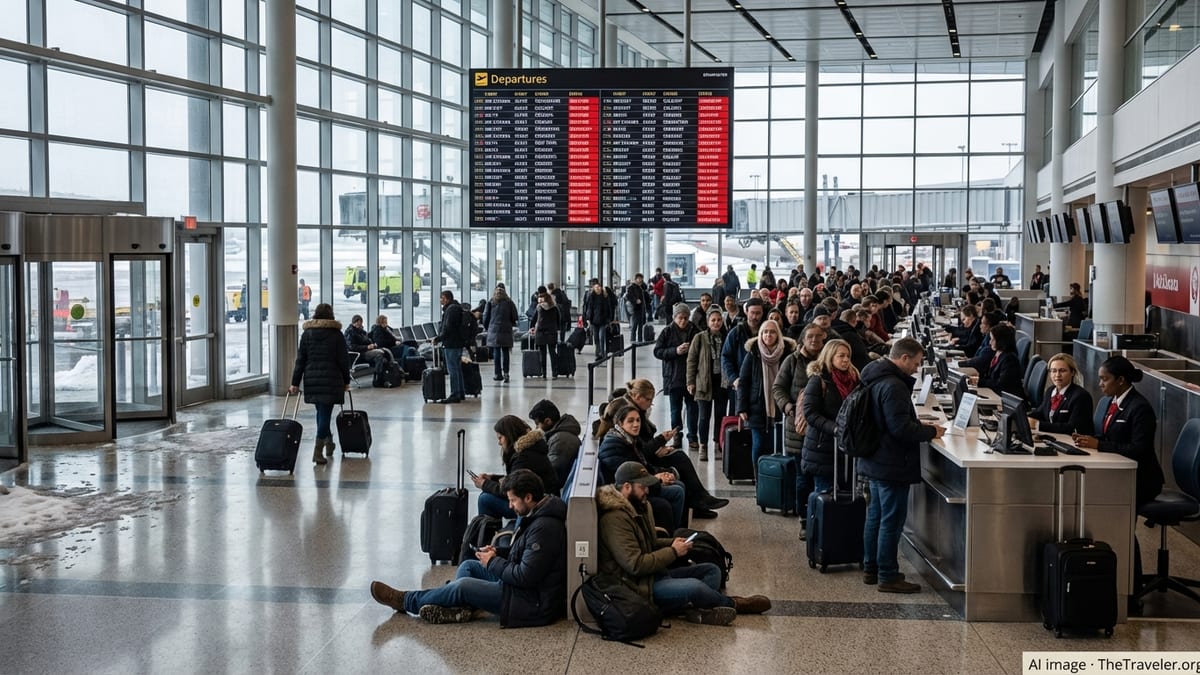
For travelers at Vancouver International Airport, the immediate impact of the latest disruption was felt in longer lines at check-in counters and service desks, as passengers sought rebookings or clarification on their options. Real-time accounts shared on social channels described crowds clustering around departure boards as flight statuses flipped between on-time, delayed, and canceled.
Under Canada’s Air Passenger Protection Regulations, passengers may be entitled to compensation, meals, or accommodation in certain circumstances where delays or cancellations are within an airline’s control and not caused by safety-related issues or severe weather. However, determining eligibility in practice can be complex, and many travelers remain uncertain about what they can reasonably request when their plans are upended.
Consumer advocates frequently advise passengers to document the timing and cause of disruptions as clearly as possible, keep receipts for any extra expenses, and follow up directly with airlines through official channels after travel is complete. Recent coverage of previous disruption periods suggests that some claims can take weeks or months to resolve once formal requests are filed.
In the meantime, same-day travelers from Vancouver to Calgary, Toronto, San Francisco, and other destinations were left weighing whether to accept alternative routings through different hubs, shift their trips by a day or more, or cancel altogether.
Travelers Urged To Build In Buffer Time As Peak Season Nears
With spring travel intensifying and the busy summer period approaching, aviation analysts say that the situation at Vancouver is a reminder for passengers to build more flexibility into their plans. Recent disruption waves across Canada and the United States show that even on clear-weather days, airlines and airports can still struggle with congestion, staffing gaps, and knock-on effects from previous storms.
Practical advice emerging from recent coverage includes booking longer connection times than the minimum offered by airlines, especially when connecting through multiple hubs such as Vancouver and Calgary on the same itinerary. Travelers on critical journeys may also wish to look for earlier departures in the day, when there is more slack in the schedule to absorb small delays before they cascade.
Experts further encourage passengers to use airline apps and airport notification systems to monitor flights from the moment a ticket is purchased, not just on the day of travel. Given how frequently schedules have been adjusted in recent months, an itinerary that appears convenient at the time of booking may change several times before departure.
As the latest figures from Vancouver International Airport show, a cluster of 21 delayed flights and nine cancellations is sufficient to disrupt travel plans across multiple provinces and at least one major US hub in a single day. For passengers, that reality makes vigilance, preparation, and flexibility more important than ever.