

More news on this day
Vietnam Airlines is warning that it could lose money on every single flight in the coming months, as the war in Iran and a wider Middle East conflict send jet fuel prices to unprecedented levels and force a rapid rethink of how, and where, people travel in 2026.
Get the latest news straight to your inbox!
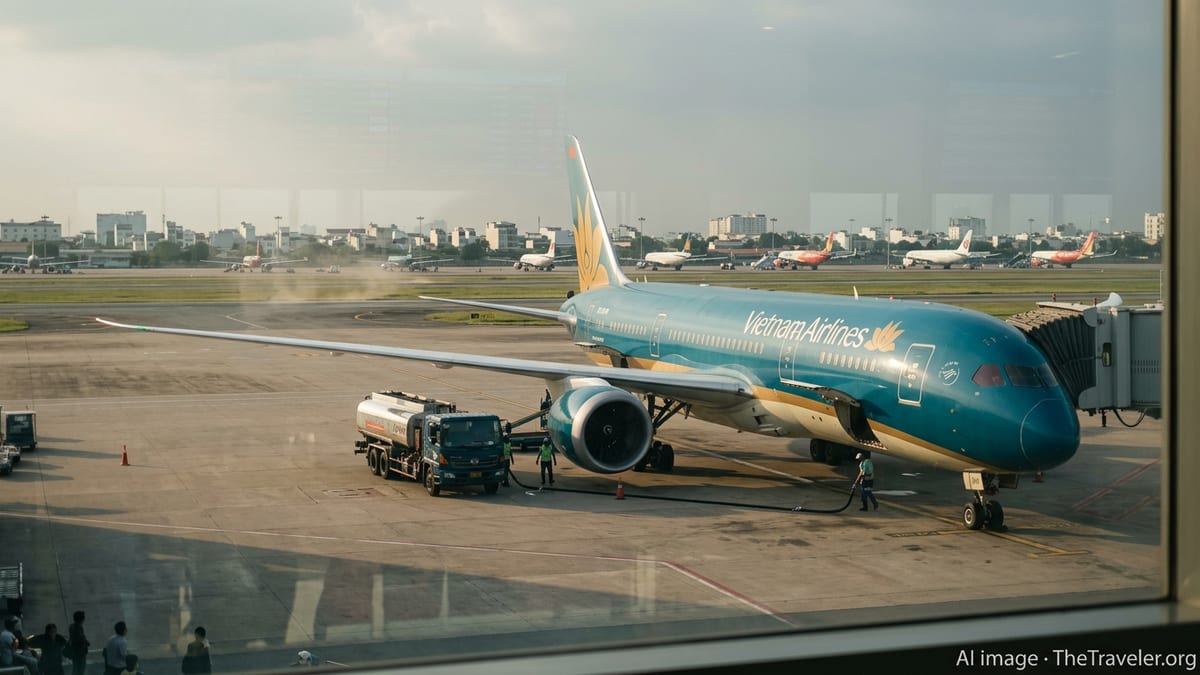
Fuel Shock Hits Vietnam’s Flag Carrier
Vietnam’s aviation regulator says the price of Jet A1 has roughly tripled since fighting escalated on February 28, with benchmark levels hovering near 200 dollars a barrel in recent days. For Vietnam Airlines, the national flag carrier, that surge is threatening to erase what had only recently become a fragile post-pandemic recovery.
Executives at Vietnam Airlines estimate that if jet fuel remains around current levels, the airline’s operating costs could effectively double, turning even previously profitable routes into loss-making ventures. Fuel typically represents about one fifth to one quarter of an airline’s cost base; when that single line item spikes this fast, there is little room to adjust without passing pain onto passengers or scaling back operations.
The airline, which reported a record consolidated profit in 2024 and laid out an ambitious capital-raising and restructuring plan for 2025 and 2026, now finds that core assumptions about stable fuel markets no longer hold. Analysts say that what was meant to be a consolidation phase is rapidly turning into another survival test, only this time driven not by a health crisis but by geopolitics and energy insecurity.
Middle East Conflict Upends Jet Fuel Supply
The latest shock originates far from Hanoi and Ho Chi Minh City, in the congested sea lanes and energy hubs of the Persian Gulf. Since late February, the Strait of Hormuz and nearby export terminals have been at the center of a fast-moving conflict involving the United States, Israel and Iran, alongside a wave of drone and missile strikes on critical oil and gas infrastructure.
Attacks on pipelines, refineries and export terminals, combined with temporary closures of airspace over Iran, Iraq, Kuwait, Qatar, the United Arab Emirates and Israel, have rattled energy traders and insurers. Tanker traffic through key chokepoints has slumped, and war risk premiums on vessels and cargo have jumped, feeding directly into the cost of refined products such as jet fuel.
Industry benchmarks show jet fuel prices climbing from around 85 to 90 dollars per barrel before the escalation to a band between 150 and 200 dollars within less than two weeks. In Asia, which depends heavily on imported fuel shipped through the Middle East, the squeeze has been particularly sharp, with regional jet fuel markers setting new records.
This surge comes on top of an already tight refining system and ongoing disruptions to Red Sea shipping. For airlines like Vietnam Airlines, which buy most of their fuel at market prices and have limited hedging in place after the volatility of recent years, the combination is proving especially punishing.
Rising Fares, Route Changes and Capacity Cuts
Vietnam’s Civil Aviation Authority has acknowledged that overall airline costs have jumped by 60 to 70 percent since the conflict began, driven almost entirely by fuel. Regulators and carriers are scrambling to avoid a sudden spike in ticket prices that could shut ordinary travelers out of the skies just as regional tourism was hitting its stride again.
Vietnam Airlines and its domestic rivals are already preparing a range of measures. These include fuel surcharges on international tickets, targeted fare increases on long haul routes and tighter capacity management on marginally profitable services. In some cases, airlines are considering temporarily grounding older, less fuel efficient aircraft in favor of newer jets that burn less per seat.
Route planning is also being redrawn in real time. With stretches of Middle Eastern airspace restricted and overflight risk premiums higher, some flights between Vietnam and Europe are being rerouted away from traditional corridors, adding flight time and therefore even more fuel burn. Vietnam Airlines has been adjusting schedules and, in some cases, adding capacity on alternative routings to help move stranded passengers as other international carriers scale back or suspend services.
Behind the scenes, the government and industry are in talks over temporary tax relief on imported jet fuel, reductions in environmental and value added taxes on aviation fuel, and more flexible airport fee policies. Officials say the goal is to preserve safety and continuity of air links without triggering an inflationary spike in airfares that would undermine Vietnam’s broader tourism and export recovery.
What This Means for Travelers in 2026
For passengers, the effects of the fuel shock are already beginning to surface. Promotional fares on key regional routes are becoming scarcer, while average ticket prices for flights between Vietnam and Europe or Australia are starting to edge higher. Travel agents report that some Vietnamese families are reconsidering long haul leisure trips, opting for closer beach destinations or domestic holidays to keep costs in check.
Business travelers, who are often less sensitive to price, are likely to shoulder the brunt of early fare increases, especially in premium cabins. However, if elevated fuel prices persist into the second half of 2026, analysts warn that even economy travelers will face broader fare hikes and reduced choice as weaker carriers scale back.
Travel patterns may shift in subtler ways as well. With airlines prioritizing the most profitable trunk routes, secondary international destinations could see fewer nonstop options from Vietnam, pushing travelers onto connecting itineraries through major hubs in Northeast and Southeast Asia. Flight times on some long haul sectors may lengthen slightly as carriers detour around high risk zones, altering departure and arrival times that had become routine.
At the same time, Vietnam’s role as a manufacturing and tourism hub in Asia means the government has a strong incentive to keep the country well connected. Industry observers expect targeted support for the national carrier, alongside efforts to diversify fuel supply away from the most exposed Middle Eastern sources over the medium term.
Testing Vietnam Airlines’ Long Term Strategy
The current crisis arrives at a pivotal moment for Vietnam Airlines. After years of losses tied to the pandemic, the carrier only recently returned to profit and began implementing a multi year restructuring plan that includes fresh capital injections, fleet renewal and a sharper focus on high yielding international markets.
The assumption underpinning that strategy was a period of relative stability in energy markets and gradual, predictable growth in travel demand. The Iran war and the resulting fuel price shock have upended that outlook, forcing management to focus again on short term liquidity, cost cutting and emergency scenario planning.
How Vietnam Airlines navigates this episode will help determine whether it can emerge as a stronger regional champion or be forced into deeper restructuring. If fuel prices retreat and supply routes normalize later in the year, the airline could yet resume its investment plans with only a temporary dent to profits. But a prolonged conflict, or a further escalation that tightens energy supplies, could push even well managed carriers into sustained losses.
For now, travelers flying with Vietnam Airlines in 2026 can expect relatively full planes, fewer ultra cheap deals, and a growing awareness that what happens in distant straits and refineries can be felt almost immediately in the price of a ticket from Hanoi to Paris or Ho Chi Minh City to Tokyo.